
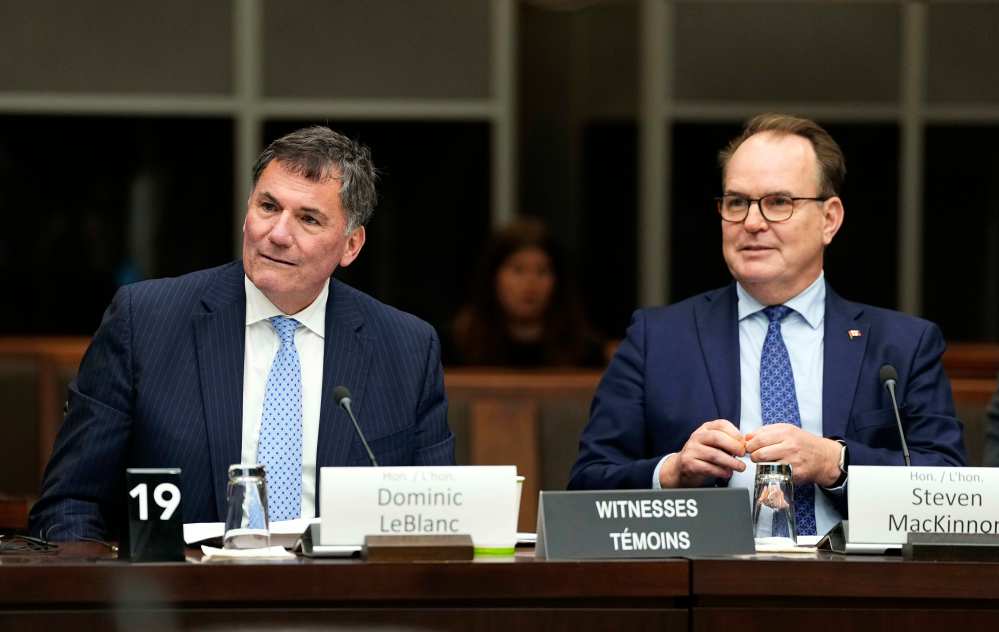
Federal ministers defend major projects bill at House committee meeting
Advertisement
Read this article for free:
or
Already have an account? Log in here »
We need your support!
Local journalism needs your support!
As we navigate through unprecedented times, our journalists are working harder than ever to bring you the latest local updates to keep you safe and informed.
Now, more than ever, we need your support.
Starting at $15.99 plus taxes every four weeks you can access your Brandon Sun online and full access to all content as it appears on our website.
Subscribe Nowor call circulation directly at (204) 727-0527.
Your pledge helps to ensure we provide the news that matters most to your community!
To continue reading, please subscribe:
Add Brandon Sun access to your Free Press subscription for only an additional
$1 for the first 4 weeks*
- Enjoy unlimited reading on brandonsun.com
- Read the Brandon Sun E-Edition, our digital replica newspaper
*Your next Free Press subscription payment will increase by $1.00 and you will be charged $20.95 plus GST for four weeks. After four weeks, your payment will increase to $24.95 plus GST every four weeks.
Read unlimited articles for free today:
or
Already have an account? Log in here »
OTTAWA – Four federal ministers defended the government’s contentious legislation to speed up major projects in the House of Commons Monday, as Ottawa continues to face criticism from Indigenous, environment and labour groups.
The 243-page bill would fast-track approvals for major projects, cut their review times and create zones of “national interest” to pre-approve certain types of projects.
It proposes to expand the government’s one-project, one-review, within one-year approach for major infrastructure plans to other projects across the country.
Labour leaders and union members gathered across Canada last week to protest Bill C-39, arguing the legislation would undermine workers’ right to strike.
The bill proposes changes to the Canada Labour Code. The most consequential of those changes are adjustments to Section 107 to explicitly state that a minister can order a business under federal jurisdiction to resume operations or put parties into binding arbitration.
The Liberals have in recent years leaned on this contentious part of the law to shut down strikes in federally regulated sectors such as rail, ports and air transportation.
The legislation also adds conditions the federal government must meet before triggering the section: it must consider a special mediator’s report and determine whether a work stoppage is adversely affecting the “national interest.”
Labour experts have said the new language likely does confer additional powers on the minister — and those powers will be subject to Charter challenges questioning their constitutionality.
Jobs Minister Patty Hajdu said Monday the bill strengthens the right to strike by removing the ability to use Section 107 before a labour disruption. She added that the government has the responsibility to act when an exceptionally consequential dispute remains unresolved with no path to resolution in sight.
“Protecting workers and protecting the national interest go hand in hand,” she said.
A collective of First Nations groups has also condemned the legislation, arguing it would weaken environmental oversight and strip away their ability to influence decisions affecting their territories.
The Chiefs of Ontario, Assembly of First Nations Quebec-Labrador, Nishnawbe Aski Nation and the British Columbia Assembly of First Nations said their “free, prior, and informed consent cannot be squeezed into a predetermined federal project timeline.”
Canada-U.S. Trade Minister Dominic LeBlanc said Monday that Bill C-39 does not reduce Ottawa’s requirement to consult with Indigenous rights holders and “a more efficient process does not mean a less rigorous one.”
Transport Minister Steven MacKinnon said the legislation looks to reduce administrative burdens while also maintaining strong safety and environmental standards.
Members of Parliament have passed a motion to begin clause-by-clause consideration of Bill C-39 in mid-November.
The legislation is a core part of the Liberals’ plans to pivot the economy away from reliance on the United States and present Canada as a reliable trading partner to overseas markets.
Conservative Leader Pierre Poilievre said earlier this month that his party would support sending the legislation to the committee study in order to propose amendments to what he called a “weak, watered-down, long-delayed” bill.
Poilievre told reporters he wants the government to speed up the decision timeline on projects to between six months and a year, and to add measures to protect workers’ rights.
He also said Conservatives would seek to eliminate the industrial carbon price and create shovel-ready zones with pre-permitting for developments.
This report by The Canadian Press was first published Oct. 19, 2026.
-With files from Craig Lord and Alessia Passafiume