
A look at past referendums in Canada as Albertans reject future separation vote
Advertisement
Read this article for free:
or
Already have an account? Log in here »
We need your support!
Local journalism needs your support!
As we navigate through unprecedented times, our journalists are working harder than ever to bring you the latest local updates to keep you safe and informed.
Now, more than ever, we need your support.
Starting at $15.99 plus taxes every four weeks you can access your Brandon Sun online and full access to all content as it appears on our website.
Subscribe Nowor call circulation directly at (204) 727-0527.
Your pledge helps to ensure we provide the news that matters most to your community!
To continue reading, please subscribe:
Add Brandon Sun access to your Free Press subscription for only an additional
$1 for the first 4 weeks*
- Enjoy unlimited reading on brandonsun.com
- Read the Brandon Sun E-Edition, our digital replica newspaper
*Your next Free Press subscription payment will increase by $1.00 and you will be charged $20.95 plus GST for four weeks. After four weeks, your payment will increase to $24.95 plus GST every four weeks.
Read unlimited articles for free today:
or
Already have an account? Log in here »
Albertans voted in a referendum Monday against separation. In early results, about 76 per cent of said they wanted the province to stay in Canada, while 24 per cent said they wanted the province to hold a second, binding referendum on leaving the country.
Here’s a look at some of the other referendums held across Canada:
2021 — Alberta on daylight time
The province asked residents whether it should adopt year-round daylight time — the time often used across Canada in the summer — to put an end to twice-yearly clock changes.
Out of more than 1 million votes, 50.2 per cent were against the idea, while 48.8 per cent were in favour of ditching clock changes.
Premier Danielle Smith announced this year that starting Nov. 1, the province is adopting year-round daylight time.
She said it’s to gauge opinion and that most people will agree. She said if she’s wrong, the government could put the matter to a vote in 2027.
—
2019 — Prince Edward Island electoral reform
Voters weighed in on electoral reform alongside the provincial election.
It followed similar votes in 2016 and 2005, which both failed to eliminate the voting practice known as “first past the post.”
The referendum asked: “Should Prince Edward Island change its voting system to a mixed member proportional voting system?”
The threshold for a win in either direction would have been 17, but neither side was able to secure that number — 13 districts voted against, while 14 voted in favour.
—
2018 — British Columbia electoral reform
After failed votes in 2009 and 2005, the province held a third referendum on electoral reform.
Out of all ballots received, 61.3 per cent voted to keep first past the post, while proportional representation got 38.7 per cent.
—
2007 — Ontario electoral reform
The referendum asked voters to chose between the existing first-past-the-post or the mixed-member proportional systems.
Voters overwhelmingly rejected mixed-member proportional representation, with Elections Ontario figures showing roughly 1.5 million people voted for change, while nearly 2.7 million voted against it.
—
2001 — New Brunswick video lottery terminals
Voters were asked whether the province should ban VLTs, following a 1999 campaign promise by former premier Bernard Lord.
“Should the province of New Brunswick continue to permit the legal and regulated operation of video gaming devices, commonly known as video lottery terminals?”
About 53 per cent were in favour of keeping VLTs, while 47 per cent were opposed.
New Brunswick was the first to allow VLTs after Ottawa, in 1985, allowed provinces and territories to operate the machines.
—
1997 — Newfoundland education
Newfoundlanders voted in on the churches’ role in the province’s education system.
The referendum asked: “Do you support a single school system where all children, regardless of their religious affiliation, attend the same schools where opportunities for religious education and observances are provided?”
More than 70 per cent of voters wanted to create a non-denominational public education system still allowing religious instruction and observance, ending the church-run school system.
In a similar vote two years earlier, voters narrowly approved the government’s plan to reform the church-run education system.
—
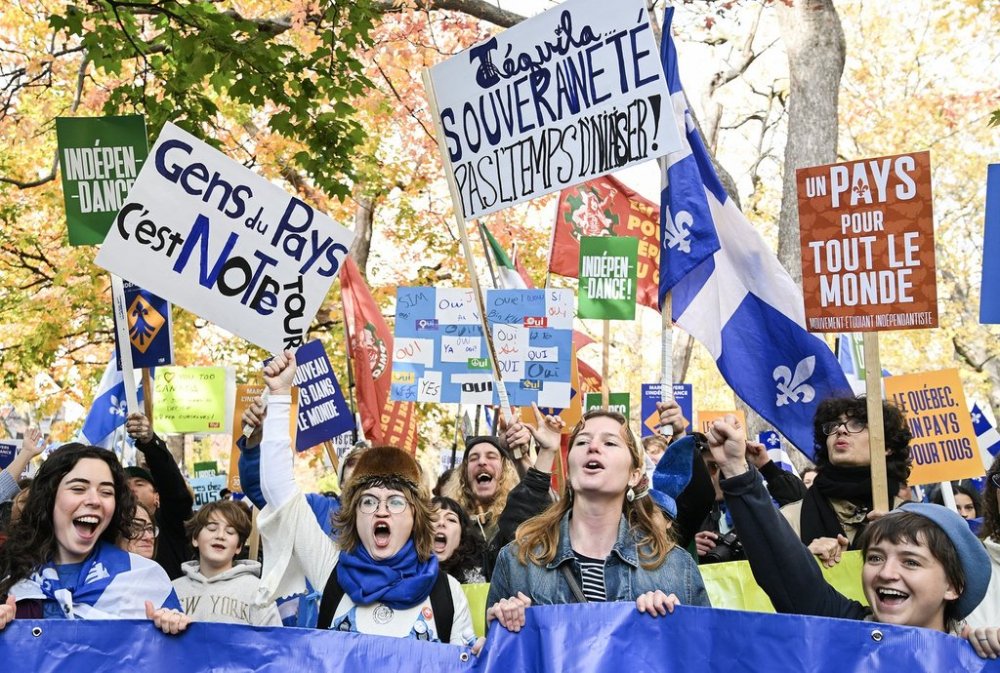
1995 — Quebec sovereignty
A razor-thin majority rejected the idea of the province leaving Confederation and becoming its own country.
In a dramatic campaign, the sovereigntist side came from behind to take a lead in the polls in the final weeks before the vote. In the end, 50.58 per cent voted no.
Another vote was held in 1980, and 60 per cent also said no to sovereignty.
—
This report by The Canadian Press was first published Oct. 20, 2026.