
Wait times for mental health help putting lives at risk
Advertisement
Read this article for free:
or
Already have an account? Log in here »
We need your support!
Local journalism needs your support!
As we navigate through unprecedented times, our journalists are working harder than ever to bring you the latest local updates to keep you safe and informed.
Now, more than ever, we need your support.
Starting at $15.99 plus taxes every four weeks you can access your Brandon Sun online and full access to all content as it appears on our website.
Subscribe Nowor call circulation directly at (204) 727-0527.
Your pledge helps to ensure we provide the news that matters most to your community!
To continue reading, please subscribe:
Add Brandon Sun access to your Free Press subscription for only an additional
$1 for the first 4 weeks*
- Enjoy unlimited reading on brandonsun.com
- Read the Brandon Sun E-Edition, our digital replica newspaper
*Your next Free Press subscription payment will increase by $1.00 and you will be charged $20.95 plus GST for four weeks. After four weeks, your payment will increase to $24.95 plus GST every four weeks.
Read unlimited articles for free today:
or
Already have an account? Log in here »
Hey there, time traveller!
This article was published 07/02/2022 (1689 days ago), so information in it may no longer be current.
» EDITOR’S NOTE: This story contains graphic elements that may be upsetting to some readers, including suicide. The Sun originally received a request from Clayton Heppner to help him advertise his online petition to open up access to online and telehealth mental health services outside of Manitoba. We put out a call for people to share their stories about their own struggles with finding help for their mental health challenges.
Access to mental health services in Manitoba has been challenging for people like Clayton Heppner, so he started an online petition to bring attention to the issue of accessibility.
After 17 months of waiting to see a psychiatrist in Brandon for panic attacks, anxiety and depression, he said the province doesn’t have the resources to provide proper, timely care to its residents. Manitoba has laws in place that prevent any providers from outside of the province to help, which is extremely concerning, he added.
The change.org petition is calling to “amend the current laws preventing Manitoba patients in need of mental health care to get help outside of our province by virtual or telehealth options.” It can be found at chng.it/sHjJTkjf9c.
As of Sunday afternoon, it had reached 699 of the needed 1,000 signatures.
“What I’m hoping for is to raise awareness that there are very real barriers out there that are preventing people from getting help,” he said. “That part bothers me a lot when there are other organizations within Canada.”
There are some great online Canadian resources for those who want psychiatric help and are willing to pay for it, he said, but due to current laws in Manitoba, they cannot help anyone in our province.
He stressed he isn’t denigrating the people working in the system; this is about calling for it to be revamped to make it more accessible.
He also said he understands there are a lot of problems with recruiting people to Brandon. Demand for mental health professionals has grown exponentially during the pandemic, but the pool of professionals has stagnated, he said. Those who are working do not have enough time or resources to handle the volume of people needing help in a timely manner.
His physician told him the current wait time to see a psychiatrist in Brandon is long because the local doctors either have no room for more patients or are retiring. The physician had referred some people to psychiatrists in Winnipeg, but they are now refusing to take any more, he said.
“Even my doctor is frustrated with this. This sort of wait time is extremely dangerous. Lives are at stake,” he said.
He contacted the College of Physicians and Surgeons of Manitoba (CPSM) to find out why they can’t access services outside the province. The college sent him a link to a document that stated “full [practising] class registration in Manitoba is required for those physicians registered in another province or a jurisdiction outside of Canada who are seeking to practice virtual medicine for any patient located in Manitoba. This applies whether treating Manitoba patients for insured or non-insured services. Currently, there is no separate virtual medicine registration in Manitoba for treating Manitoba patients.”
The wait time for mental health services is complex and affects all facets of health care, stated Wendy Elias-Gagnon, communications officer for CPSM, in an email.

Virtual access to mental health professionals is allowed, provided “it does not alter the ethical, professional, and legal obligations of members to provide good medical care,” according to the college’s Standard of Practice for Virtual Medicine.
The document also states there is a need for virtual medicine in providing access to care, especially for patients in remote and underserviced areas, patients with disabilities, patients in institutional settings, limited psychosocial supports or economic means, and in a pandemic, or state of emergency.
However, it is not an acceptable standard of care to solely practice virtual medicine. A blended care model balancing in-person and virtual medicine is required.
“Many aspects of mental health care require in-person care to be competent care. A physical assessment might be required to assess the patient’s appearance, actions, mannerisms, countenance, etc. This may or may not be achieved by video, and video is highly encouraged by CPSM for all virtual encounters in mental health,” the document read.
It also points out a successful patient-physician relationship is better achieved in person than through virtual medicine, with some exceptions as listed above. As well, each member’s medical practice must include timely in-person care when clinically indicated or requested by the patient, according to Elias-Gangon.
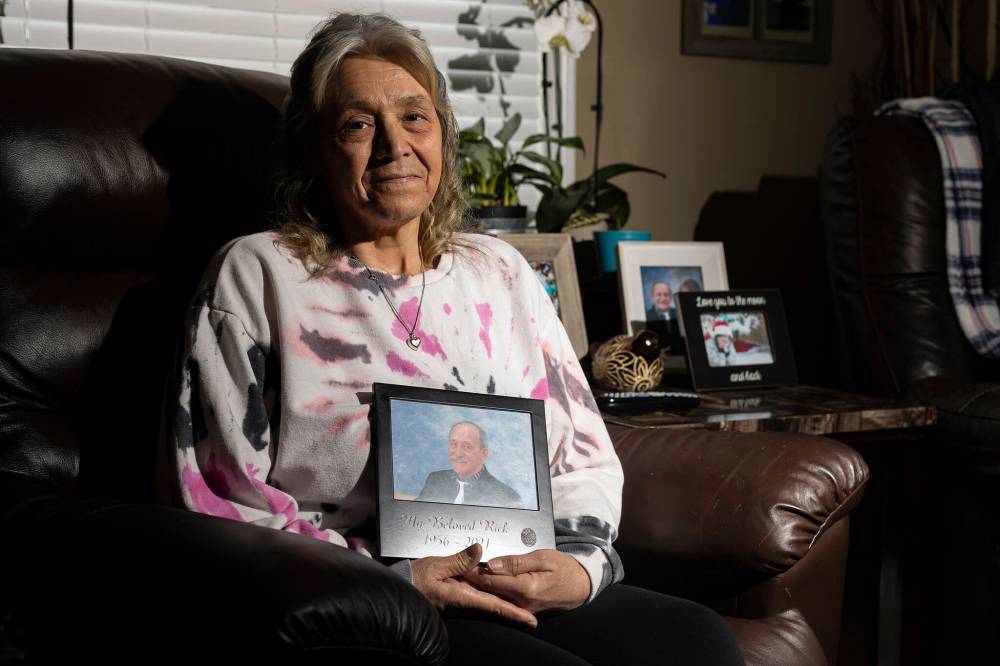
It has been a struggle for Marlene Blake, 64, to maintain her physical and mental health since her husband, Rick, died of a heart attack in front of her last February in their Brandon home. Last October, she landed in the hospital and a psychiatrist said her physical issues are coming from her grief. He diagnosed her with depression and PTSD. She was told medical staff were going to refer her to an adult services organization in the city, but she has yet to hear back.
Even her family physician said she had to see a mental health professional to help her through the grieving process. Blake said the doctor also sent a referral but hasn’t heard anything.
Blake agreed her grief is wearing on her physically and mentally. It doesn’t help she does not have a support circle or family in Brandon, and the pandemic has limited her movement.
“It would be better if I could talk to someone who knows how to deal with something like this,” she said. “It’s nice when you have friends that will listen to you, but I need a professional that is equipped for this.”
Time hasn’t dulled the trauma. She said she still sees Rick’s face when she closes her eyes at night. When she is in the bathroom, she can’t look in the corner where he died. She even instinctively steps over the spot where his body was.
She understands the entire health-care system is backlogged because of the pandemic but said better access to mental health care would help her get the closure she needs.
Mental health struggles cut across age, gender, ethnicity and financial backgrounds. Kaelyn Prince, 22, said she isn’t just speaking for herself as a young woman, but also for her late cousin, Dillan Liam Prince, who died from an overdose three months ago. She has also had eight family members and family members of friends die by suicide, including her father.
She said she has been on antidepressants since age 13 and in and out of counselling for six years. She has attempted suicide multiple times since she was 13, with four serious enough to be admitted to emergency. She was able to talk to a psychiatrist for a short time after being admitted, but nothing else.
For years, she has had trouble with managing her medications, and she struggles day to day.
“I am not an addict. I am a normal living, working, surviving, young adult, just like the rest, and no one ever sees what truly it is like functioning day to day constantly with this type of messed up mentality undiagnosed,” she said.
She would also have to pay out of pocket to see a private psychiatrist — if she gets an appointment. She would also have to schedule around work, which isn’t easy, she said. However, she understands health-care workers themselves are doing what they can to help people, but wishes there was more they could do besides tell her to hang on and try to cope until they can get to her.
Ultimately, she wants to raise awareness not just about the state of mental health services, but to show that those who have issues are just normal people dealing with battles that may not be visible right away.
The specific amount of time it takes to access health-care services in the province can vary. However, emergent and urgent needs are being prioritized, said a spokesperson from Shared Health.
Some mental health services in the province are offered virtually in order to improve access and allow more people to benefit, they said. One service is the Cognitive Behaviour Therapy with Mindfulness classes found at www.cbtm.ca. These classes are geared toward helping people learn ways to deal with depression, worry and anxiety, and connect participants to additional resources. The classes can be accessed by anyone directly, and a referral is not required.
However, before seeking out therapies or support, Shared Health asks people to contact their primary care provider — their family doctor, nurse practitioner or other health professional — to discuss services that would be best for them. If there is a wait, a provider can help them find resources for safely managing or coping in the meantime.
» kmckinley@brandonsun.com
» Twitter: @karenleighmck1