
Low-impact logging for all land owners
Advertisement
Read this article for free:
or
Already have an account? Log in here »
We need your support!
Local journalism needs your support!
As we navigate through unprecedented times, our journalists are working harder than ever to bring you the latest local updates to keep you safe and informed.
Now, more than ever, we need your support.
Starting at $15.99 plus taxes every four weeks you can access your Brandon Sun online and full access to all content as it appears on our website.
Subscribe Nowor call circulation directly at (204) 727-0527.
Your pledge helps to ensure we provide the news that matters most to your community!
To continue reading, please subscribe:
Add Brandon Sun access to your Free Press subscription for only an additional
$1 for the first 4 weeks*
*Your next subscription payment will increase by $1.00 and you will be charged $20.00 plus GST for four weeks. After four weeks, your payment will increase to $24.00 plus GST every four weeks.
Read unlimited articles for free today:
or
Already have an account? Log in here »
Hey there, time traveller!
This article was published 05/07/2010 (5651 days ago), so information in it may no longer be current.
A low-impact logging workshop by Mountainside Community Woodlands has one main goal for anyone with any amount of land: to encourage people to manage their wood lots in a sustainable manner.
Ian Kirby, a Woodlot Forester and Business Development Specialist with MAFRI (Manitoba Agriculture, Food and Rural Initiatives), helps landowners, small-scale loggers and small-scale forestry companies with woodlot management and ecologically sustainable practices.
“When you’re managing your woodlot you’re trying to steer the woodlot towards an end result for the land owner.”
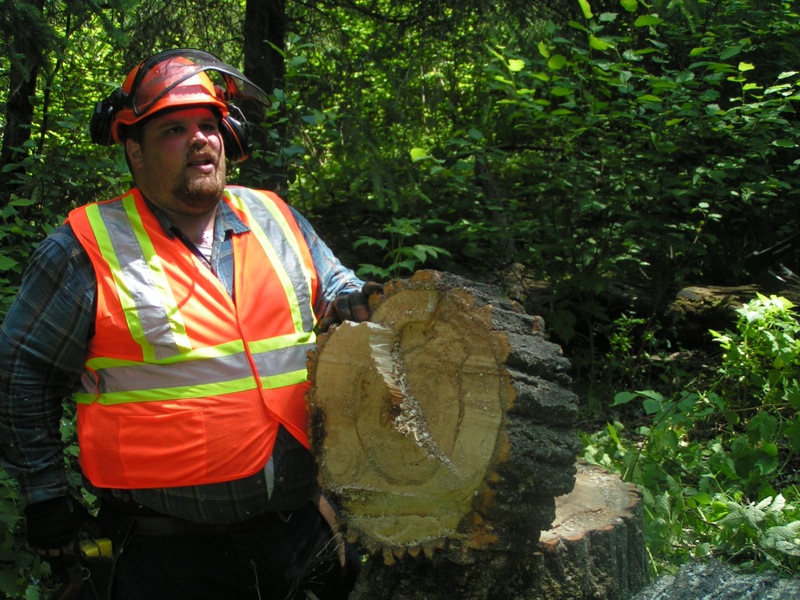
Depending on the goals and depending on the type of property that is owned, harvesting timber and harvesting trees to simulate natural disturbances can be beneficial because of the lack of natural disturbances due to fire suppression.
Valerie Pankratz, Executive Director of Riding Mountain Biosphere Reserve says being involved in this initiative is important not only because it is an ecologically sustainable practice but because “our workshops bring the community together. We have a lot of diverse forest land and woodlots within the biosphere reserve and managing it is an integral part of sustainable development which is one of our core values.”
Colleen Cuvelier, Manager of Little Saskatchewan River Conservation District, which provides incentives for landowners in the Little Saskatchewan River and Oak River watersheds, says that they participate in the Mountainside Community Woodland to help “maintain biodiversity and the health of the watersheds which are affected by the woodlands.”
Mountainside Community Woodlands recommends low impact logging, a technique that uses natural species and promotes natural regeneration in areas which logging has occurred in.
Cuvelier says that low impact logging is important because it “causes the least amount of disturbance in the area being logged.”
In many cases diseased trees are cut down to prevent disease from spreading and to allow young healthy trees to grow in their place. An example of this would be shifting to a more natural mix of spruce and poplar trees in an area where poplar may be taking over; it encourages a natural healthy biodiversity of spruce mixed wood forests.
“When you’re managing in ecologically sustainable ways the woodlot is not just the timber resource, not just the understory, or vegetation not just one aspect,” says Kirby. “You’re managing holistically, you’re managing all those things in combination and a healthy forest will have an ample amount of wildlife and animals and herbivores like deer and elk and moose and mix of habitat species.”
Mountainside Community Woodland is made up of Riding Mountain Biosphere Reserve, MAFRI, , Nature Conservancy Canada, and Little Saskatchewan River Conservation District. Workshops on sustainable woodlot management are held at various times throughout the year. For more information contact the Riding Mountain Biosphere Reserve, the Little Saskatchewan River Conservation District or check out the biosphere website at www.rmbr.ca.