
Mortars a blast from the past
Advertisement
Read this article for free:
or
Already have an account? Log in here »
We need your support!
Local journalism needs your support!
As we navigate through unprecedented times, our journalists are working harder than ever to bring you the latest local updates to keep you safe and informed.
Now, more than ever, we need your support.
Starting at $15.99 plus taxes every four weeks you can access your Brandon Sun online and full access to all content as it appears on our website.
Subscribe Nowor call circulation directly at (204) 727-0527.
Your pledge helps to ensure we provide the news that matters most to your community!
To continue reading, please subscribe:
Add Brandon Sun access to your Free Press subscription for only an additional
$1 for the first 4 weeks*
*Your next subscription payment will increase by $1.00 and you will be charged $20.00 plus GST for four weeks. After four weeks, your payment will increase to $24.00 plus GST every four weeks.
Read unlimited articles for free today:
or
Already have an account? Log in here »
Hey there, time traveller!
This article was published 19/08/2010 (5736 days ago), so information in it may no longer be current.
CFB SHILO — A collection of mortars are on display at the RCA Museum at Canadian Forces Base Shilo.
Four mortars from the museum’s collection will be displayed in the temporary gallery until March 31.
The exhibit’s highlight is a German 24-cm heavy trench mortar used in the last half of the First World War, says museum director Marc George.
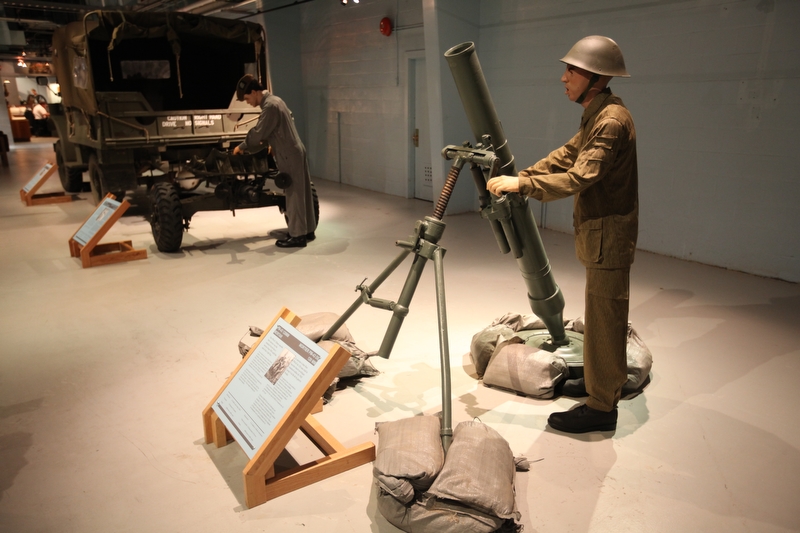
"We know that it was actually captured by the Canadian corps in battle," George said. "It’s also quite rare — there aren’t any others that we know about in Canada. There were only ever about 300 produced by the Germans. It’s huge — it’s almost as big as a person standing. So I think in rarity and scale, it’s pretty special."
Other mortars on display include a Soviet 120-mm mortar that was used in the Second World War, Cold War and Vietnam war, and a rare prototype Canadian 120-mm mortar — only one of six produced — and towing vehicle from 1945.
Missing from the exhibit is the 81-mm mortar used in Afghanistan today, as it is currently being used for training soldiers. George hopes it will return to the exhibit after Labour Day.
Mortars provide close-range, indirect fire support. They’re used when the weight of the weapon system is the principle consideration.
"An 81-mm projectile has the same explosive power as a 105-mm howitzer shell. But the 105-mm howitzer needs a two-and-half-ton truck to tow it and a seven-person detachment. Three people can operate the 81-mm mortar and they can carry it on their backs. But the difference is the 105-mm howitzer has almost three times as much range. They compromise range for simplicity and portability."
George says they are currently being used to defend the Canadian Forces base in Afghanistan.
"They let you get very close to the front lines. They’re very small with intense fire power within the little envelope of their range. They’re easy to hide and easier to move around," he said.
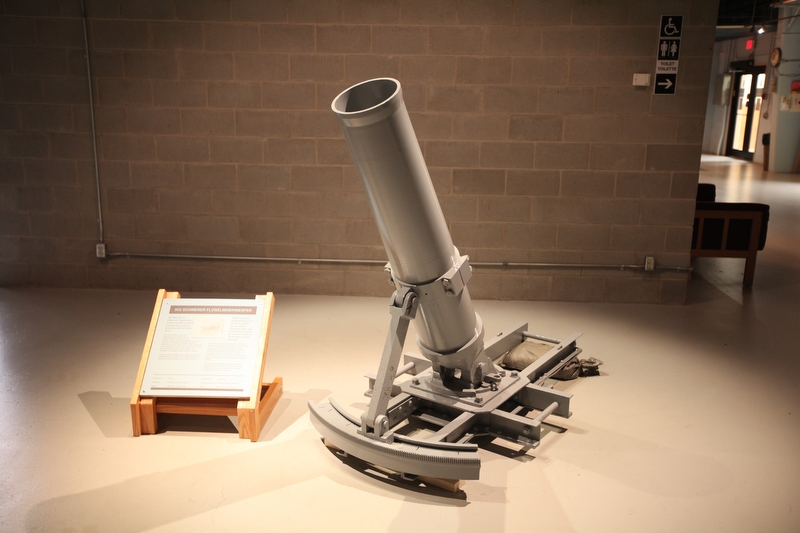
Temporary exhibits like the mortar exhibit give the museum an opportunity to showcase more of its vast collection.
"We have about 28 guns and vehicles on permanent exhibit in the main building. But in our collection, we have about 200 guns and vehicles. We try to refurbish enough to do one or two temporary exhibits every year to get them all on display," George said.
The museum is open from 10 a.m. to 5 p.m., seven days per week until after Labour Day, when the museum will be closed on weekends.