
Killarney battling blooming algae in its lake
Advertisement
Read this article for free:
or
Already have an account? Log in here »
We need your support!
Local journalism needs your support!
As we navigate through unprecedented times, our journalists are working harder than ever to bring you the latest local updates to keep you safe and informed.
Now, more than ever, we need your support.
Starting at $15.99 plus taxes every four weeks you can access your Brandon Sun online and full access to all content as it appears on our website.
Subscribe Nowor call circulation directly at (204) 727-0527.
Your pledge helps to ensure we provide the news that matters most to your community!
To continue reading, please subscribe:
Add Brandon Sun access to your Free Press subscription for only an additional
$1 for the first 4 weeks*
*Your next subscription payment will increase by $1.00 and you will be charged $20.00 plus GST for four weeks. After four weeks, your payment will increase to $24.00 plus GST every four weeks.
Read unlimited articles for free today:
or
Already have an account? Log in here »
Hey there, time traveller!
This article was published 07/09/2010 (5717 days ago), so information in it may no longer be current.
KILLARNEY LAKE — For over half a century, the algae fight at this lake was easy.
The town simply applied bluestone crystals (copper sulfate) to the water and the algae died and fell to the bottom of the lake.
But bluestone has been banned for algae control for more than a decade now because it can kill fish, among other things. Now algae has soared to levels unseen for generations on Prairie lakes like this one.
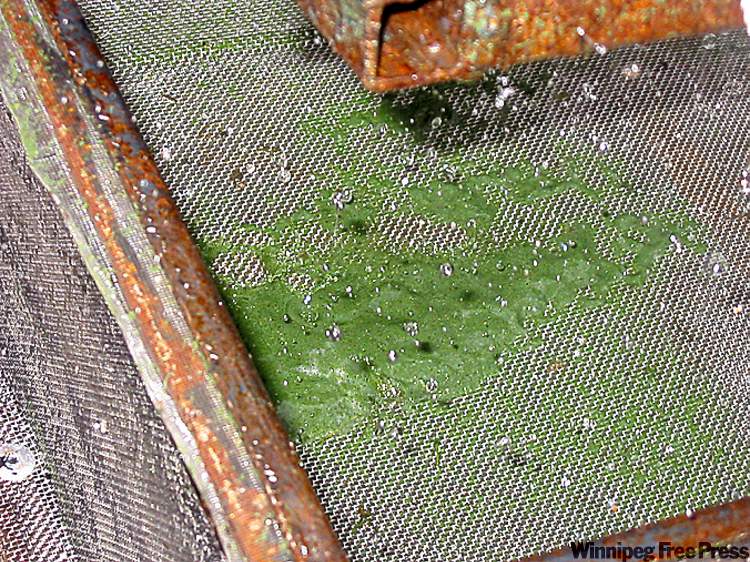
Seeing is believing. The shoreline rocks here look like they’ve had at least two coats of green latex paint — an Irish green to match the area’s settlement history. The algae also paints docks and dock bumpers and most anything else on shore.
The water is green throughout. Boat wakes are green. It can also kill. Last year, the algae turned toxic, resulting in a major fish kill.
Naturally, people in the area are sensitive about being singled out for algae. It harms reputation and ultimately tourism, which is a staple of the town’s economy.
At the same time, officials here are urging governments to make Killarney Lake a kind of test laboratory to combat algae. Solutions that work here could then be used on larger bodies of water like Lake Winnipeg.
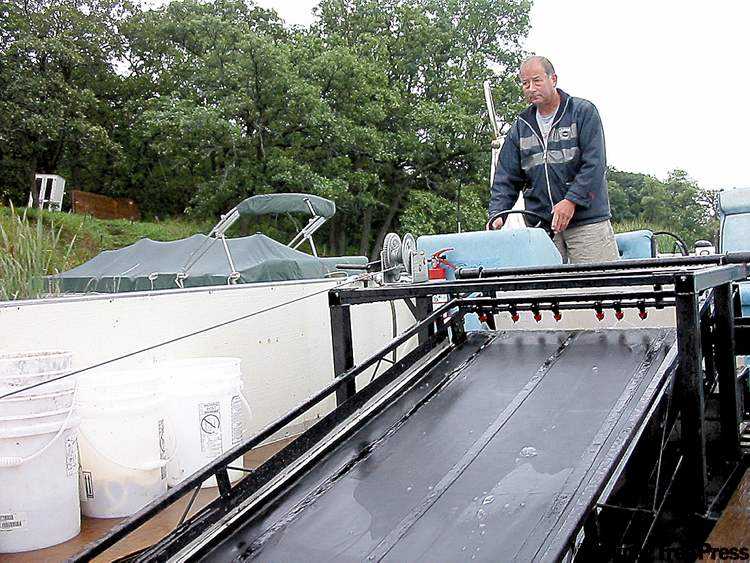
For example, people here recently invented an "algae skimmer." It was designed by Killarney School biology students and built by two brothers originally from New Zealand, Mike and John Bellew, who run Kiwi Welding in the town of 2,500 people, 220 kilometres southwest of Winnipeg.
Despite its modest origins, the skimmer is having an impact at least as far as cleaning up algae around beaches. Neither has there been a fish kill this year.
The skimmer is affixed to a pontoon boat. It’s a conveyor belt with a coarse screen. The screen picks up the algae and conveys it to the top, where spray nozzles, taken from a farm field sprayer, shoot it into a bucket. The apparatus was built from parts lying around the Bellew brothers’ shop.
Mike Bellew estimates a couple of tonnes of algae have been skimmed out so far this year and dumped in the local nuisance grounds. Manitoba Agriculture is testing the algae for possible uses like animal feed, fertilizer (it’s high in phosphorous) and even biofuel, although its oil content isn’t believed to be high enough.
The algae skimmer is also testament to the community’s commitment to combat algae. About 50 people have volunteered to drive the skimmer. There’s a schedule with two-hour shifts people sign up for.
"When the cottagers stand on their balconies as you go past and go like this (makes the thumbs-up sign), that means something," said Mike Bellew. Limitations are the skimmer can only target small areas, and only picks up algae where it’s thickest.
The community is also looking at another control called Phoslock, made by an Australian company. It’s a naturally occurring clay that binds with phosphorous and sinks it to the lake bottom. "The Lake Simcoe area (in southern Ontario) has tested it and people love it," said Jay Struth, who chairs the Killarney Lake Action Committee.
However, locals also question the ban on bluestone by the Pest Management Regulatory Agency, under Health Canada. They wonder which is the lesser of the evils — copper buildup in the lake sediment, or lake-choking algae. Only a few kilometres south in North Dakota, bluestone crystals are still being used to combat algae.
Killarney Lake is believed to be a naturally eutrophic lake due to runoff from exceptionally nutrient-rich soils. Core studies obtained by University of Manitoba biologist Gordon Goldsborough indicate the lake had algae blooms dating back 3,000 years. It’s also a relatively small lake of about 480 acres, or less than a square mile. It’s fed by the Long River.
The community has installed a fountain to help aerate lake water and has stepped up efforts to educate the public on water-quality issues.
bill.redekop@freepress.mb.ca