
Soldiers’ wartime letters help keep history alive
Advertisement
Read this article for free:
or
Already have an account? Log in here »
We need your support!
Local journalism needs your support!
As we navigate through unprecedented times, our journalists are working harder than ever to bring you the latest local updates to keep you safe and informed.
Now, more than ever, we need your support.
Starting at $15.99 plus taxes every four weeks you can access your Brandon Sun online and full access to all content as it appears on our website.
Subscribe Nowor call circulation directly at (204) 727-0527.
Your pledge helps to ensure we provide the news that matters most to your community!
To continue reading, please subscribe:
Add Brandon Sun access to your Free Press subscription for only an additional
$1 for the first 4 weeks*
*Your next subscription payment will increase by $1.00 and you will be charged $20.00 plus GST for four weeks. After four weeks, your payment will increase to $24.00 plus GST every four weeks.
Read unlimited articles for free today:
or
Already have an account? Log in here »
Hey there, time traveller!
This article was published 12/11/2010 (5546 days ago), so information in it may no longer be current.
Letters sent home from war zones by Canada’s soldiers during the First and Second World Wars share many memories that could be lost forever if family members discard them.
Audrey Silvius, an 86-year-old Brandonite, has letters her father, Percy Honeyman, sent home to Elgin to his future wife Pearl Spratt, describing the ups and downs of military life as he headed for England and France.
"As far as I’m concerned, if I am to die at sea instead of in a trench, all is well and good. But if I can prevent it and still keep my honour, I’ll not die in either place," Honeyman wrote to Spratt in April 1916.
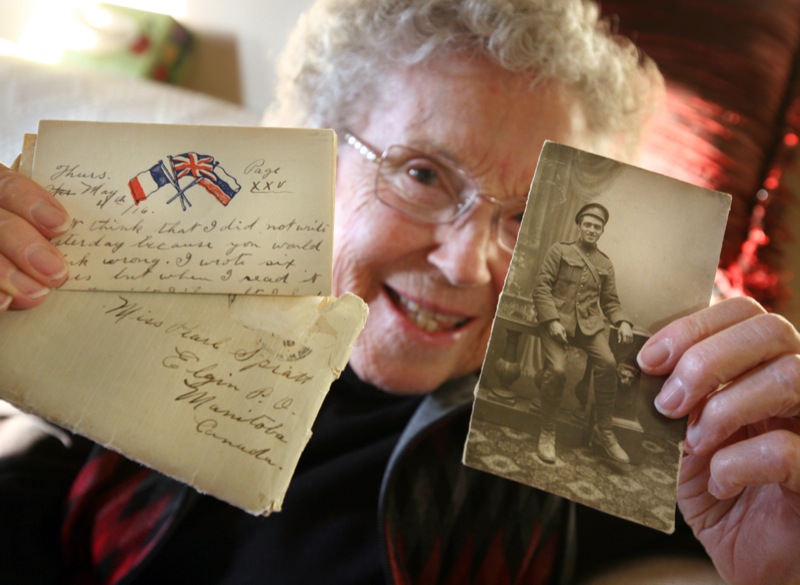
In another letter, Honeyman wrote: "But for all the thoughts of loved ones back home, I cannot say I am sorry I came; only sorry that I had to come. When I went to Elgin to enlist, it was not done without thinking."
Beth English, who was 2 1/2 when her brother Frank Harrison went to Europe to fly bombing missions on Halifax bombers headed Germany. He and his crewmates were declared missing in action on May 24, 1943.
She had a letter dated Sept. 22, 1941 that described how soldiers spent their leisure time in Brandon as they trained prior to heading to Europe.
"The rest of our flight were put on guard duty today and tonight. So I just missed that," Frank Harrison wrote to his parents. "I went to the Y.M.C.A. tonight and had a swim, shower and some athletics, all for a cent piece of nickel. It was sure great."
Silvius and English said the letters provided a key insight into the life of an ordinary soldier heading off to war that could be valuable to those studying wartime history.
"I think it’s because our young people, myself, don’t realize what these people went through," English said.
Silvius fears her father’s letters could be lost or discarded after her own death, but doesn’t know what to do with them herself. Many others with similar wartime letters may also be asking what they should do with letters they don’t want to keep, but could have historical value.
Those working at the Canadian Letters and Imaged Project (canadianletters.ca), based at Vancouver Island University in Nanaimo, B.C., have collected wartime correspondence and posted those letters on a website to share the experiences of ordinary soldiers on a battlefield.
Project workers do not keep the letters. Instead, letters are scanned and copies are kept in a digital archive.
Others, like the Historica-Dominion Institute, have been creating online audio and video records and interviews for The Memory Project: Stories of the Second World War.
However, Jill Paterson, a deputy program manager for The Memory Project, said families may also want to consider contacting the Canadian War Museum or other local museums to see if they are also interested in obtaining original letters or copies for their archives.