
Manitoba lives high off these hogs
Province key to firm's billion-dollar strategy
Advertisement
Read this article for free:
or
Already have an account? Log in here »
We need your support!
Local journalism needs your support!
As we navigate through unprecedented times, our journalists are working harder than ever to bring you the latest local updates to keep you safe and informed.
Now, more than ever, we need your support.
Starting at $15.99 plus taxes every four weeks you can access your Brandon Sun online and full access to all content as it appears on our website.
Subscribe Nowor call circulation directly at (204) 727-0527.
Your pledge helps to ensure we provide the news that matters most to your community!
To continue reading, please subscribe:
Add Brandon Sun access to your Free Press subscription for only an additional
$1 for the first 4 weeks*
*Your next subscription payment will increase by $1.00 and you will be charged $20.00 plus GST for four weeks. After four weeks, your payment will increase to $24.00 plus GST every four weeks.
Read unlimited articles for free today:
or
Already have an account? Log in here »
Hey there, time traveller!
This article was published 26/02/2011 (5516 days ago), so information in it may no longer be current.
Standing side by side on the pork production lines, hundreds of workers per shift brandishing razor-sharp knives work silently on the cut floor at the massive Maple Leaf Foods plant in Brandon.
With each worker wearing heavy aviation-style noise protectors, full balaclavas, hard hats and safety glasses, there isn’t much opportunity for joking about amidst the constant noise of machinery and the refrigerated cut floor.
Each of the workers sports a chain mail glove that covers the arm not wielding the knife up to the elbow, undoubtedly aiding in the plant’s record of two million hours of work without an injury.
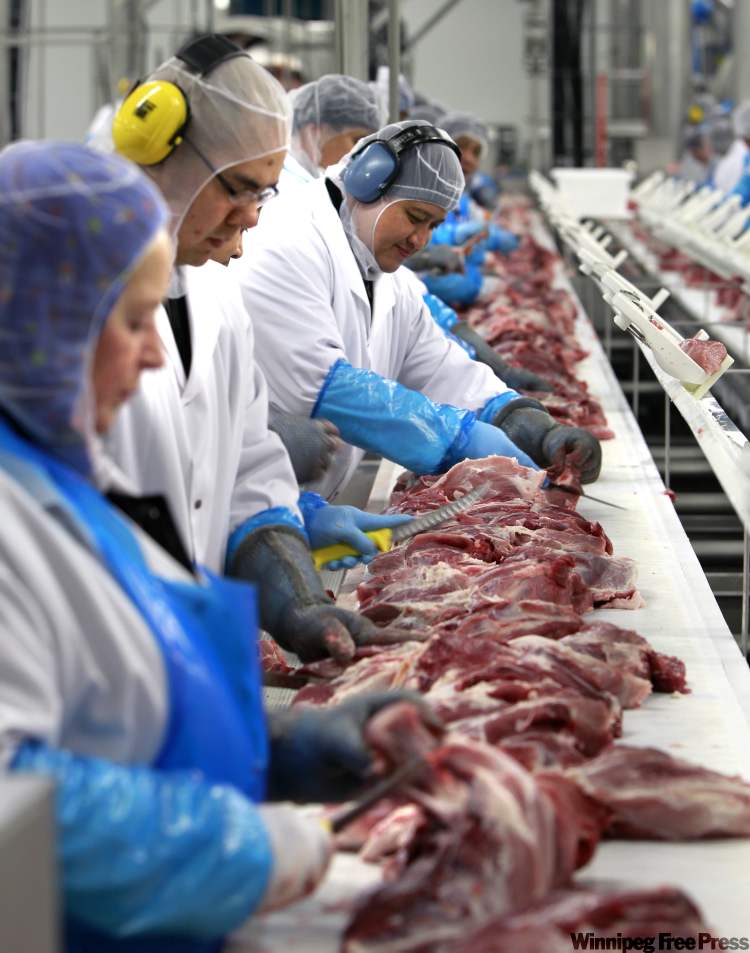
Maple Leaf Foods is in the middle of a billion-dollar reorganization and the Brandon pork kill-and-cut plant is integral to the plan.
The company’s Manitoba operations — including a Winnipeg ham-deboning plant, a Winnipeg outlet of its Rothsay rendering division and a large-scale hog-production complex based in Landmark– form the lynchpin to the strategy.
Last fall, Maple Leaf Foods CEO Michael McCain announced a controversial $1-billion plan to become a Canadian global competitor in an environment that does not include a cheap loonie to help mask inefficiencies.
The strategy calls for plant consolidations, investment in technology to improve efficiencies in select locations and construction of a large-scale bakery in Hamilton and a large processed meats plant in a yet-to-be-determined location.
Even though sources say Manitoba will not be the site of the new processing plant (but those sources said the company had looked closely at Winnipeg), its impact on the province’s important food-processing industry — and the economy — is massive.
Since 2007 when the company began phasing in a second shift at the Brandon plant — the largest of its kind in the country and one of the largest in North America — Maple Leaf has added about 1,200 jobs to Manitoba’s economy.
About 1,000 of them are in Brandon where the company is slaughtering and processing about 85,000 hogs a week — about 4.4 million a year. Another 200 jobs were added to its Winnipeg plant on Lagimodiere Boulevard where 7.4 million hams — all from the Brandon plant — are deboned every year.
With hog prices on the rise again, Manitoba produced 7.7 million hogs last year and Maple Leaf accounted for about 12 per cent of that, or 924,000 hogs from its MLF Agri-Farms operation (formerly Elite Swine and the Landmark Group).
Maple Leaf Foods directly employs about 3,500 people in the province, including more than 2,300 in Brandon, another 800 in Winnipeg and close to 400 throughout its swine-production operation. It is likely one of the Top 5 private-sector employers in Manitoba.
Rick Young, Maple Leaf Foods executive vice-president in charge of transformation of Maple Leaf Consumer Foods, leaves little doubt as to the importance of Manitoba in the company’s reorganization.
“Manitoba remains a very important part of our entire strategy,” he said.
Over the past three years the company has invested more than $100 million in the Brandon plant (including about $20 million in a new, high-efficiency industrial waste-water treatment plant in partnership with the City of Brandon) and $35 million in expansions and upgrades at the Lagimodiere plant.
“We’re thrilled with that,” he said “They are great operations. In Brandon, we now have Canada’s largest pork facility. It is one of the most efficient in North America, which was the goal. And we have achieved it.”
In the past three months the company has announced the sale of its Burlington, Ont., pork kill-and-cut plant and the closing of prepared meats plants in Berwick, N.S., and Surrey, B.C.
Those moves bolster the importance of its Manitoba assets and signal the likelihood of further expansions here.
Leo Collins, the 46 year-old manager of the Brandon plant, said although his plant is operating with two full shifts — a third shift every night is required for cleaning and sanitation — a Saturday shift could be introduced to further maximize efficiencies.
Dave Shambrock of the Manitoba Food Processors Association said the plant is of such a scale that the addition of one eight-hour shift would be significant to the industry.
“That plant out there is humming,” he said. “They could go with a Saturday shift and what’s really exciting about that is that if you work backwards, the number of (additional) animals they’ll put through there in a year will be huge to the Manitoba farmer.”
But the plant was not always the jewel in Maple Leaf’s portfolio that it has become.
“Nothing makes us feel better than when customers or industry people tell us it’s the cleanest and best looking plant they’ve seen,” Collins said.
That’s because it was not always the well-run machine it now is. For many years after its 1999 opening, the company had a terrible time keeping the plant staffed up and endured several years of 80-per-cent worker turnover.
Officials acknowledge they learned from their mistakes. Initially workers were hired on who didn’t know much about the tough working conditions in the meat packing industry. Since then, the company has become a super-star in recruiting and retaining workers.
One of the most remarkable features of Maple Leaf’s Brandon success story has been its recruitment of foreign workers. In total, about 1,700 of them came to work at the Brandon plant, 1,400 remain with the company, 75 per cent of whom are now in possession of their permanent residency. (The company helps file the application papers and covers the cost.)
“The arrival of Maple Leaf fundamentally changed our community,” said Shari Decter Hirst, new mayor of Brandon. “Five years ago or so we had about 500 non-English speaking people living in Brandon. Now we have over 8,000.”
She said it has put a huge stress on the community in terms of housing and social services.
“But Brandon is meeting that challenge,” she said. “And there is no denying the economic impact those people bring to our community.”
The turnover at the plant is down to 10 per cent and if you listen to Robert Ziegler, the powerful president of the United Food and Commercial Workers Local 832, it has a lot to do with an almost unprecedented level of cooperation between the company and the union.
“When I first took over as president of the local (in September 2002) it was not unusual to have 100 people phone in sick on any given day at the old Burns plant (now MLF’s Lagimodiere plant),” he said.
At Brandon, Collins said the company spent a few years training and hiring on 800-to-900 new workers every year.
“It was like a new plant day in and day out because of all the new people,” he said.
Now, with a slew of innovative inclusions in the collective bargaining agreement — including $1-an-hour bonuses for attendance and up to $1 an hour for productivity achievements as well as job rotation to cut down on repetitive stress injuries and services to aid in the settlement of the foreign workers — the plant has achieved a state of relative labour relations tranquility.
“We could say we did this (providing benefits and concessions to recruit foreign workers) out of the goodness of our heart, but frankly, it’s good business,” Collins said.
The experience and loyalty of the workforce is paying huge benefits to the company.
“They know what good looks like now,” Collins said.
While John Burnett, general manager of the Lagimodiere plant, does not have foreign workers in his plant, it too has been able to find its way to labour force stability in the physically arduous work environment of the ham deboning plant.
The solution also speaks to the underlying goal of the larger Maple Leaf strategy of intensifying the use of the assets and applying specialized skills in each plant. The idea is to have just one large plant making hotdogs or deboning hams efficiently rather than have five small plants.
“The secret of the advantage of all the ham deboning here is the skill-set and the focus of the workers,” Burnett said. “Our workers bone hams 52 weeks per year. They become technicians at that.”
Burnett points out that whereas car manufactures put cars together, his plant dismantles hams.
But while the auto industry has moved towards greater automation, the pork industry can only go so far in that regard.
“You will see the labour intensive lines here,” he said. “That is the nature of the business. It is a surgical skill to effectively disassemble a ham and maximize your yield and quality.”
Maple Leaf Foods wants to protect its franchise as a market leader against potential incursions from large-scale U.S. and global competitors.
It’s doing that by going big, which is not the traditional Canadian approach. But it’s one that’s designed to keep jobs in Canada.
martin.cash@freepress.mb.ca