
Efficiency the key to success
Advertisement
Read this article for free:
or
Already have an account? Log in here »
We need your support!
Local journalism needs your support!
As we navigate through unprecedented times, our journalists are working harder than ever to bring you the latest local updates to keep you safe and informed.
Now, more than ever, we need your support.
Starting at $15.99 plus taxes every four weeks you can access your Brandon Sun online and full access to all content as it appears on our website.
Subscribe Nowor call circulation directly at (204) 727-0527.
Your pledge helps to ensure we provide the news that matters most to your community!
To continue reading, please subscribe:
Add Brandon Sun access to your Free Press subscription for only an additional
$1 for the first 4 weeks*
- Enjoy unlimited reading on brandonsun.com
- Read the Brandon Sun E-Edition, our digital replica newspaper
*Your next Free Press subscription payment will increase by $1.00 and you will be charged $20.95 plus GST for four weeks. After four weeks, your payment will increase to $24.95 plus GST every four weeks.
Read unlimited articles for free today:
or
Already have an account? Log in here »
Hey there, time traveller!
This article was published 21/03/2011 (5558 days ago), so information in it may no longer be current.
Like a well-oiled machine, every facet of daily operations at Maple Leaf Foods runs with calculated, thoughtful intent.
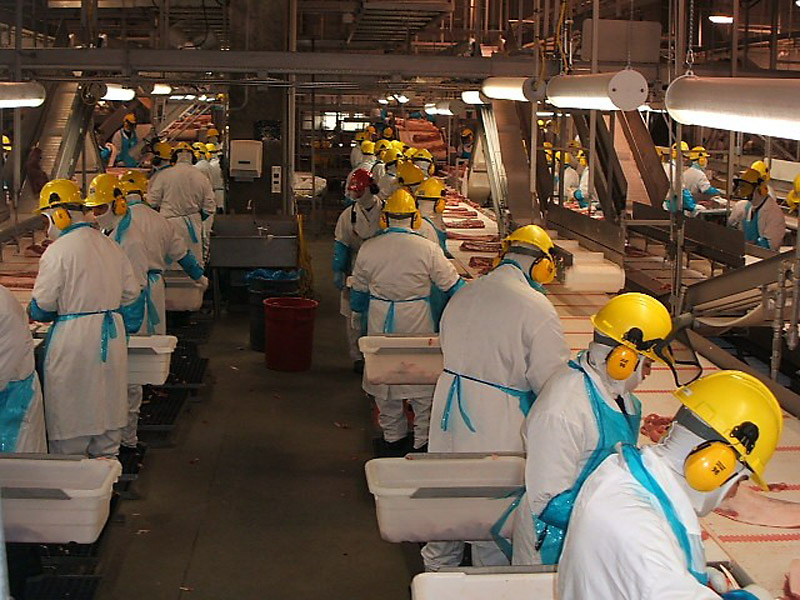
It begins with the hundreds of vehicles that congest the employee parking lot and continues just steps inside the 600,000-square-foot production facility as hundreds of employees arriving for the afternoon shift line up, flash their ID and receive their respective safety gear for the day — noise protectors, balaclavas, hard hats, safety glasses and dark grey smocks if you work on the kill floor, light grey for the cutting floor and white for packaging and shipping.
The colour-coded smocks are a small but important piece of the puzzle as they not only identify in which department a worker is employed, but reduce the risk of cross-contamination. Employee break rooms are also segregated.
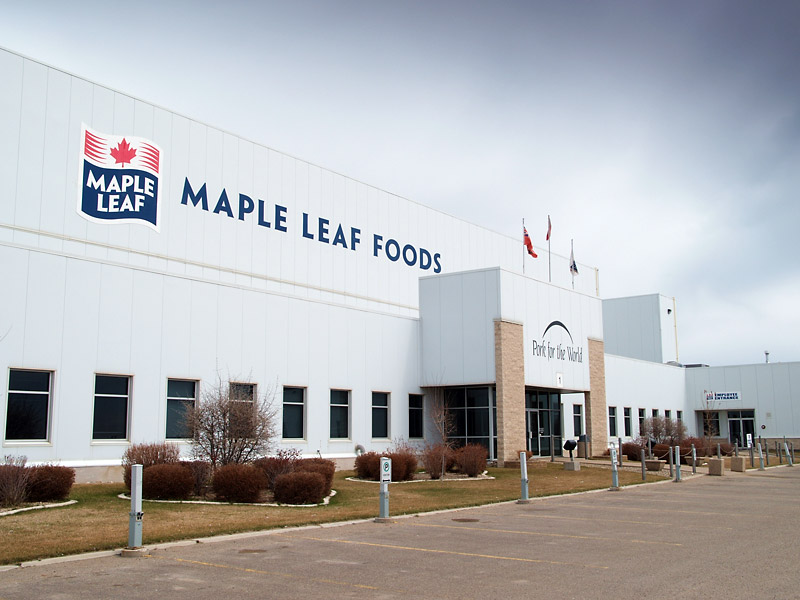
Touring the facility starts at the end of the production line, where the packaged pork — 1.7 million kilograms shipped per day — sits destined for markets in Canada, the U.S., Japan and Korea.
Through heavy swinging doors and a quick stop at one of the many boot- and hand-washing facilities (mandatory before entering or exiting every department) is the cutting floor. It’s here where the employees themselves are the well-oiled machine, working as a methodical team to keep the conveyor belts moving. Conveyor belts that transport everything from boneless riblets, requested by customers like Earl’s and Boston Pizza, to Asian market staples, such as tongue, stomach and heart, are built high above the cutting room floor.
Pieces of discarded fat, skin and finished cuts fall from above, into large dumpster-size buckets. Once filled, the buckets are swiftly removed and relocated to pallets ready for the next step — packaging and labelling. Anything that misses a bucket is scooped up and discarded within seconds, all in an effort to maintain top-notch sanitary conditions and minimal idle time for employees. There’s no such thing as a sluggish day on the job.
Whether it’s the sharpness of a knife or the weight of an individual side rib, every aspect is measured, calculated and eventually, improved upon.
"We measure everything and we have a philosophy here, that you manage by measuring," plant manager Leo Collins said during a recent tour of the facility. "We work towards efficiency every day. Everyone takes pride in a job well done."
Weekly production is capped at 90,000 hogs per week. When the plant is running at full capacity, 18,000 hogs are processed Monday through Friday. And the weekly goal is always reached. The entire plant will reopen on Saturday to make up for a shortfall incurred due to a mechanical error or to compensate for a statutory holiday, for example.
Although it’s a refined, measured and calculated business, daily operations are flexible. Each day the entire facility responds to customer specifications that also fluctuate with the market.
As a competitor in the global marketplace — Maple Leaf Foods has a 12 per cent share, and annual growth is its ultimate goal — the company is looking to its Brandon plant for the introduction of value-added processes.
Its new mechanically separated meat machine that tears the small pieces of meat still on the bone and processes it for use in sausages and hotdogs is a prime example.
Previously good quality meat was being discarded because it was simply impossible, and much too time-consuming for any employee to retrieve. The plant has recently also incorporated in-house meat slicing and pre-pricing for retailers.
"At the end of the day, a pig is a pig and there’s only so much you can get out of that animal. It’s hard to really look at being creative in how you can modify the genetics of a hog," Collins said. "It’s a lot easier to look at you how you can better the product that you provide and that’s what we try to focus on."
Over the last three months, the company has announced the sale of its Burlington, Ont., pork kill-and-cut plant and the closure of prepared meats plants in Berwick, N.S., and Surrey, B.C. This bolsters the importance of Maple Leaf’s Manitoba assets and Collins expects the Brandon plant will figure prominently in the company’s ambitious vision of growth.
"The overall vision of the organization is to try and internalize as much of the product as possible … Long term that’s where we see our facility going. Our efficiency will probably increase over time as they decide to consolidate these other prepared meats plants in the country," Collins said. "It potentially could change (the work we do.) We’re always looking at what different options we could put in the marketplace."
Concentrating operations in "super plants" will create production efficiencies from start to finish.
"It will allow us to focus on getting our product into one plant all of the time, rather than into multiple plants," Collins said. "Obviously you’re going to have less to produce and freight will be more efficient."
In addition, the plant closures in Ontario, B.C. and Nova Scotia could see the Brandon plant raise its weekly production to 100,000 hogs, depending week to week on market conditions and availability.
"What the company is doing by consolidating and leveraging the larger facilities … that’s going to roll down to this plant to make it more efficient and give it a longer lifespan," he said. "We’ve always been upfront about our plans for growth."
Meantime, a multi-operational plant with increased production could spur the need for more employees. The company currently employs 2,325 people and has enjoyed great success with its recruitment of 1,700 foreign workers — 1,400 of whom remain with the company today and nearly 100 per cent of whom are now permanent Canadian residents — Collins says it’s unlikely they will look overseas again.
"We’ve talked about it a little bit, but not right now. Our preference would be to hire locally if we can do that," he said. "To us, going to the foreign worker route is a last resort. I’d rather look at how can we somehow entice our local First Nations to come and work here … it’s a work in progress right now. We’re always a work in progress."
Maple Leaf Foods facts
* Is Canada’s largest pork-processing facility, built in 1999 and expanded in 2007 to 600,000 square feet
* Processes up to 90,000 hogs a week on a double shift
* producing premium quality chilled and frozen products for Canada, the United States, Japan and Korea
* Has 2,325 employees
* The newly constructed waste-water treatment facility in partnership with the City of Brandon, is the first plant in Manitoba to meet new nitrogen and phosphorus requirements
* $85-million investment from 2007-09, of which $47 million was invested to expand the plant to a double shift
* boasts a record two million hours of work without an injury (aided by job rotation, intense ergonomic, muscular/skeletal, and health and safety training)
Economic impact of Brandon plant:
* $4 million to $6 million — capital improvements annually ($10 million in capital improvements budgeted in 2010)
* $70 million — annual operating costs
* $93 million — 2009 payroll
* $1.5 million — annual local taxes paid including $888,000 to education and $502,000 to the Brandon School Division
* $530 million — hog purchases in 2009
Composition of Brandon plant’s foreign workforce:
* El Salvador — 500

* China — 300
* Colombia — 250
* Honduras — 100
* Ukraine — 80
* Mauritius — 50
Hogs sourced from:
* Winnipeg/Steinbach region — 36,000 a week
* Brandon/Portage la Prairie region — 27,000 a week
* Saskatoon — 12,000 a week
* Swift Current — 10,000 a week
» Sources: Maple Leaf Foods, City of Brandon