
Bank of Canada unveils plastic $100 and $50 bills
Advertisement
Read this article for free:
or
Already have an account? Log in here »
We need your support!
Local journalism needs your support!
As we navigate through unprecedented times, our journalists are working harder than ever to bring you the latest local updates to keep you safe and informed.
Now, more than ever, we need your support.
Starting at $15.99 plus taxes every four weeks you can access your Brandon Sun online and full access to all content as it appears on our website.
Subscribe Nowor call circulation directly at (204) 727-0527.
Your pledge helps to ensure we provide the news that matters most to your community!
To continue reading, please subscribe:
Add Brandon Sun access to your Free Press subscription for only an additional
$1 for the first 4 weeks*
- Enjoy unlimited reading on brandonsun.com
- Read the Brandon Sun E-Edition, our digital replica newspaper
*Your next Free Press subscription payment will increase by $1.00 and you will be charged $20.95 plus GST for four weeks. After four weeks, your payment will increase to $24.95 plus GST every four weeks.
Read unlimited articles for free today:
or
Already have an account? Log in here »
Hey there, time traveller!
This article was published 21/06/2011 (5454 days ago), so information in it may no longer be current.
OTTAWA — Get ready to have a little more plastic in your wallet.
Starting in November, new polymer bank notes will start to replace paper-cotton bills that wear and tear more easily.
The first bills to go plastic will be $100 notes. The $50 bills will follow in March. The rest of the plastic money will be in circulation by the end of 2013.
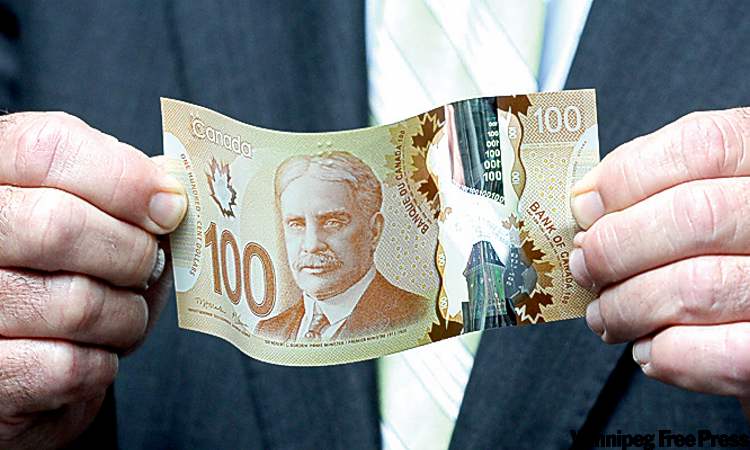
The Bank of Canada expects the new bills to last 2.5 times longer than the paper notes. They’re also harder to counterfeit. Security features include raised ink, hidden numbers and metallic images in see-through windows.
The bills feel smooth and slightly waxy. They don’t crumple easily, and they don’t seem to tear in half.
The $100s have two portraits of prime minister Robert Borden — a large one and a smaller, metallic one above an image of Parliament Hill’s Peace Tower in a clear band running through the note.
On the other side, there’s an image of a person at a microscope, a strand of DNA, an electrocardiogram, a bottle of insulin and the words “medical innovation.”
The $50 bill has an image of research icebreaker CCGS Amundsen and a map of the North. The colours haven’t changed.
The Conservative government announced in its 2010 budget that Canada would be switching to synthetic bills.
“The polymer notes we’re introducing today are unique,” Bank of Canada Governor Mark Carney said in Ottawa. “There’s simply no other currency like them.”
— The Canadian Press