
NDP Grand Slam!
Advertisement
Read this article for free:
or
Already have an account? Log in here »
We need your support!
Local journalism needs your support!
As we navigate through unprecedented times, our journalists are working harder than ever to bring you the latest local updates to keep you safe and informed.
Now, more than ever, we need your support.
Starting at $15.99 plus taxes every four weeks you can access your Brandon Sun online and full access to all content as it appears on our website.
Subscribe Nowor call circulation directly at (204) 727-0527.
Your pledge helps to ensure we provide the news that matters most to your community!
To continue reading, please subscribe:
Add Brandon Sun access to your Free Press subscription for only an additional
$1 for the first 4 weeks*
- Enjoy unlimited reading on brandonsun.com
- Read the Brandon Sun E-Edition, our digital replica newspaper
*Your next Free Press subscription payment will increase by $1.00 and you will be charged $20.95 plus GST for four weeks. After four weeks, your payment will increase to $24.95 plus GST every four weeks.
Read unlimited articles for free today:
or
Already have an account? Log in here »
Hey there, time traveller!
This article was published 05/10/2011 (5439 days ago), so information in it may no longer be current.
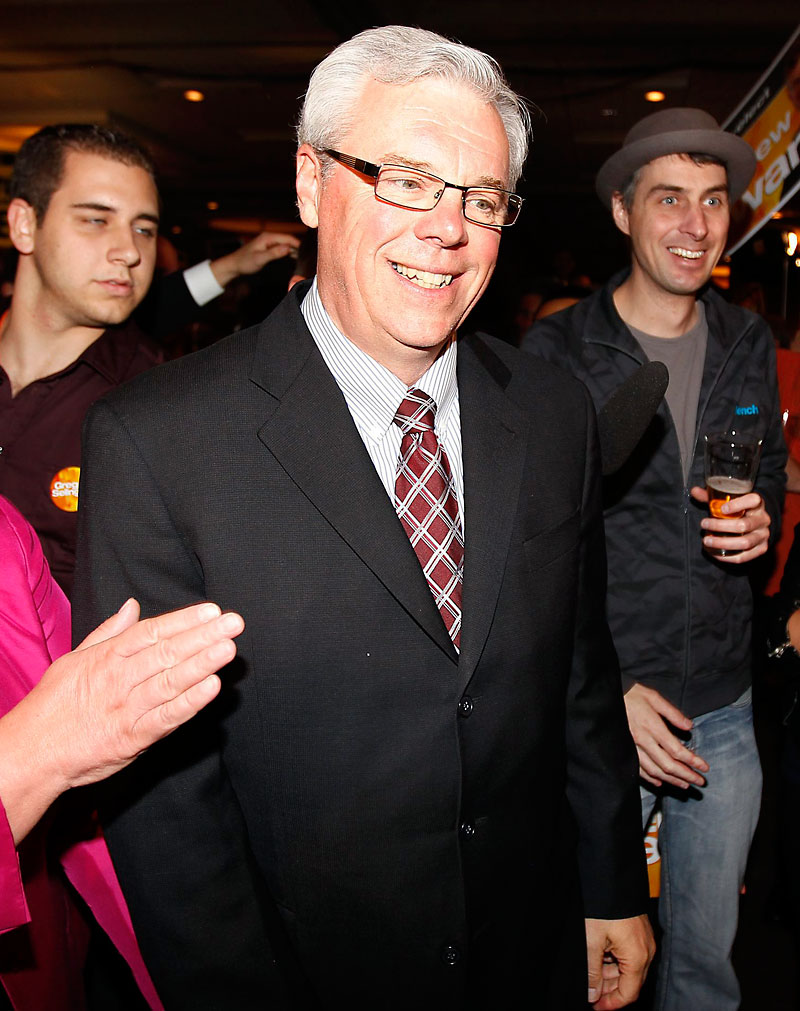
It was a historic night for Manitoba’s NDP as Premier Greg Selinger led his party to its fourth straight majority win on Tuesday night.
But the election was a huge disappointment for the Progressive Conservatives as the party failed to make needed inroads into several key Winnipeg constituencies, and the political map looked much as it had before the election.
And as a result, Hugh McFadyen announced he was stepping down as leader of Manitoba’s Progressive Consevatives after losing provincial election.
McFadyen told supporters he takes personal responsibility for the failure and will step down once a replacement is chosen.
Premier Greg Selinger’s party was on track to take at least 35 of the 57 legislature seats, even though the Tories were almost matching the NDP in percentage of the vote. The NDP won 36 seats in the 2007 election.
“Today Manitobans went to the ballot box and they voted for optimism!” Selinger told a crowd of cheering supporters after the results came in. “Tonight we have made history in Manitoba. Life is never better than when we work together for a purpose greater than ourselves, and that’s what we’ve done tonight.”
The results in Brandon ended up a split between the NDP and the Progressive Conservatives.
In former Tory MLA Rick Borotsik’s riding of Brandon West, the election win came down to a matter of less than 200 ballots. But Brandon West remained in Tory hands as PC candidate Reg Helwer squeaked out an election win at the end of the evening with 4,219 votes, compared to the runner-up, NDP candidate Jim Murray who had the support of 4,073 voters.
“The NDP created a lot of fear out there in people and we were able to overcome that fear,” Helwer told the Sun last night.
NDP Brandon West association president Ray Berthalette indicated to the Sun they will not be pressing the issue of a recount. Liberal Party campaigner George Buri came in a distant third with 378 votes.
Like his government, Brandon East NDP candidate Drew Caldwell won his fourth term in office, handily defeating Tory challenger Mike Waddell for the second time with nearly 1,000 votes to spare. By 10:25 last night, Caldwell had 3,320 votes to Waddell’s 2,387, with three more polls left to report.
“It was close all night, there was no runaway horses,” Caldwell said. “I think we ran a good race, I think the Tory Machine rolled over us. It was a great run and I give Reg all the credit in the world.”
Shaun Cameron had 239 votes for the Liberal Party and Vanda Fleury came in fourth with 147 votes. It was the first time the Green Party had run a candidate in Brandon East.
Westman constituencies were once again painted a strong Tory blue as the Progressive Conservatives took 14 ridings in southern Manitoba.
In Arthur-Virden, PC incumbant Larry Maguire won a commanding victory over Garry Draper of the NDP, winning by more than 2,400 votes. Tory incumbant Cliff Cullen from the former Turtle Mountain constituency handily beat Cory Szczepanski with a similar margin in the new Spruce Woods riding.
Leanne Rowat, the Conservative incumbant from the former Minnedosa riding, sailed to victory in the newly created constituency of Riding Mountain, with NDP candidate Albert Parsons a distant second.
And Stu Briese, the incumbant for the former constituency of St. Rose, won by more than 3,000 votes in the new Agassiz riding.
In spite of a strong showing by Tory candidate Lloyd J. McKinney, Manitoba Agriculture Minister Stan Struthers managed to hold on to his seat in Dauphin for the NDP.
It was an urban-rural split that denied the Tories an election victory. They dominated the seats and popular vote outside Winnipeg, but failed to capitalize in seat-rich Winnipeg, where the NDP cemented its fourth-straight majority.
The NDP was elected in all but a handful of seats in the capital city, which allowed the party to hold off a strong rural showing by the Tories.
With nearly 95 per cent of the polls reporting last night, the NDP walked away with more than 45 per cent of the popular vote, coming very close to what public opinion polls had predicted. The Progressive Conservatives, meanwhile, had garnered 44.4 per cent of the popular vote, mostly at the expense of the Manitoba Liberal Party which took only 7.5 per cent of the votes.
The Tories had targeted a number of Winnipeg seats with little success. Star candidates such as Olympic speedskater Susan Auch and former city councillor Gord Steeves went down to defeat by healthy margins.
Liberal Leader Jon Gerrard retained his Winnipeg riding of River Heights, but a party flirting with single-digit support in recent polls appeared hard-pressed to gain a second.
Gerrard wouldn’t discuss his future but did say he would represent his constituents for the next four years. He told his supporters not to lose faith.
“There is a very strong future for Liberals in Manitoba,” he said.
“We have a dream someday we will have a Liberal government in this province. Let us, in spite of the results today, not be disheartened.”
James Beddome, leader of the Green Party of Manitoba, had hoped for a watershed but it was more like a trickle.
With a second-place result in Wolseley, Beddome won 50 per cent more votes than the party achieved last election. The Greens scored a record number of third-place finishes.
Selinger retained his Winnipeg seat of St. Boniface and McFadyen was re-elected in the city’s Fort Whyte constituency.
The win is a personal victory for Selinger, who took over from Gary Doer, the charismatic leader who was the face of the NDP for 20 years. Doer left to become Canada’s ambassador to the United States and party support dipped under Selinger. He had served as the province’s finance minister for a decade but struggled as leader to connect with voters.
As recently as seven months ago, polls suggested the Tories were well out in front of the New Democrats, but Selinger polished his public-speaking skills and developed a more aggressive tone when debating his opponents.
That tone was evident throughout the hotly contested four-week election campaign. The parties were differentiated more by their attacks ads than by policies.
On billboards, television and in print, the NDP accused McFadyen of having a secret agenda to privatize Crown corporations and cut health care.
McFadyen, 44, is a former lawyer who has led the Tories through two unsuccessful campaigns. He was painted by the NDP as a neo-conservative threat to government programs based on his time as a policy adviser to the Tory government of the 1990s, which sold off the province’s telephone company.
McFadyen spent much of the campaign on the defensive. He took out ads that promised no such cuts would occur.
But the Tories also took their own jabs. They accused the NDP of having a soft-on-crime stance and letting criminals roam free. One candidate’s radio ad called the Point Douglas area north of downtown Winnipeg “a war zone.”
All three parties promised to hire more doctors and nurses to improve health care and to put more police officers on the streets to fight the province’s high crime rate.
Gerrard, 63, has had four kicks at the can and has failed to bring the Liberals out of the political wilderness. He struggled in a campaign that was personally disheartening and, at times, riven with dissent.
One week before the election, one Liberal candidate said he was worried the party might not win any seats and placed part of the blame on Gerrard.
Days later, two former Liberal members of Parliament wrote letters of support for New Democrats in two constituencies. Then someone using a photo of Liberal candidate Paul Hesse opened a Twitter account and started posting messages urging Gerrard to step down. Hesse immediately denounced the move and said he had not authorized it.
The Liberals won two seats in the 2007 election. One became vacant last year when Kevin Lamoureux resigned for a successful run at federal politics.
When the election was called, the NDP had 36 seats, the Tories had 18, the Liberals had one and there were two vacancies.
But the NDP’s historic win comes as Manitoba’s voter turnout continues to be the lowest in the country. With nearly every poll reporting by press deadline, voter turnout hovered around 50 per cent, down from 56.76 per cent in 2007.
Between 1980 and 2009, only Ontario and Alberta have also maintained average turnouts below 60 per cent, according to Elections Canada.
» mgoerzen@brandonsun.com
» With files from Allison Dowd, Keith Borkowsky, The Canadian Press and Winnipeg Free Press