
It’s proving to be a jam fine business
Couple ditches farming for jams and isn't looking back
Advertisement
Read this article for free:
or
Already have an account? Log in here »
We need your support!
Local journalism needs your support!
As we navigate through unprecedented times, our journalists are working harder than ever to bring you the latest local updates to keep you safe and informed.
Now, more than ever, we need your support.
Starting at $15.99 plus taxes every four weeks you can access your Brandon Sun online and full access to all content as it appears on our website.
Subscribe Nowor call circulation directly at (204) 727-0527.
Your pledge helps to ensure we provide the news that matters most to your community!
To continue reading, please subscribe:
Add Brandon Sun access to your Free Press subscription for only an additional
$1 for the first 4 weeks*
*Your next subscription payment will increase by $1.00 and you will be charged $20.00 plus GST for four weeks. After four weeks, your payment will increase to $24.00 plus GST every four weeks.
Read unlimited articles for free today:
or
Already have an account? Log in here »
Hey there, time traveller!
This article was published 14/10/2011 (5290 days ago), so information in it may no longer be current.
NEAR STARBUCK — Sam and Paulette Crampton have a lot of jam.
The couple once ran a grain and cattle operation on the hilly escarpment near Somerset. Then they added strawberries and marketed them. Then they began processing the strawberries into jam.
In 1997, the Cramptons ditched the cattle and grain operation to make jam full time. They moved from Somerset to a 40-acre lot here, just west of Winnipeg. Now the farm couple make 27 different jams from mostly local fruits and berries under the brand name, Crampton’s Manitoba Maid. Today, they are believed to be Manitoba’s largest jam producer with product retailing in 40 different outlets.
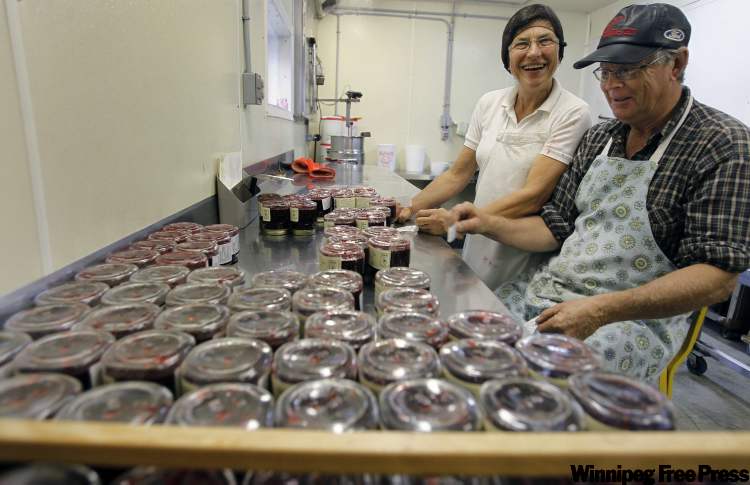
“I started with a pot on a stovetop,” said Paulette. They went high-tech when they designed their first automated jam stirrer using a windshield wiper motor taken from a school bus.
Not that there is much equipment involved. Little has changed in the jam business in the last millennium. “There are no secrets. It’s the same recipe that’s on the Certo box,” Paulette said. (Certo pectin, made from lime peels and apple, makes jam more viscous.) But fewer people make jam anymore.
“Mom’s working. She doesn’t have time,” said Paulette.
The Cramptons go to great lengths to procure fruit, even picking product like crabapples out of people’s backyards. They ask permission, of course. Their “crabapple raiding” days are in the past. Paulette won’t reveal the variety of crabapple used but the jam became their top seller this year, surpassing Saskatoon jam.
They also pick some Pembina plums from private yards. The plum was developed at the Agriculture Canada Research Centre in Morden before the federal government killed off its fruit and horticulture division. Crampton’s still sells product in the old-fashioned Mason jars, with the separate tin lid and thing you spin to open it (but not before running it under hot water so it loosens — the tin and glass expand at a different speeds).
Crampton jams are neither pricey like health food products nor cheap like jam imports from Poland and the Czech Republic that fill many stores shelves. But then those companies can’t give you jams made with local Saskatoons, or Pembina plums, or diced rhubarb made into jams, or a marmalade with carrots and oranges.
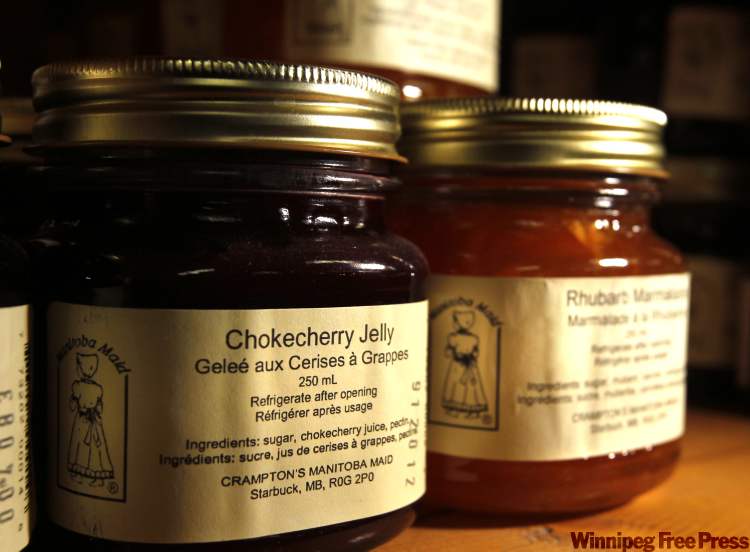
“We have a completely different product,” said Paulette.
Another thing you won’t find in the big commercial jams is chunks of the fruit. Larger commercial operations are automated and the fruit clogs the automated jar fillers. So fruit has to be pureed first. The Cramptons fill jars manually so the fruit stays in. “You know what your eating,” cracked Paulette.
Imported jams don’t have highbush cranberry jam either. The red berries grow wild and Hutterites pick them for the Cramptons. “It usually grows in low-lying areas shaded by poplar trees. You’ll find them in most little bluffs. There are all kinds in Beaudry Provincial Park,” explained Sam. They smell “like old socks,” said Sam, even after being made into jams, which prompted one novice highbush jam eater to try to return it thinking it had gone bad.
The Cramptons get strawberries from Mayfair Farms near Portage la Prairie, and Saskatoon berries from Graham’s Groves near Carman. Some fruits, like blueberries and peaches, are imported from the West Coast. They even make a seedless raspberry jam for people with digestive problems. The seeds are removed by centrifugal force.
There are many jam makers at farmers markets but few on a scale like the Cramptons. Kroeker Farms, known more for their potatoes, ventured into the raspberry jam business in 2008 with a sugarless jam. But that venture failed in part because consumers weren’t used to looking for jam in the refrigerated section. (Sugar acts as a preservative.)
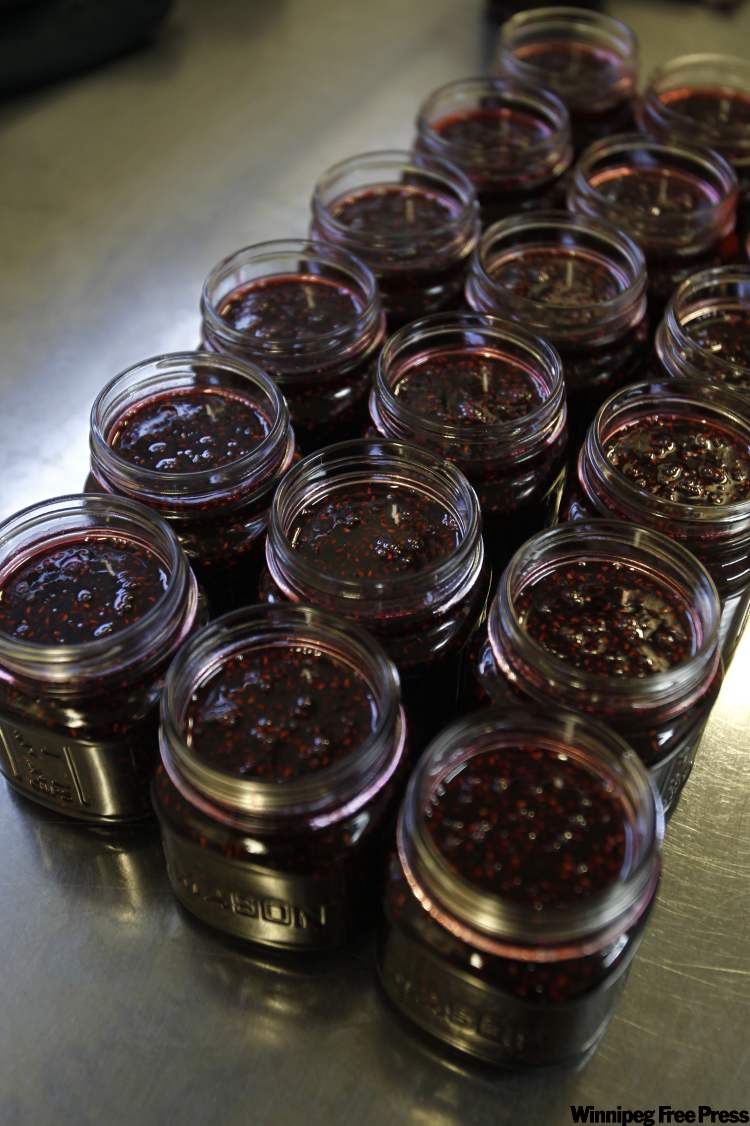
What’s the difference between mixed farming and making jam? “You can control (your returns),” said Sam, instead of being a purely price-taker. The Cramptons have been burned by corporate food stores and only retail through independents like Petrasko Bros. and Neumann’s Market on Henderson Highway, De Luca’s on Portage Avenue, Frigs Natural Meats on Main Street, co-op stores in St. Norbert, Selkirk, Morden, Winkler and Carman, Pine Ridge Hollow, and the Little Red Barn east of Winnipeg, to name some. Their daughter, Erin, owns Crampton’s Market at Waverley Street. and Bishop Grandin, that is now closed until May.
bill.redekop@freepress.mb.ca