
Divided city has mayor worried
Advertisement
Read this article for free:
or
Already have an account? Log in here »
We need your support!
Local journalism needs your support!
As we navigate through unprecedented times, our journalists are working harder than ever to bring you the latest local updates to keep you safe and informed.
Now, more than ever, we need your support.
Starting at $15.99 plus taxes every four weeks you can access your Brandon Sun online and full access to all content as it appears on our website.
Subscribe Nowor call circulation directly at (204) 727-0527.
Your pledge helps to ensure we provide the news that matters most to your community!
To continue reading, please subscribe:
Add Brandon Sun access to your Free Press subscription for only an additional
$1 for the first 4 weeks*
- Enjoy unlimited reading on brandonsun.com
- Read the Brandon Sun E-Edition, our digital replica newspaper
*Your next Free Press subscription payment will increase by $1.00 and you will be charged $20.95 plus GST for four weeks. After four weeks, your payment will increase to $24.95 plus GST every four weeks.
Read unlimited articles for free today:
or
Already have an account? Log in here »
Hey there, time traveller!
This article was published 25/11/2011 (5408 days ago), so information in it may no longer be current.
Brandon Mayor Shari Decter Hirst pleaded with Premier Greg Selinger to help repair the damage left over from the Brandon University faculty strike, once the dispute, now in Day 44, finally reaches a settlement.
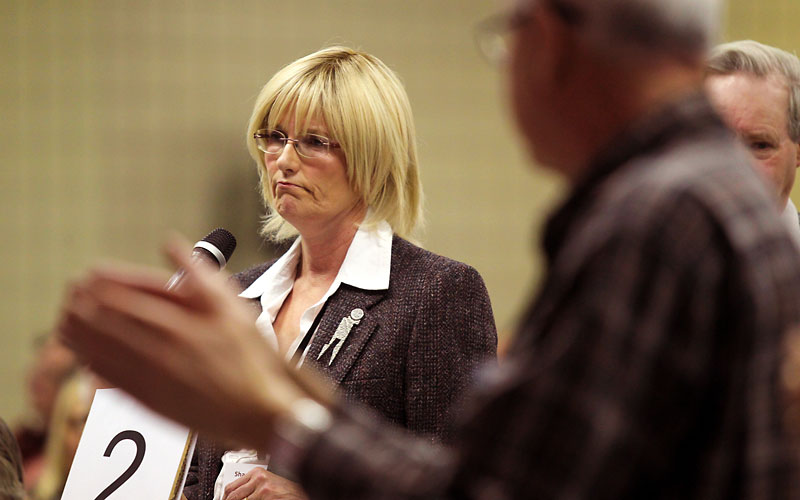
“This strike is more threatening to our community than (the 2011) flood because it divides us rather than unites us,” Decter Hirst said at the Association of Manitoba Municipalities ministerial bear pit session on Thursday at the Keystone Centre. The damage it leaves behind is not easily seen, will be very difficult to repair and it will be very long-lasting.
“Mr. Premier, can you reassure us the province will be there when this strike is over to make whole an institution and community that’s been broken?”
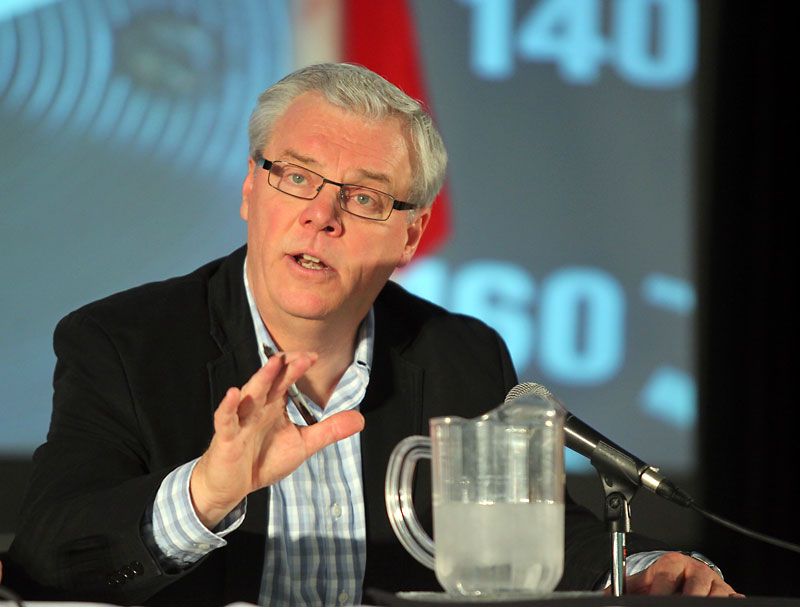
Selinger said his government has been there, with offers of conciliation, mediation and will be there with arbitration should the strike continue to Dec. 10. He reiterated Labour Minister Jennifer Howard’s unusual move to call for a vote on the last administration offer.
“I hope it’s over today,” Selinger said of the strike. “But as soon as it’s over, and even before, we have asked our post-secondary education minister to work with the university on a plan to save the term. Nobody will graduate with an asterisk behind their name. All graduates will have a first-class education because it is a first class institution which has served this region, not just in Manitoba but in other parts of Western Canada exceptionally well.
“Of course we will work with you to restore and build (the university’s) reputation.”
Selinger said Wednesday night that Manitoba’s labour legislation was the strongest in the country and provides methods to resolve strikes. When asked Thursday whether the length of the Brandon University faculty strike gave him reason to revise that legislation, Selinger said: “We’ll consider that after this conflict is over.”
“Right now, we want this conflict to end,” he added. “We want students back in the classes and want parents to know they are getting a chance to complete their education.
“We want to focus on the immediate because there will be time for those other things later.”
Decter Hirst, a former NDP provincial party president, was somewhat critical of the Selinger government’s pace in attempting to resolve the strike, even with Howard’s call for a faculty vote on the university’s final offer, currently underway.
She added the “critical nature of this strike has not been recognized in Winnipeg.”
“I want to commend the provincial government and (Howard) for taking action …however and frankly, I worry that it’s too late,” Decter Hirst said. “Sometimes resolve softens over time. Living in this community, I can see that time has hardened that resolve. The bitterness and vitriol from this strike has been corrosive.”
Decter Hirst feared further damage to the city and its university should the Brandon University Faculty Association vote to reject the administration’s last offer.
“If the vote fails and we are forced to wait out several more weeks for arbitration, there will be precious few pieces to pick up,” Decter Hirst said.
That is, in part due to the university’s labour relations reputation, especially given this is the second strike since 2008. Decter Hirst said there would be lasting impacts to the city’s economic health and sense of community because of the strike.
“The resilience of this university to withstand this storm has been seriously undermined by years of ongoing battles,” Decter Hirst said. “We’ve had students who have had a strike in their first year and are now living through this in their last year. We don’t want these students graduating with an asterisk on their degree.
“There’s no winners in this strike, only varying degrees of loss.”
Selinger noted his pledge to raise funding for the university by five per cent per year for the next three years will help address some those issues. He also wants both parties in the dispute immediately follow mediator Michael Werier’s suggestion to go to binding arbitration now.
“We want to see people back in classes as soon as possible,” Selinger said. “We think the gap is very small. Let’s get it done.”
Related Articles
AMM deals with 66 issues at annual conference
Advertisement Advertise With Us
Advertisement Advertise With Us