
New effort to put Churchill on shipping map
Advertisement
Read this article for free:
or
Already have an account? Log in here »
We need your support!
Local journalism needs your support!
As we navigate through unprecedented times, our journalists are working harder than ever to bring you the latest local updates to keep you safe and informed.
Now, more than ever, we need your support.
Starting at $15.99 plus taxes every four weeks you can access your Brandon Sun online and full access to all content as it appears on our website.
Subscribe Nowor call circulation directly at (204) 727-0527.
Your pledge helps to ensure we provide the news that matters most to your community!
To continue reading, please subscribe:
Add Brandon Sun access to your Free Press subscription for only an additional
$1 for the first 4 weeks*
*Your next subscription payment will increase by $1.00 and you will be charged $20.00 plus GST for four weeks. After four weeks, your payment will increase to $24.00 plus GST every four weeks.
Read unlimited articles for free today:
or
Already have an account? Log in here »
Hey there, time traveller!
This article was published 22/12/2011 (5218 days ago), so information in it may no longer be current.
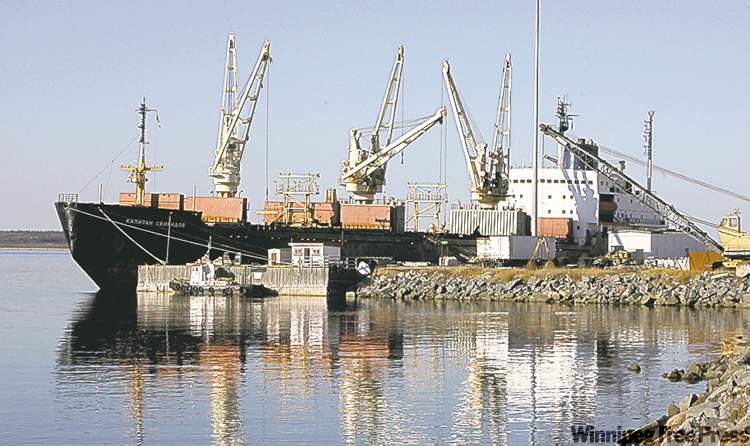
Talks are underway to arrange for a shipment of goods from Churchill to China next year.
It may not even matter what the cargo contains. The point of the exercise would be to alert the global shipping industry that with warming Arctic waters, there is a potential new trade route for shippers to consider.
The Port of Churchill has been open since 1929, but the short shipping season and risk of freeze-up have made insurance hard to come by and has restricted interest in using the port.
Of course, a single symbolic vessel does not make a market. Plenty more work would have to be done to the northern transportation infrastructure to make expansion of the port’s activities a sustainable proposition.
Manitoba Premier Greg Selinger and Prime Minister Stephen Harper agreed at a meeting last week to move ahead with forming a task force to look at the future of Churchill.
The details and format of the task force are still being worked out.
That a town of not much more than 1,000 people should attract such a high level of interest shows the strategic significance of the community.
The end of the Canadian Wheat Board’s monopoly puts future business with the port’s major customer in jeopardy, but interest in developing Churchill as a strategic gateway remains as strong as ever.
Global warming creates opportunities for Churchill just as its traditional business model becomes uncertain. At the same time, global demand for mineral resources means greater interest in mining development in the North and more pressure to establish adequate transportation networks.
The foundations are in place for Churchill to become the gateway for a more efficient supply chain to Nunavut.
Last week, the Conference Board of Canada’s Centre for the North issued a study on the subject called Northern Assets: Transportation Infrastructure in Remote Communities with Churchill as the case study.
In it, the Ottawa-based think-tank detailed the realities of the greater costs associated with transportation infrastructure in the North and the greater costs to maintain it.
David Stewart-Patterson, the Conference Board’s vice-president of public policy, said, “The general observation that flows from the study is that you can’t measure the costs or benefits of transportation infrastructure in the North by the same standards that you would the rest of the country.”
That may not be enough to open the purse strings and divert hard-to-find infrastructure money northward, but it provides some context to rethink strategies in dealing with a long neglected part of the country.
There must be some sort of economic imperative to provide the incentive.
Stewart-Patterson put it this way: “Part of the message for the rest of Canada is that what happens in the North matters to all of us.”
Lloyd Axworthy, president of the University of Winnipeg, has championed Churchill for several decades. From his position in the federal cabinet, Axworthy was instrumental in orchestrating the sale of the port and the Hudson Bay Line to OmniTRAX in 1997.
He was in Churchill recently with the Chinese consul-general to Canada. The idea of testing the Churchill-to-China shipping route was discussed.
“The global economic news is not heartening,” Axworthy said recently.
“People are looking for something to provide a catalyst and new energy into the system. The idea of a brand-new trade route that connects down the central spine of North America into Mexico… that is the kind of thing that can give a boost.”
It’s not a new idea, but it may be one whose time has come.
Meanwhile, planning continues for an all-season road from Gillam to Hudson Bay and the proposed construction of an all-weather road connecting Rankin Inlet in Nunavut, to Manitoba’s highway system. The province’s winter road network links all northern communities, but climate change is making them vulnerable.
Manitoba has budgeted $70 million this year for the ongoing development of an all-season road up the east side of Lake Winnipeg.
Steve Ashton, Manitoba’s infrastructure minister, said, “Even though it might be costly to build roads we have reports that show a significant positive cost-benefit analysis.”
He said there are substantial cost savings to the communities that are linked and substantial potential for economic development. “It really comes down to it being a significant investment, not an expenditure.”
There’s no doubt the investment required would be billions of dollars — but it’s not out of the question. Baffinland Iron Mines Corp. is putting together a $4-billion development of a massive iron ore deposit on Baffin Island that includes $2 billion for a rail link.
martin.cash@freepress.mb.ca