
Better slow down near schools
Province moves toward reduced-speed zones
Advertisement
Read this article for free:
or
Already have an account? Log in here »
We need your support!
Local journalism needs your support!
As we navigate through unprecedented times, our journalists are working harder than ever to bring you the latest local updates to keep you safe and informed.
Now, more than ever, we need your support.
Starting at $15.99 plus taxes every four weeks you can access your Brandon Sun online and full access to all content as it appears on our website.
Subscribe Nowor call circulation directly at (204) 727-0527.
Your pledge helps to ensure we provide the news that matters most to your community!
To continue reading, please subscribe:
Add Brandon Sun access to your Free Press subscription for only an additional
$1 for the first 4 weeks*
- Enjoy unlimited reading on brandonsun.com
- Read the Brandon Sun E-Edition, our digital replica newspaper
*Your next Free Press subscription payment will increase by $1.00 and you will be charged $20.95 plus GST for four weeks. After four weeks, your payment will increase to $24.95 plus GST every four weeks.
Read unlimited articles for free today:
or
Already have an account? Log in here »
Hey there, time traveller!
This article was published 19/04/2012 (5302 days ago), so information in it may no longer be current.
Drivers will soon have to slow down when going through school zones.
Infrastructure and Transportation Minister Steve Ashton said Wednesday he’ll introduce legislation as early as today to give local authorities the power to create reduced-speed zones for schools.
“Our focus will be in terms of giving municipalities the ability to deal with what is a major concern in many communities and that is speeding through school zones,” Ashton said.
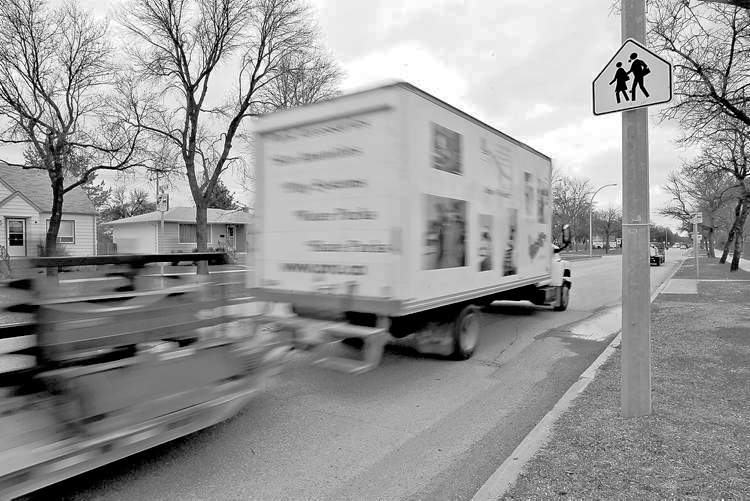
Winnipeg is the only large city in Western Canada that does not have a reduced speed limit in a school zone. The speed limit in Winnipeg is 50 kilometres per hour unless otherwise posted. In other cities such as Saskatoon, the reduced speed limit in a school zone varies between 30 km/h to 40 km/h.
“It’s long overdue, to be very frank with you,” said Winnipeg Mayor Sam Katz, who has authored two separate council motions aimed at making the change. “I’m glad to see the province realizes this is something that should have been done before.”
What remains to be seen is how extensive the legislation will be — what might work for an elementary school on a residential street won’t work for one adjacent to Portage Avenue.
“The experience across Canada is that you’re better off to allow communities to make those kinds of decisions,” Ashton said. “No two communities are alike.”
In Saskatoon, the school speed zone was reduced to 30 km/h from 50 km/h in 2002 for all elementary schools and high schools, effective 8 a.m. to 5 p.m. Monday to Friday from September to June. The 30 km/h maximum is designed to give motorists more time to react and brake in case a child darts out unexpectedly onto the street. The penalty for speeding in a school zone is the same as any other speeding offence in Saskatchewan, including a fine and three licence demerit points.
Winnipeg police Const. Ray Howse said the new speed limit might allow police to enforce speed laws in areas where they haven’t before because of parking or other restrictions.
He said police might be able to use a newer generation of a hand-held laser gun that has the capacity to take high-resolution photos of licence plates of offending vehicles.
bruce.owen@freepress.mb.ca
Vehicles monitored
CITY police monitored 38,890 vehicles Sept. 22-28, 2010 on Day Street in Transcona, near École Centrale. What police found:
16,443 vehicles travelled one kilometre above the posted 50 km/h speed limit.
2,662 vehicles travelled 10 kilometres above the limit.
the top speed measured was 113 km/h at 4:28 p.m. Sept. 26, a Sunday.