
The wonder of creepy, crawly Manitoba spiders
Advertisement
Read this article for free:
or
Already have an account? Log in here »
We need your support!
Local journalism needs your support!
As we navigate through unprecedented times, our journalists are working harder than ever to bring you the latest local updates to keep you safe and informed.
Now, more than ever, we need your support.
Starting at $15.99 plus taxes every four weeks you can access your Brandon Sun online and full access to all content as it appears on our website.
Subscribe Nowor call circulation directly at (204) 727-0527.
Your pledge helps to ensure we provide the news that matters most to your community!
To continue reading, please subscribe:
Add Brandon Sun access to your Free Press subscription for only an additional
$1 for the first 4 weeks*
*Your next subscription payment will increase by $1.00 and you will be charged $20.00 plus GST for four weeks. After four weeks, your payment will increase to $24.00 plus GST every four weeks.
Read unlimited articles for free today:
or
Already have an account? Log in here »
Hey there, time traveller!
This article was published 30/04/2012 (5085 days ago), so information in it may no longer be current.
BRANDON — Maybe it should be called the “clothesline” spider.
This common spider spins a sheet of web, nothing fancy, that acts like a trampoline.
Then, above the trampoline, it strings a few threads, like clotheslines, called knock down threads. The unsuspecting fly or mosquito comes merrily buzzing along, gets clotheslined by a thread, and drops onto the trampoline.
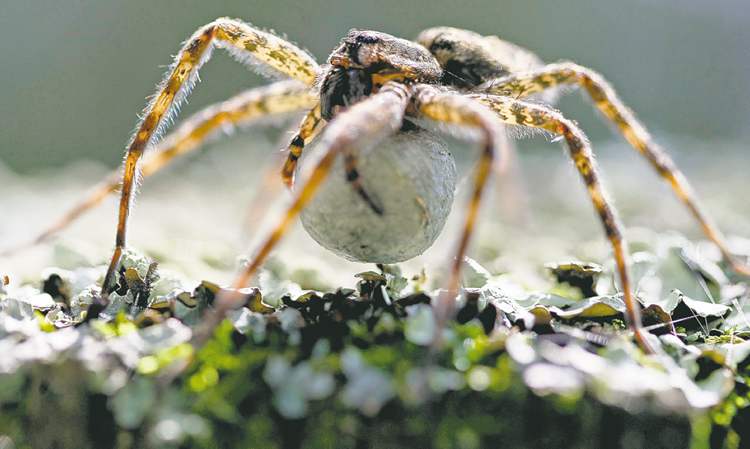
The vibrations from the trampoline alert the spider, called a sheetweb spider, who’s hunkered in a web-spun funnel beneath the trampoline. The spider bounds out of the funnel and sinks its tiny fangs into the prey. Dinner’s ready!
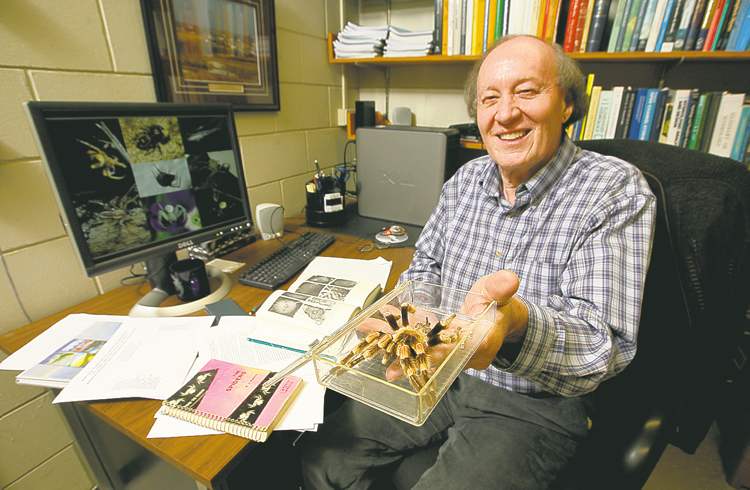
The curmudgeon of the insect world — I want to be alone, doesn’t begin to describe the reclusive spider — doesn’t get a lot of love but that is part of the attraction for Brandon University Prof. Rod McGinn, one of Manitoba’s two expert hobbyists on the arachnid.
He shows off his pet tarantula, Ambrosia, preserved under glass. “She was 25 (years old) when she went,” he said. One almost expects McGinn to sniffle briefly. It’s a Mexican red knee tarantula, with orange stripes.
Millions of spiders are emerging right now in Manitoba as the spring sunshine warms the eggs.
There are 10 families of spider in Manitoba and McGinn maintains if you go out in your backyard after dark with a flashlight, as he does, you might find species from seven or eight of those families.
It’s hard to go into all the different markings on spiders but you can also tell a spider by its web. Spiders spin five different kinds of webs but only one is symmetrical, and that’s from the family of orb spiders. It’s web radiates out like sun’s rays, with short cross pieces between them.
The crosspieces have little dots on them, like ellipses lines. The dots are the glue. The radii — lines that stretch out like the sun’s rays — are kept free of glue so the spider can scamper up and down them to patrol his web.
There are ground spiders, shamrock spiders, barn spiders and long-jawed spiders in Manitoba. Burrowing wolf spiders take up residence in the Spruce Woods Sand Hills.
“They dig a hole as big as your thumb.” Then there’s the plain old wolf spider. “It doesn’t spin web but runs around on the round and jumps on its prey.”
There are banded garden spiders, comb-footed spiders, and house spiders. You’ve probably met the parson spider. “You’ll find it in the bathtub or shower,” McGinn said.
Can it climb out after you wash it down the sink? “Sometimes.” The daddy long legs is not a spider, despite the requisite eight legs.
Then there’s the humongous dock spider, about the size of a CD. They hang around under the dock and eat water striders and water beetles, and even horseflies.
All spiders can bite but whether you’d actually feel it depends on its size. McGinn has always collected his spiders by hand, and used to let Ambrosia crawl around his arms. “They don’t bite unless they’re being irritated.”
Interestingly enough, the spider kills its prey by injecting an enzyme into its body that liquifies the insides (which are already quite liquid). Then the spider — their mouths are like straws — slurps it up like one of those Weight Watchers all-in-one breakfast drinks.
Spiders have four, six or eight eyes, depending on the species. The jumping spider — a family of spider that makes up 13 per cent of the world’s species — is believed the most evolved because its eyesight, with all eight eyes, is best; the tarantula, with a measly four eyes and none of them much good, is considered the least evolved.
The jumping spider tethers a thread to the surface before jumping in case it should fall. If its jump falls short, it simply climbs back up the thread.
One reason spiders prefer to be alone is they are cannibalistic. It becomes a problem for siblings. Families fracture about the time one sibling starts to eye another inappropriately. However, there is one spider that does colonize in a large web called the con social spider (not found in Manitoba), which are a great source of fascination to Darwin theorists.
The word “gossamer” is derived from “goose summer” and is spider silk sailing on a breeze. Young spiders will let out a line until the wind lifts them up. People can be out on the lake fishing and gossamer will wrap around the end of their rods.
McGinn is actually a geography professor but combines his field trips with his love of studying spiders. He gives talks to school groups on spiders and has catalogued his photographs of spiders from across Manitoba.
“They’re not loveable. ‘Save the spider!’ I don’t think that’s going to work,” he said. But there are reasons not to kill them. “I think the public should be aware of the good spiders do by controlling insect populations like aphids, mosquitoes and flies.”
bill.redekop@freepress.mb.ca