
Wear those bike helmets, kids
NDP introduces law making headgear mandatory for those under 18
Advertisement
Read this article for free:
or
Already have an account? Log in here »
We need your support!
Local journalism needs your support!
As we navigate through unprecedented times, our journalists are working harder than ever to bring you the latest local updates to keep you safe and informed.
Now, more than ever, we need your support.
Starting at $15.99 plus taxes every four weeks you can access your Brandon Sun online and full access to all content as it appears on our website.
Subscribe Nowor call circulation directly at (204) 727-0527.
Your pledge helps to ensure we provide the news that matters most to your community!
To continue reading, please subscribe:
Add Brandon Sun access to your Free Press subscription for only an additional
$1 for the first 4 weeks*
- Enjoy unlimited reading on brandonsun.com
- Read the Brandon Sun E-Edition, our digital replica newspaper
*Your next Free Press subscription payment will increase by $1.00 and you will be charged $20.95 plus GST for four weeks. After four weeks, your payment will increase to $24.95 plus GST every four weeks.
Read unlimited articles for free today:
or
Already have an account? Log in here »
Hey there, time traveller!
This article was published 24/05/2012 (5267 days ago), so information in it may no longer be current.
After refusing for years to mandate the use of bicycle helmets, the Manitoba NDP relented with legislation that will require cyclists under the age of 18 to don protective headgear.
Healthy Living Minister Jim Rondeau, who introduced the legislation on Wednesday, said the government’s approach was to rely first on public education and programs that provided free or inexpensive helmets to preschool and school-age children. Those programs saw 80,000 helmets distributed to kids over the past half-dozen years, he said.
Introducing a bike-helmet law was “the next logical step,” Rondeau said Wednesday.
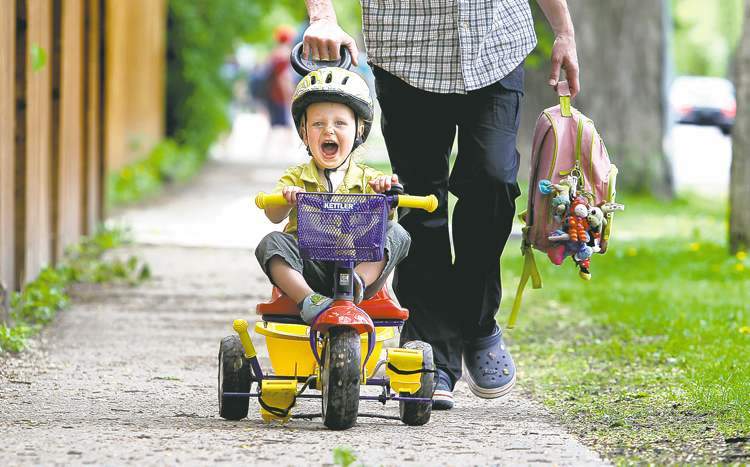
“The amendments introduced today are a critical step forward in protecting our children and young cyclists and preventing serious injuries and fatalities,” Rondeau said.
Anke Sinclair, a mother of two boys, Mehru, 9, and Yannick, 3, said her children use helmets.
“I think it’s a safety issue. I think if they do fall — whatever the cause — I think it will protect their heads,” she said.
Sinclair said she thinks there needs to be more education for motorists around cyclists.
“Me, as a cyclist, I see that some motorists don’t really know what to do with me,” said Sinclair.
She said she’s spoken to other people who want to ride their bikes more, but “do not feel safe.”
Sinclair also said it’s very important to improve bike lanes in the city.
Rondeau told reporters he doesn’t expect police will be handing out many tickets once the bill is passed and proclaimed. He did not indicate when the new law would take effect.
“We’re not going to have a lot of cops chasing kids — ever,” Rondeau said, noting that in jurisdictions with similar legislation “very, very few tickets are given out.”
What the government is counting on, he said, is once a law is in effect, folks will understand it and obey it. “The major goal is to get people to know the law.”
Manitoba is one of only four provinces without some kind of bicycle-helmet law. Several jurisdictions, such as Alberta and Ontario, have had laws in place for a decade or more, while four provinces require all cyclists wear helmets.
In provinces where child bicycle-helmet use is mandatory, compliance rates are 80 per cent or more. The usage rate in Manitoba sits at 42 per cent among children.
The Manitoba Liberals have beat the drum for a bike-helmet law since 2006, but every time one of its members introduced a private member’s bill touting a bike law, it was shot down by the ruling NDP. Liberal Leader Jon Gerrard said he was “very pleased that the government at last has listened” to his party and introduced the legislation. But he said it should have applied to adults as well as children.
A Winnipeg pediatric neurosurgeon agreed. “There’s nothing more protective about an adult’s skull and brain versus a 17-year-old’s. When your head hits the concrete… the impact is the same,” Dr. Patrick McDonald told The Canadian Press.
Rondeau didn’t rule out expanding the helmet law to cover adults, but he said for now the government was content to apply it only to kids. He said children are less-experienced riders and prone to “the most risky behaviours” on a bicycle. “We’ll monitor (the legislation) to see if we have to go further in the next little while.”
Charles Weaver, a spokesman for the Winnipeg cycling group Bike to the Future, said he is disappointed the government isn’t doing more to protect cyclists. He noted his organization is split on whether bike-helmet use should be legislated.
The province should be doing more to promote cycling as a healthy form of transportation and to educate motorists and cyclists on road safety, he said. Right now, many people are discouraged from riding their bikes because of safety fears.
“We’d much rather they (the government) spent an effort on making cycling safer rather than protecting us from our own crashes,” Weaver said.
In some countries, such as Holland and Denmark, bike usage is much higher and injury rates are lower because of better laws, bike infrastructure and education, he said.
“In this legislation, government is telling Manitobans: ‘Our roads are dangerous for cyclists, so wear a helmet to protect yourself.’ This is a Band-Aid solution,” Weaver said.
Will Belford, a mechanic/owner at Natural Cycle on Albert Street, said there are “many different aspects” of safety on the road.
“As it stands right now, for Winnipeggers, it is still dangerous,” he said. “Given the complexity of the situation, helmets for minors… would not be a mistake in my mind. Children are certainly at most risk because they have the least experience riding on roads, and that’s really where most of the accidents happen.”
— with files from Gabrielle Giroday
larry.kusch@freepress.mb.ca