
Learning lessons on the colony
Advertisement
Read this article for free:
or
Already have an account? Log in here »
We need your support!
Local journalism needs your support!
As we navigate through unprecedented times, our journalists are working harder than ever to bring you the latest local updates to keep you safe and informed.
Now, more than ever, we need your support.
Starting at $15.99 plus taxes every four weeks you can access your Brandon Sun online and full access to all content as it appears on our website.
Subscribe Nowor call circulation directly at (204) 727-0527.
Your pledge helps to ensure we provide the news that matters most to your community!
To continue reading, please subscribe:
Add Brandon Sun access to your Free Press subscription for only an additional
$1 for the first 4 weeks*
*Your next subscription payment will increase by $1.00 and you will be charged $20.00 plus GST for four weeks. After four weeks, your payment will increase to $24.00 plus GST every four weeks.
Read unlimited articles for free today:
or
Already have an account? Log in here »
Hey there, time traveller!
This article was published 31/05/2012 (5061 days ago), so information in it may no longer be current.
Deerboine Hutterite Colony — It’s a field trip close to home, but far from the city.
Students from Waverly Park School in Brandon were given a tour of Deerboine Hutterite Colony near Alexander to see sustainable farming in action.
The school spent the year focusing on sustainable agriculture and to bring home the point, arranged eight tours at Deerboine for different grades.
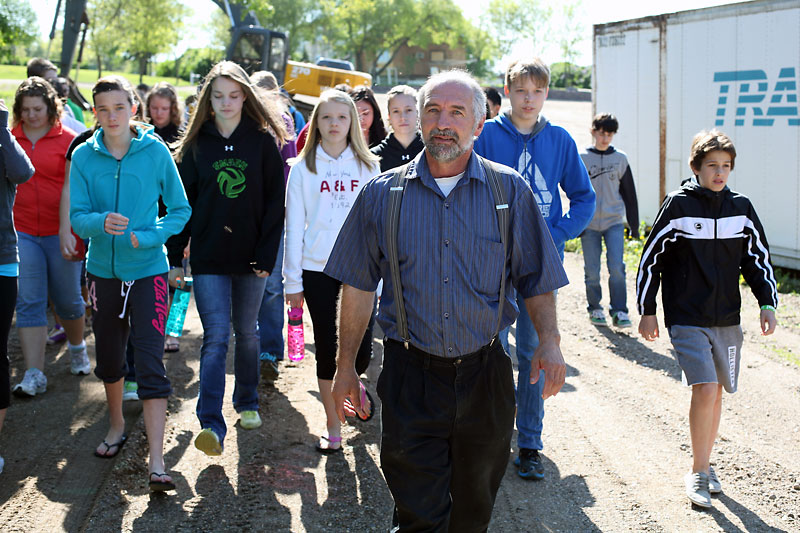
“The students are learning how to reduce their carbon footprint and how they can buy food locally,” teacher Felicia Billaney said.
Billaney was with the group of 37 Grade 8 students for a three and a half hour tour Wednesday, led by colony boss Mel Hofer. Along the way, students were shown how each part of the farm runs and how it contributes to the community.
“We try to keep self-sufficient,” Hofer told the group.
Seventy-three people live on the Deerboine Colony, a number Hofer’s daughter, Tirzah, said is “always changing.”
“Babies are born, girls marry and some people leave to try a different life,” she said.
Tirzah is the oldest of Hofer’s six children, and spends her time with the other single girls taking care of miscellaneous duties.
“We try to do whatever we can to keep the colony running,” she said.
Positions in the colony are elected, and one or two people are in charge of a specific function on the farm.
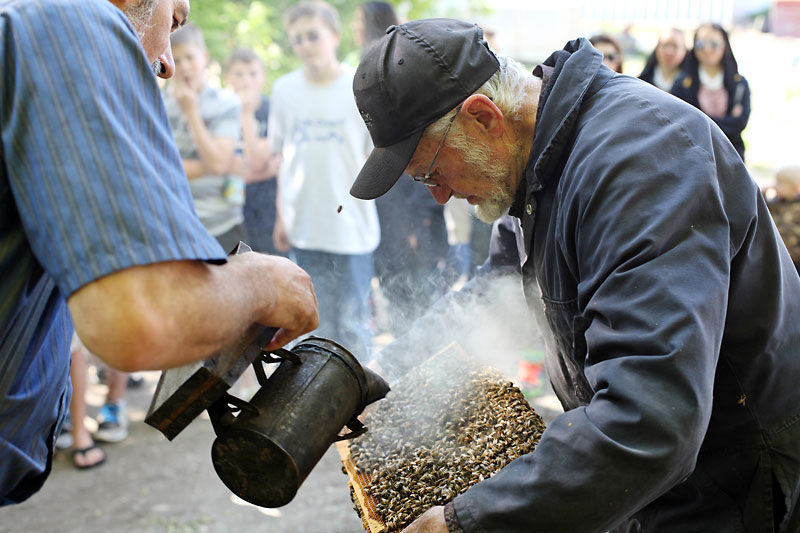
Hofer’s 81-year-old father, Edwin, is the colony beekeeper. After learning from his father, Edwin has kept bees for more than 53 years, and proudly showed off bee-laden slates to the students.
“If I get a sting, it’s because I’m working with it in the cold,” he said. “Their minds are on making honey, they’ll leave you alone.”
The students weren’t bothered by the bees, chattering about how the hives were “cool and awesome.” While some of the honey stays on the colony, the rest is sold.
Last year, the beekeeper brought 27 bars of honey to the market — each containing 630 pounds of the sweet stuff. It’s a labour of love, and one the grandfather hopes to pass on.
“I’m trying to teach the young ones, but they’re saying all allergic,” he said.
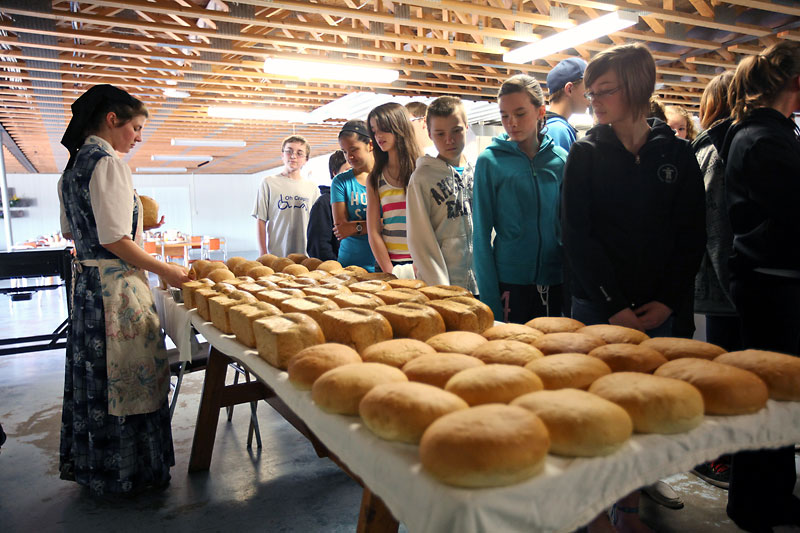
Honey isn’t the only self-sustaining sweet treat — the single women on the colony have started their own project: tapping maple syrup. Hardly any brown sugar is used in their baking now, and Hofer said customers have enjoyed the change.
The colony also keeps it natural for its water supply.
“We don’t put anything in our water — it’s still from the ground, we test it once a month,” Hofer said. “We’re very lucky to have that water — what we drink, the animals drink.”
They also eat from the same garden — the ingredients used in the animal feed are grown on the colony. Pigs, chickens and cows are raised for food, compost and byproducts used to keep the colony running.
“We usually use five gallons of milk a day in our kitchen,” Hofer said.
The colony maintains its own vehicles and reuses machinery — such as the almost-new back end of a cement truck — to keep the farm running efficiently.
“We buy two trucks to make one,” Hofer said. He buys the vehicles from Manitoba Public Insurance, keeping colony mechanics busy year-round.
Most driving happens off the colony, as people walk along neat paths and beautifully landscaped areas to their jobs each morning.
The tidy nature of the colony was not lost on the students, who were impressed that boys their age maintain the large lawns regularly.
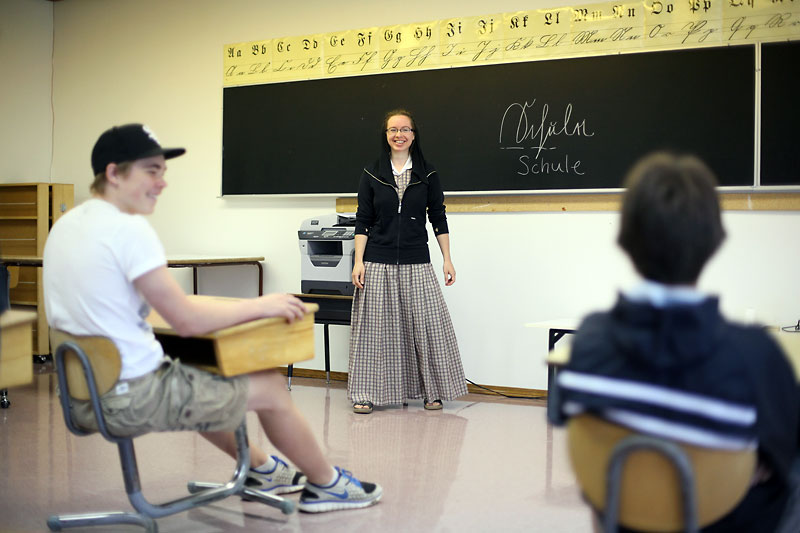
“The land is very well taken care of, they’re not really corrupting the area,” said student Matt Byers, adding that “seeing how they burn coal so it comes out clean — that was cool.”
Three more student tours are scheduled at Deerboine, and Hofer hopes his insight offers students a better perspective on colonies.
“It’s not a cult, it’s just a different way of life,” he said.
» dponticelli@brandonsun.com