
Mammoth task: U of M professor pens article on resurrecting ice-age DNA
Advertisement
Read this article for free:
or
Already have an account? Log in here »
We need your support!
Local journalism needs your support!
As we navigate through unprecedented times, our journalists are working harder than ever to bring you the latest local updates to keep you safe and informed.
Now, more than ever, we need your support.
Starting at $15.99 plus taxes every four weeks you can access your Brandon Sun online and full access to all content as it appears on our website.
Subscribe Nowor call circulation directly at (204) 727-0527.
Your pledge helps to ensure we provide the news that matters most to your community!
To continue reading, please subscribe:
Add Brandon Sun access to your Free Press subscription for only an additional
$1 for the first 4 weeks*
*Your next subscription payment will increase by $1.00 and you will be charged $20.00 plus GST for four weeks. After four weeks, your payment will increase to $24.00 plus GST every four weeks.
Read unlimited articles for free today:
or
Already have an account? Log in here »
Hey there, time traveller!
This article was published 14/08/2012 (4981 days ago), so information in it may no longer be current.
Winnipeg woolly mammoth fans rejoice. The newest issue of Scientific American features the work of a Winnipeg professor with a flair for the prehistoric beasts.
University of Manitoba professor Kevin Campbell, a pioneer in the field of paleophysiology, has published an article in the August 2012 issue of the magazine titled New Life for Ancient DNA.
Campbell, a professor of environmental and evolutionary physiology, co-wrote the article with Michael Hofreiter, a professor of biology at the University of York.
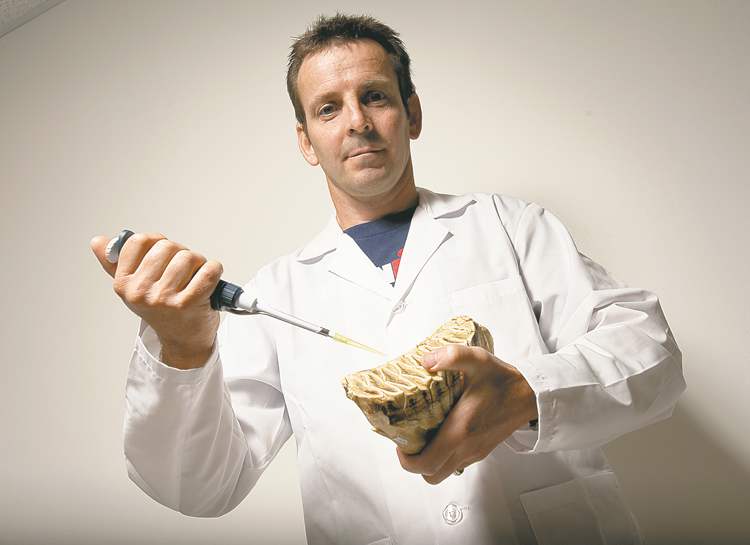
The article details the authors’ uses of biotechnology to recreate and study functional genes, such as blood protein hemoglobin, from the extinct woolly mammoth.
“Essentially we were able to resurrect an important ‘living’ cellular process in an extinct animal that hasn’t walked the Earth in many thousands of years and study it as if it were still alive,” said Campbell.
“This work demonstrates that much of the physiology — or living attributes — of mammoths and other extinct ice-age animals may one day be recoverable.”
Campbell said the resurrected mammoth blood showed the beasts could continue delivering oxygen to body tissues even in extreme cold, something human hemoglobin cannot do. The next step, the professor said, is determining how the mammoth was capable of this and to reverse-engineer human proteins to have the same abilities.
“For instance, certain new ‘hypothermia-dependent’ heart and brain surgeries require that doctors lower the patients’ body temperature. Hence, our work could facilitate the design of a medically relevant hemoglobin-based oxygen carrier for these types of procedures,” he said. “Other genes we are now studying may become important targets for the development of pain medications.”
Campbell said he is also helping Morden’s Canadian Fossil Discovery Centre to develop an ice-age exhibit that will display some of Campbell’s findings. He is vice-president of the centre’s board.
“This is still in the works. It’s in the conceptual planning stage. But what we’d like to do is develop it and since we have some of my work from the mammoth, we can display that as well,” said Campbell.
Campbell grew up in Morden and his work in paleophysiology has been featured in the New York Times, BBC Nature, the London Daily Mail and the Toronto Star.
Campbell hopes the latest article will spread awareness on the ways science can help people and preserve history.
“When we do write these articles, we interest people,” he said.
“To me that’s the greatest thing I can do in my job, just to show people the wonder of some of these animals and that more needs to be done, that we need to learn about these things.”
katherine.dow@freepress.mb.ca