
Anti-flood devices tested in U of M wave pool
Advertisement
Read this article for free:
or
Already have an account? Log in here »
We need your support!
Local journalism needs your support!
As we navigate through unprecedented times, our journalists are working harder than ever to bring you the latest local updates to keep you safe and informed.
Now, more than ever, we need your support.
Starting at $15.99 plus taxes every four weeks you can access your Brandon Sun online and full access to all content as it appears on our website.
Subscribe Nowor call circulation directly at (204) 727-0527.
Your pledge helps to ensure we provide the news that matters most to your community!
To continue reading, please subscribe:
Add Brandon Sun access to your Free Press subscription for only an additional
$1 for the first 4 weeks*
- Enjoy unlimited reading on brandonsun.com
- Read the Brandon Sun E-Edition, our digital replica newspaper
*Your next Free Press subscription payment will increase by $1.00 and you will be charged $20.95 plus GST for four weeks. After four weeks, your payment will increase to $24.95 plus GST every four weeks.
Read unlimited articles for free today:
or
Already have an account? Log in here »
Hey there, time traveller!
This article was published 17/08/2012 (5182 days ago), so information in it may no longer be current.
It could be the best $25,000 taxpayers ever spent — if the dikes hold when the rivers rise.
The University of Manitoba unveiled a handmade, unpretentious gizmo Thursday that’s essentially a wave pool that tests whether various protective devices can withstand the pressure of floodwater and wind.
“It’s to see how these flood-fighting structures can handle the waves,” explained the project’s head boffin, civil engineering Prof. Shawn Clark.
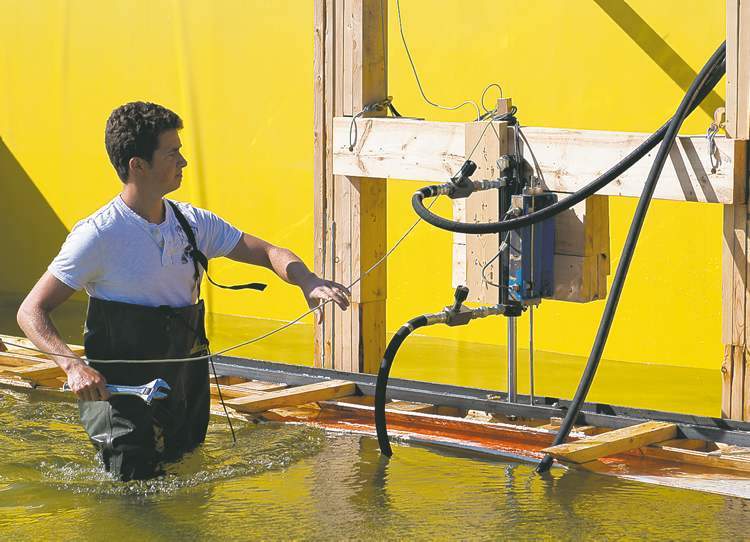
Behind a simple fence in one corner of SmartPark, the U of M can generate different levels of floodwater, program in different wind levels, then blast that water at a variety of devices meant to hold the flood at bay.
On Thursday, it was a 1.2-metre-high sandbag called the Wave Breaker being tested, a product of Winnipeg company ITW Syn-Tex Bag.
Each Wave Breaker is intended to replace dozens of old-fashioned sandbags and eliminate the back-breaking labour of volunteers who come out each spring when our floodwaters rise.
“We can have different wave structures” while adjusting the effects of wind, Clark said. “We’ll measure how much water seeps through and under.”
The research team, which includes engineering students, will even toss in a log or two to see what happens. “Debris can be under the water,” pounding into dikes, Clark noted.
The U.S. Army Corps of Engineers has been using such a device for many years, he said. A grant of $250,000 from the Natural Sciences and Engineering Research Council of Canada covers the project, including labour, but Clark said the materials used to build the wave pool cost only $25,000.
“This technology will be very helpful, obviously, to all the citizens of Manitoba,” said Winnipeg South Tory MP Rod Bruinooge. “The studying of (flood) water is going to be tested here at the U of M.”
Clark said people threatened by floodwater will sleep better at night if they know the materials in their dikes have passed the test.
“It will allow the province’s flood-flighting co-ordinators to have extra confidence in at least one of the tools” available to them, Clark said.
The wave pool will not be covered for year-round experiments, but researchers will continue to test diking materials this summer and resume in the spring of 2013.
Clark said the province has been out to the site and is carefully watching the U of M research.
Conservation and Water Stewardship Minister Gord Mackintosh could not be reached Thursday.
nick.martin@freepress.mb.ca