
Unmanned aerial vehicles draw praise from RCMP
Advertisement
Read this article for free:
or
Already have an account? Log in here »
We need your support!
Local journalism needs your support!
As we navigate through unprecedented times, our journalists are working harder than ever to bring you the latest local updates to keep you safe and informed.
Now, more than ever, we need your support.
Starting at $15.99 plus taxes every four weeks you can access your Brandon Sun online and full access to all content as it appears on our website.
Subscribe Nowor call circulation directly at (204) 727-0527.
Your pledge helps to ensure we provide the news that matters most to your community!
To continue reading, please subscribe:
Add Brandon Sun access to your Free Press subscription for only an additional
$1 for the first 4 weeks*
- Enjoy unlimited reading on brandonsun.com
- Read the Brandon Sun E-Edition, our digital replica newspaper
*Your next Free Press subscription payment will increase by $1.00 and you will be charged $20.95 plus GST for four weeks. After four weeks, your payment will increase to $24.95 plus GST every four weeks.
Read unlimited articles for free today:
or
Already have an account? Log in here »
Hey there, time traveller!
This article was published 11/10/2012 (5017 days ago), so information in it may no longer be current.
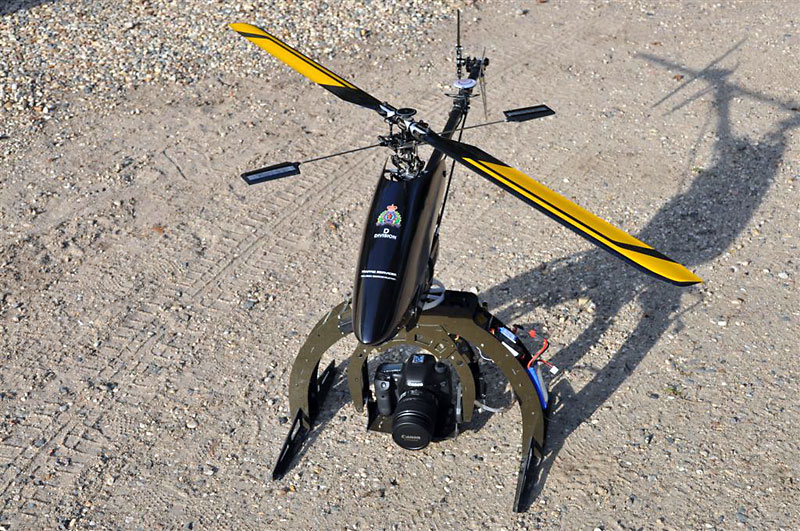
From as high as 100 metres in the air, an RCMP remote-controlled helicopter can take aerial photos and videos of crime scenes, traffic collisions and be an asset in search-and-rescue operations.
Brandon is one of two Manitoba RCMP detachments with an unmanned aerial vehicle. They were officially launched in August, and are proving to be a great investigative tool.
“It certainly gives us an entirely different aspect to look at collision scenes, crime scenes and in air search and rescue,” said Cpl. Byron Charbonneau.
“What I like about it is that it’s portable. It’s something that I can take with me … (Previously) if we needed an aircraft for aerial photos, a lot of times we have to wait for a number of days … You can’t hold a crime scene or close a highway for a number of days sometimes, so it’s definitely a value-added tool in that regard.”
The helicopter is about one metre long and costs roughly $20,000.
It carries a high-resolution digital SLR camera.
Charbonneau facilitates the UAV program for the province, which operates out of Brandon and Dauphin. Training began last February.
Since then, the UAVs have had 32 operational missions.
“We use it routinely for getting aerial photographs of collision scenes, it’s also used routinely by the forensic identification section for aerial photographs at crime scenes,” Charbonneau said.
Last month, the helicopters were used in a ground search and rescue exercise in Clear Lake.
Charbonneau said they have used the helicopters for some experimental purposes as well, such as using different filters to enable them to see into a body of water.
“If we were looking for a deceased person that had drowned, and as long as the water’s not terribly deep and has relatively good clarity, you can see far more from the helicopter that you can from a boat,” he said.
Charbonneau said the RCMP opted to go for a custom-modified device to make it suitable for conditions in Manitoba.
The UAV can be flown in extreme winter temperatures and in winds up to 60-80 km/h — conditions which off-the-shelf products cannot handle.
Charbonneau said the UAVs will be a great tool when dealing with dangerous goods spills and contaminated sites.
“The dangerous and dirty areas that you don’t want to send humans into,” he said.
“That’s the ideal situation for the UAV. You can get above a distater and get a top-down view, provide those photos and videos to the incident commanders and then they can formulate a plan.”
Charbonneau hopes to expand the fleet of UAVs in Manitoba. Similar units are used by RCMP in Saskatchewan and B.C.
» jaustin@brandonsun.com, with files from the Winnipeg Free Press