
History traced in postcards
Advertisement
Read this article for free:
or
Already have an account? Log in here »
We need your support!
Local journalism needs your support!
As we navigate through unprecedented times, our journalists are working harder than ever to bring you the latest local updates to keep you safe and informed.
Now, more than ever, we need your support.
Starting at $15.99 plus taxes every four weeks you can access your Brandon Sun online and full access to all content as it appears on our website.
Subscribe Nowor call circulation directly at (204) 727-0527.
Your pledge helps to ensure we provide the news that matters most to your community!
To continue reading, please subscribe:
Add Brandon Sun access to your Free Press subscription for only an additional
$1 for the first 4 weeks*
*Your next subscription payment will increase by $1.00 and you will be charged $20.00 plus GST for four weeks. After four weeks, your payment will increase to $24.00 plus GST every four weeks.
Read unlimited articles for free today:
or
Already have an account? Log in here »
Hey there, time traveller!
This article was published 15/12/2012 (4782 days ago), so information in it may no longer be current.
When the postcard craze hit at the turn of the 20th century, entrepreneurs tried making postcards out of almost anything.
One in Jack Stothard’s collection of mostly early Brandon postcards — he has more than 700 different ones, the majority from 1900 to 1914 — is made of aluminum. It’s a 3.5 x 5.5-inch piece of flat aluminum. Etched on its surface is a photograph overlooking Brandon, possibly shot from a church tower, said Stothard.
Then there are his postcards made out of leather — they look like large Lee jeans patches.
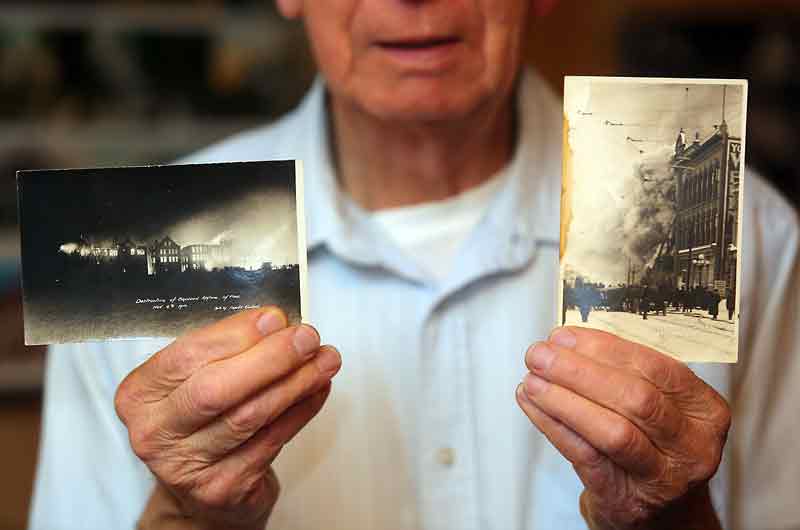
Postcards were an early phenomenon in a pre-automobile, pre-telephone age. They were cheap, costing just one cent to mail and people would send them from one side of town, in this case Brandon, to the other — and Brandon wasn’t that large a century ago. Many communities, no matter how small, produced postcards of themselves. Households kept scrapbooks of their postcards on coffee tables for display.
But one of the most intriguing early applications of postcards was as photojournalism. A photo of a local disaster was on the front. Then people would write their own news report on the back. One such postcard in Stothard’s collection is the conflagration of the Hospital for the Insane, as the former Brandon Mental Health Centre was called, that lit up the city’s night sky on Nov. 4, 1910. No one died but 643 patients were displaced and 30 escaped. One escapee was later found dead in a field and another turned up in Yorkton, Sask. The 650 patients were housed in Brandon Winter Fair buildings for two years until their facility was rebuilt.
Another disaster postcard shows the famous Syndicated Block fire in downtown Brandon in the winter of 1916. Four employees of department store Doig, Rankin & Robinson, the main tenant, died. Three of the deceased were single women in their 20s working as dressmakers on the second floor. A 16-year-old elevator boy tried in vain to save them. A cigarette in the cloak room was the suspected cause, but it was never proven.
Stothard is a history buff and natural born collector. He started as a hobby numismatist (coin collector), then switched to being a deltiologist (postcard collector). His postcards have been featured generously in the Brandon Sun and in Manitoba History magazine produced by the Manitoba Historical Society. He finds the treasures in the usual haunts like auctions, garage sales, flea markets and other sources.
The early 1900s up until the First World War are regarded as the Golden Era for postcards, he said. Photographers would travel across the country taking pictures of every village, then sell the images for the purpose of making postcard. Photographs would usually be sent to Germany for reproduction because that’s where colour printing developed.
Just about anything made a postcard. Brandon fired up the province’s first hydroelectric dam on Oct. 4, 1901, where the Little Saskatchewan River flows into the Assiniboine west of the city. Local pride is manifested by all the postcards of the thing.
There are the usual streetscapes (the really early ones show horse and buggies on mud streets), churches, parades, downtown buildings, municipal buildings, hotels, restaurants, and even faces of prominent merchants, made into postcards. One postcard shows workers cutting ice blocks on the Assiniboine River to supply ice boxes, before refrigerators became widespread.
His most valuable postcard is of Brandon Mayor John Fleming, jacket off and in suit vest, preparing to drive the last spike into the street car track. It’s valued at more than $100. Stothard, in his 80s, can still remember the street car system. “It never made a profit. Eventually, they just closed it down.” It halted in 1932 after two decades of losses.
The use of postcards narrowed very quickly, starting with the First World War. “(Postcards) took a beating after the First World War. There were a number of reasons, the price went up on postage, telephones were invented, people got cars,” said Stothard. Postcards have declined markedly again in the digital communication age.
» Winnipeg Free Press