
Zombie attack: Experts discuss whether it could happen here
Advertisement
Read this article for free:
or
Already have an account? Log in here »
We need your support!
Local journalism needs your support!
As we navigate through unprecedented times, our journalists are working harder than ever to bring you the latest local updates to keep you safe and informed.
Now, more than ever, we need your support.
Starting at $15.99 plus taxes every four weeks you can access your Brandon Sun online and full access to all content as it appears on our website.
Subscribe Nowor call circulation directly at (204) 727-0527.
Your pledge helps to ensure we provide the news that matters most to your community!
To continue reading, please subscribe:
Add Brandon Sun access to your Free Press subscription for only an additional
$1 for the first 4 weeks*
*Your next subscription payment will increase by $1.00 and you will be charged $20.00 plus GST for four weeks. After four weeks, your payment will increase to $24.00 plus GST every four weeks.
Read unlimited articles for free today:
or
Already have an account? Log in here »
Hey there, time traveller!
This article was published 31/10/2013 (4538 days ago), so information in it may no longer be current.
Ghouls will be lurching through the streets tonight, their arms outstretched, their teeth bared and an unquenchable hunger in their guts.
Of course, it’ll just be kids, costumed up, with a single-minded focus on gummy brains and other candy.
Most people will be prepared for this shambling horde of made-up mini-monsters. They’ll have decorated yards and bowls of sugary treats to hand out at the door.
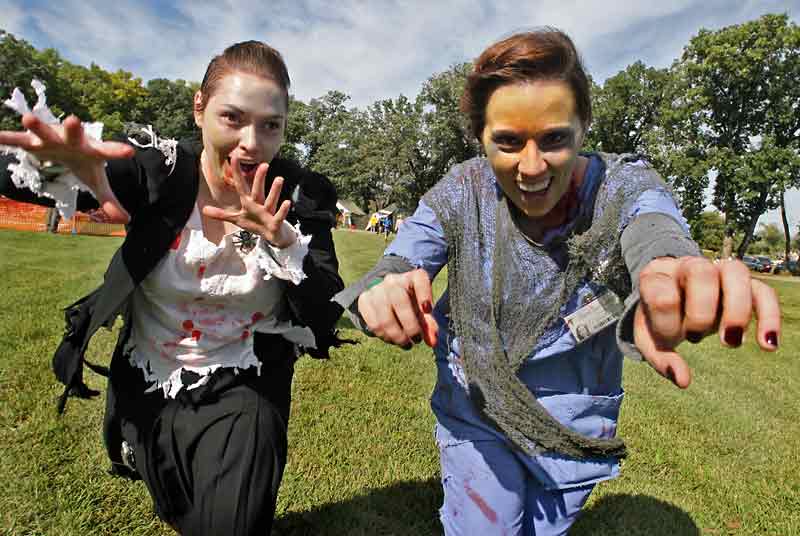
But what about a real shambling horde of real monsters? What if the zombie apocalypse hit Brandon?
Sure, it’s unlikely — very unlikely — that something along the lines of “The Walking Dead” or “World War Z” could ever happen here (or at all) but some local experts say it’s not a bad idea to be prepared.
“The zombie threat is just one of the risks (faced by the city),” says Brian Kayes, although his tongue is more than a little in his cheek.
Kayes, the city’s director of risk and emergency management, says that while Brandon doesn’t prepare specifically for a zombie attack, neither does it prepare for hurricanes. However, long-standing city plans for other emergencies could be applicable if any unforseen disaster happens.
“The basic plan is to establish an Emergency Response Control Group” that would meet in an Emergency Operations Centre, Kayes said.
After bringing together the right people to look at the situation, they would then decide on a course of action.
“If the zombies started climbing out of the cemetery, is this really a police event?” Kayes speculated.
That’s indeed how the undead were tackled in 1968’s “Night of the Living Dead,” the first true zombie film.
But if the emergency escalated, the city might have to contact the provincial Emergency Measures Organization — and from there, the feds.
Despite CFB Shilo being just down the road, “we don’t phone the military, we call the province,” Kayes said.
Jack Lindsay, an associate professor in Applied Disaster and Emergency Studies at Brandon University, agrees that planning for a zombie apocalypse can be prudent.
“A lot of the preparation we do is aimed at a lot of different hazards,” he said, meaning that if someone is ready for zombies, they’re also pretty well set for more common emergencies, like a blackout or an evacuation.
“We’re asking the public to make some very basic preparations,” Lindsay said, including keeping a stockpile of food, as well as other necessities like candles, a first aid kit and breathing masks.
Masks can be worn by healthy people (to keep them from getting sick), or by sick people (to keep them from infecting others),” Lindsay said. They’re also useful in the case of a tornado or fire, which could fill the air with dust or smoke.
Keeping food in the cupboard is also a good idea.
“A full pantry will serve you well” during any emergency, he said.
A packed bag, with seasonally appropriate clothing as well as toiletries and any medication ready to go, was another piece of advice he gave.
The City of Brandon provides detailed planning lists online at emerg.brandon.ca for people who want to make sure that their bag is ready — whether for a flood-related evacuation, or to flee the zombie hordes.
There are also pages devoted to specific plans, including how to deal with floods, flu, poor weather or widespread power outages, especially in winter. Lengthy winter blackouts were a concern that Kayes said was looked at during preparations for Y2K, in the leadup to the year 2000.
Some parts of some of those plans might even come into play, should the dead ever actually begin to devour the living.
“We have a well-developed pandemic plan,” Kayes says. “It was activated a couple of years ago for influenza.”
Lindsay added that a flu along the lines of the 1918 Spanish flu could end up with some of the same side effects that are portrayed in zombie fiction. Between three and five per cent of the world’s population was killed in that flu epidemic — up to 100 million people, by some estimates, including about 50,000 in Canada.
“When we start losing a lot of people — not necessarily dying, but too sick to work — we could see some social breakdown,” Lindsay said. “It is a handful of people who keep society running.”
In an emergency, the city plans to keep its workers healthy and safe so that they can keep civic infrastructure — and society — running.
“At what time do we suspend bus service? How do we get people safely home?” Kayes asked. “What are the key critical services that we must maintain?”
One concern would be clean water, he said.
“We have a plan to actually shelter the water treatment plant. We would have workers stay and live at the water treatment plant.”
It wouldn’t be The Ritz, he said — basically some cots wedged in — but it would keep clean water running through the city.
“If we don’t have a couple of people who know what they’re doing, we can’t make water.”
Some of the toughest parts of emergency response might come in the days or weeks following the initial crisis — something familiar to any fan of the zombie genre.
“Long-term recovery is something you don’t always see (in hazard preparation),” Lindsay said, although it’s more and more a focus of his classes.
A 2011 earthquake in Christchurch, New Zealand, was so damaging that 70 per cent of the buildings downtown had to be demolished, he said.
“If it’s foaming-at-the-mouth zombies or an F5 tornado, you could be looking at years of reconstruction.”
The idea of using a fictional zombie attack to urge preparation for a real emergency was pioneered in 2011 by the U.S. Centre For Disease Control and proved so popular that it crashed their website.
Kayes said that the City of Brandon had considered a similar strategy but thought it might be too risky.
“There’s a fine line between humour and people not understanding,” he said.
Lindsay, too, said that the fictional zombie attack scenario wasn’t one that he had used with his students. That might change, however. A new course has recently been approved at Brandon University, and Lindsay hopes he’ll be able to teach it next fall.
Called “Disaster Film: Fact or Fiction,” the course will examine Hollywood’s take on disasters — zombies possibly included.
“Hollywood doesn’t do a very good job of portraying diasters,” he said. “They spread a lot of myths.”
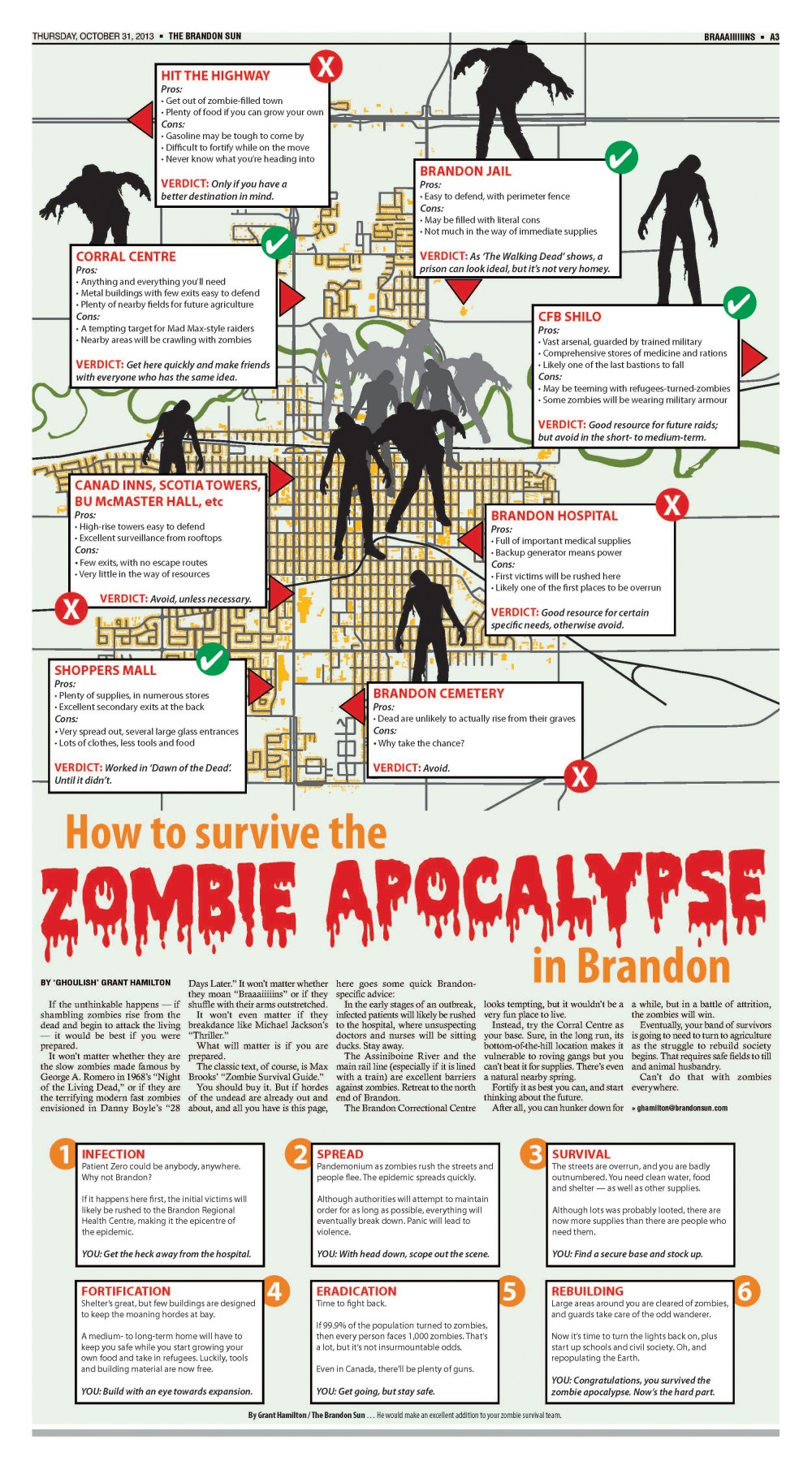
Zombie survival map
Download a PDF of ‘How to Survive the Zombie Apocalypse in Brandon‘.
More-likely disasters
While zombies caused by alien radiation, toxic waste or a genetically engineered disease can’t be entirely ruled out, the City of Brandon is much more likely to be faced with more mundane emergencies.
Both Brian Kayes, the city’s director of risk and emergency management, and Jack Lindsay, an associate professor in Applied Disaster and Emergency Studies at Brandon University, say that the following disasters are the ones we should be most prepared for:
- Summer storms — including tornadoes, hail and downburst winds.
- Spring flooding — which the city is increasingly better able to deal with.
- Winter storms — it slows or stops emergency response.
- Hazardous chemical spill — luckily, local companies are very proactive in staying safe.
- Pandemics — they are relatively common, every 15 or so years.
In most of these, Lindsay quips, “You’ll need fewer chainsaws than in the zombie apocalypse.”
What do to in an emergency
First, be prepared.
“People need to have a basic emergency plan,” Kayes says.
You should have two meeting places, in case something happens, he advises. One should be near your home, in case of a fire or something similar; the other should be outside of the neighbourhood, in case there is a wider evacuation. This helps family members locate everybody.
There should also be a family contact outside of the city, a single person who can be called if someone can’t make the meeting.
“That’s the biggest stressor,” Kayes says.
There are also detailed lists to prepare a family supply kit — including food, clothing, personal items and equipment — on the city’s emergency preparedness site at emerg.brandon.ca.
If Brandon’s emergency sirens sound (so far, they’ve never needed to be used in an actual emergency), Kayes says people should go inside and tune to a local radio station, to which emergency workers have a direct connection.
Online updates will also be provided, and the latest news will also be covered by the Brandon Sun.
» Brandon Sun
Historic Halloween weather
See also the Brandon Sun analysis of more than 120 years of Halloween weather.
When was the best year for trick-or-treating? The worst? The slushiest?
Related Articles
MAP: How to survive the zombie apocalypse in Brandon
Advertisement Advertise With Us
Advertisement Advertise With Us