
Growing season longer: stats
New choices for crops, but more variability
Advertisement
Read this article for free:
or
Already have an account? Log in here »
We need your support!
Local journalism needs your support!
As we navigate through unprecedented times, our journalists are working harder than ever to bring you the latest local updates to keep you safe and informed.
Now, more than ever, we need your support.
Starting at $15.99 plus taxes every four weeks you can access your Brandon Sun online and full access to all content as it appears on our website.
Subscribe Nowor call circulation directly at (204) 727-0527.
Your pledge helps to ensure we provide the news that matters most to your community!
To continue reading, please subscribe:
Add Brandon Sun access to your Free Press subscription for only an additional
$1 for the first 4 weeks*
*Your next subscription payment will increase by $1.00 and you will be charged $20.00 plus GST for four weeks. After four weeks, your payment will increase to $24.00 plus GST every four weeks.
Read unlimited articles for free today:
or
Already have an account? Log in here »
Hey there, time traveller!
This article was published 17/01/2014 (4377 days ago), so information in it may no longer be current.
You wouldn’t know it to look outside, but the growing season in Manitoba is getting longer.
The number of frost-free days across the Prairies has extended by at least two weeks on average in the last century, and possibly as much as three weeks as part of global warming, says Paul Bullock, a University of Manitoba agrometeorologist.
The longer growing season is providing farmers the option of growing a more diverse mix of crops, said Bullock.

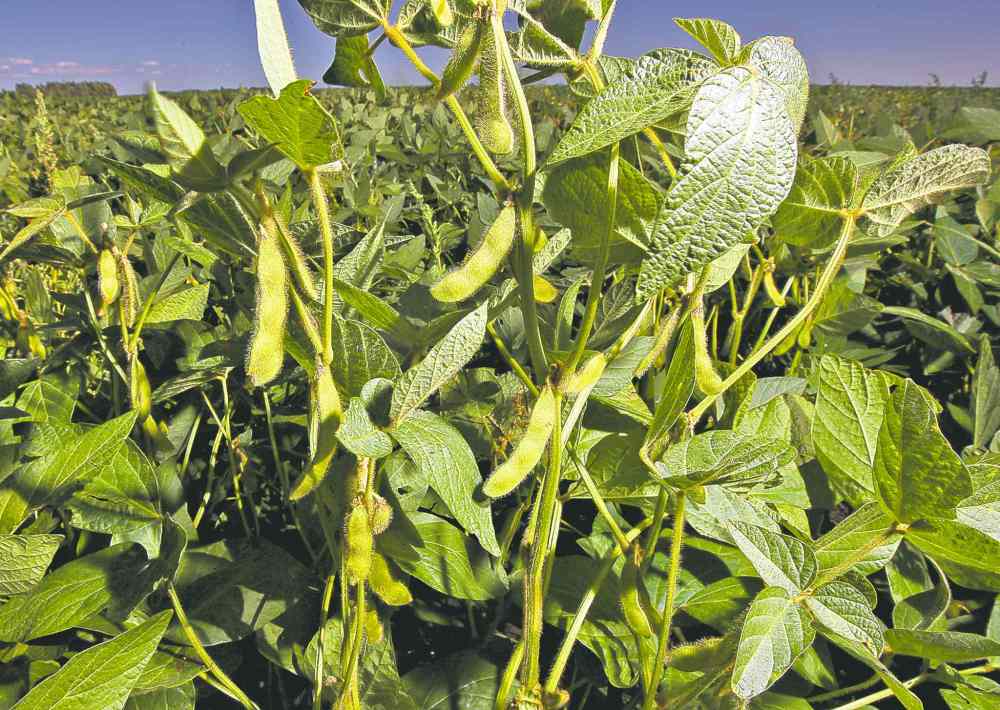
That seems to be borne out by the spread into Manitoba of corn and soybean crops, which take longer to mature. Manitoba farmers are expected to see a record 1.2 million acres of soybeans this year, thanks to a friendlier climate and the breeding of earlier-maturing varieties.
Bullock made a presentation on climate change at the Manitoba Agronomist Conference last month.
In an interview, he cited a study by Agriculture Canada agrometeorologist Herb Cutforth, published in 2004, that found the growing season had lengthened by 12 days on the Prairies between 1940 to 1997. The warming trend has continued since then.
A more recent study in North Dakota, by John Nowatzki at North Dakota State University, found the growing season in Langdon, about 30 kilometres south of the Manitoba border, has lengthened by 21 days from 1900 to 2010. Bullock said the North Dakota data are consistent with trends documented in Western Canada.
That may seem like a rosy picture, but Bullock warned that weather variability seems to have become greater than ever, too. Manitoba can experience 130 frost-free days one year and just 85 days the next, he said. An example was 2004 when Manitoba’s entire corn crop was wiped out due to early frost.
Another variable is flooding, which has replaced drought as the prime reason for crop losses in the last decade. There are more big precipitation events today than a century ago, Bullock said.
c_
He also warned that not all locations are showing longer growing seasons. In a study of a dozen weather stations across the Prairies, the growing season increased at most stations but also fell at three of them.
“When dealing with weather conditions, it’s messy. You don’t get a consistent trend,” he said.
Climate change has seen daily low temperatures increase faster than the daily highs, allowing for more frost-free days, said Bullock, citing a study by Lucie Vincent of Environment Canada.
Vincent’s study of climate records on the Prairies from 1900 to 2010 found while daily maximum temperatures have increased an average of one degree Celsius, the daily minimum temperature increased by 2.1 degrees.
As well, the study found most of the temperature change was in winter and spring. The study also found most of the change occurred in the last 30 years.
Bullock said while warmer conditions are generally positive for crop production in Manitoba’s climate, it could also invite new problems. For example, the cold does provide Western Canada with some pest control and can slow or stop the spread of some weeds and pathogens, he said.
An official with Weather Innovations Consulting, which provides weather monitoring and modelling services, also urged caution.
“We’re definitely seeing trends, as we’d expect with climate change: warmer weather, higher temperatures, longer growing seasons. On average, we are seeing that, but there seems to be some variability,” said Andy Nadler, operations manager for Western Canada.
bill.redekop@freepress.mb.ca