
Rural ambulances struggling to meet response-time marks
Advertisement
Read this article for free:
or
Already have an account? Log in here »
We need your support!
Local journalism needs your support!
As we navigate through unprecedented times, our journalists are working harder than ever to bring you the latest local updates to keep you safe and informed.
Now, more than ever, we need your support.
Starting at $15.99 plus taxes every four weeks you can access your Brandon Sun online and full access to all content as it appears on our website.
Subscribe Nowor call circulation directly at (204) 727-0527.
Your pledge helps to ensure we provide the news that matters most to your community!
To continue reading, please subscribe:
Add Brandon Sun access to your Free Press subscription for only an additional
$1 for the first 4 weeks*
- Enjoy unlimited reading on brandonsun.com
- Read the Brandon Sun E-Edition, our digital replica newspaper
*Your next Free Press subscription payment will increase by $1.00 and you will be charged $20.95 plus GST for four weeks. After four weeks, your payment will increase to $24.95 plus GST every four weeks.
Read unlimited articles for free today:
or
Already have an account? Log in here »
Hey there, time traveller!
This article was published 18/01/2014 (4507 days ago), so information in it may no longer be current.
Nearly half of Westman’s rural ambulances don’t meet provincial response-time benchmarks when going to an emergency.
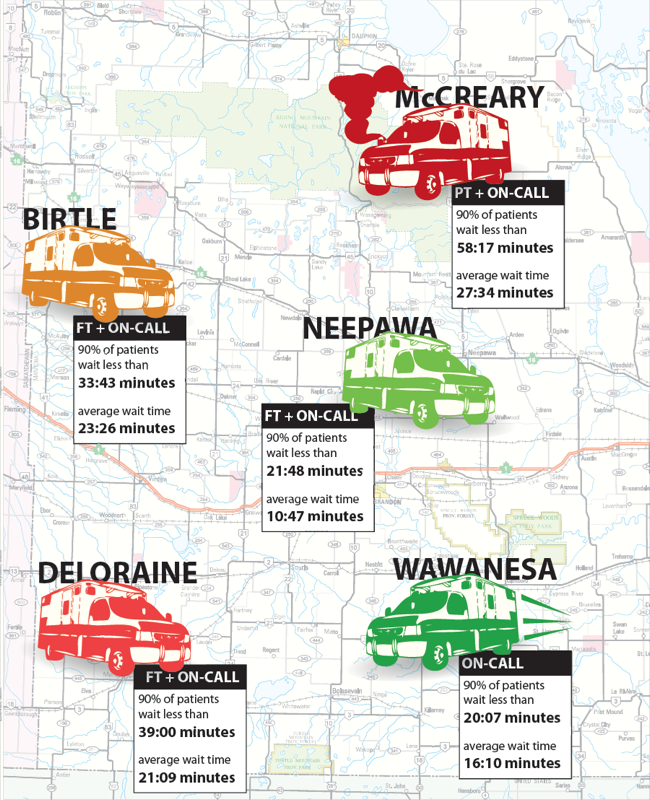
According to information obtained through a Freedom of Information and Protection of Privacy Act request made to Manitoba Health by the Brandon Sun, of the 31 rural emergency medical services (EMS) stations in Westman, 15 don’t meet the provincial guideline which provides a 30-minute window from the time the call comes in to the time the ambulance reaches the patient.
The wait time numbers examine EMS stations during a one-year period ending in March 2013.
Gerry Delorme, executive director of health emergency management with Manitoba Health, conceded some of the response times are too long.
“We want a response time benchmark of 30 minutes (90 per cent of the time), so how do we have to change the system to get that response time benchmark because those numbers are high?” Delorme asked.
Delorme is charged with implementing recommendations from a large-scale review of the EMS system in the province that was released last year.
While some communities — such as Neepawa (21:48), Wawanesa (20:07) and Hartney (22:00) — have strong 90th percentile wait times that are well below the provincial benchmark, other communities — such as McCreary (58:17), Hamiota (46:53) and Souris (41:24) — are well above the benchmark.
The 90th percentile numbers show how long it would take an ambulance to reach a patient from that station 90 per cent of the time.
Delorme said looking strictly at the numbers isn’t always comparing apples to apples.
Geographical size, roadway accessibility and how the stations are staffed are just a few of the variables that affect wait times across Westman.
“There are things that affect the times that we don’t take into account and one is weather, which drives our response times up at this time of year,” Delorme said. “In the areas where we have full-time staffing, we have lower chute times, which means people are out the door quicker.”
Chute times are the time it takes from when the call comes in to 911 to when the ambulance leaves the station. With full-time staff, the target chute time is 90 seconds or less. However, with casual on-call staff (often referred to as volunteer) that target swells to between six to 10 minutes.
In Brandon, where ambulances are staffed by full-time paramedics from the city’s fire halls, chute and response times are lower. The two fire halls check in at 9:53 minutes and 11:45 minutes, respectively —over the provincial guideline of nine minutes for urban centres.
The third Brandon time (22:53 minutes) is believed to be Shilo, according to a spokesperson from Prairie Mountain Health.
Casual staff, on the other hand, typically have day jobs in the community and are called in to respond to emergencies. That drives up chute times and subsequently response times. Chute times can top 20 minutes in some cases.
Delorme said there are times when the first attendant gets to the station almost immediately, but has to wait on a second ambulance attendant, meaning the ambulance is idling, ready to go, but is stalled, adding valuable minutes to the chute time.
“The volunteers are very committed to their community and doing the best that they can, but we have to move away from the paid on-call systems to more full-time workforce,” Delorme said. “If you change that to 90 seconds, it changes the service area dramatically and it changes the response times dramatically in those areas.”
The review suggested closing 18 EMS stations across Manitoba, with 11 of those closures coming in the Prairie Mountain Health region.
While the number of stations could be reduced, Delorme said if all the stations were staffed full-time it would create a system where the benchmarks were being met on a more consistent basis.
Another advantage to less stations with a full-time workforce is that ambulance attendants would get more calls, increasing their proficiency delivering front-line services.
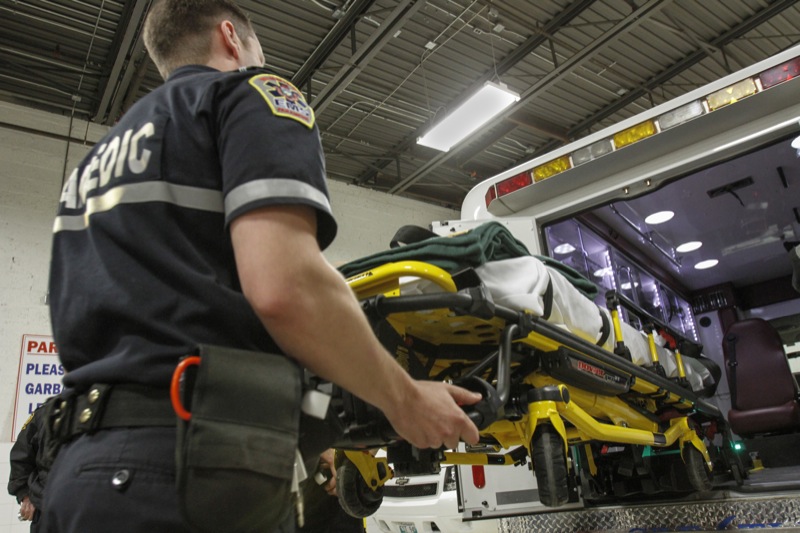
“It doesn’t matter how fast we drive, it matters about the care we deliver to your doorstep,” Delorme said.
Better public accounting and reporting is also critical, according to Delorme. He wants wait time information in the public’s hands quickly, adding that much of that information supports the review’s recommendations.
However, two community EMS co-ordinators contacted by the Brandon Sun said they are instructed not to speak to media about ambulance service.
A task force within Manitoba Health is looking at how the review’s recommendations should be implemented, although it could take more than a decade for some of the initiatives.
Delorme said they have taken a “blank slate” approach, looking at call volumes and service needs to determine the best places to establish stations with a full-time workforce.
Eliminating some stations isn’t a “solution” that sits well with RM of Roblin Reeve Tom Mowbray.
He said the union that represents paramedics has made it progressively harder for rural areas to staff stations.
“As long as we have a local ambulance it will be better for us,” he said. “The union is pushing the limits (on what training) you need to drive an ambulance. We have a lot of people that would drive, but don’t necessarily want to be the responder, but you can’t do that now … If they just want to drive, what difference does it make?”
Mowbray believes the “one size fits all” argument doesn’t work in many areas of Manitoba.
“There’s been a few people fight against it and I assume we will have to fight again,” he said. “It’s great on paper, but there is a reality here to make these things work. You’re never going to be able to train people to know where (so-and-so) lives, but the local guys all know.
“I still believe I would have someone there quicker and be alive than have a fully trained paramedic take 30 minutes and I’m dead.”
Mowbray also has a problem with cellphone coverage provided near Cartwright.
“We’ve had people see an accident and they’re used to picking up their cell and dialing 911 and they get nothing,” he said. “I believe that some day there is going to be a fatal accident because of it.”
» ctweed@brandonsun.com