
Pipeline failures relatively rare here
Advertisement
Read this article for free:
or
Already have an account? Log in here »
We need your support!
Local journalism needs your support!
As we navigate through unprecedented times, our journalists are working harder than ever to bring you the latest local updates to keep you safe and informed.
Now, more than ever, we need your support.
Starting at $15.99 plus taxes every four weeks you can access your Brandon Sun online and full access to all content as it appears on our website.
Subscribe Nowor call circulation directly at (204) 727-0527.
Your pledge helps to ensure we provide the news that matters most to your community!
To continue reading, please subscribe:
Add Brandon Sun access to your Free Press subscription for only an additional
$1 for the first 4 weeks*
*Your next subscription payment will increase by $1.00 and you will be charged $20.00 plus GST for four weeks. After four weeks, your payment will increase to $24.00 plus GST every four weeks.
Read unlimited articles for free today:
or
Already have an account? Log in here »
Hey there, time traveller!
This article was published 27/01/2014 (4452 days ago), so information in it may no longer be current.
THE fireball in the sky near Otterburne has heightened awareness of the potential impact of natural gas pipeline failures.
These incidents, however, are relatively uncommon in Manitoba. This weekend’s explosion in the Red River Valley is the first incident of its kind in this province since 2002, when the western Manitoba village of Brookdale was evacuated for one day following a TransCanada pipeline rupture.
Including the Otterburne incident, now in the early stage of a Transportation Safety Board investigation, a total of four gas explosions have rocked the province over the past two decades.
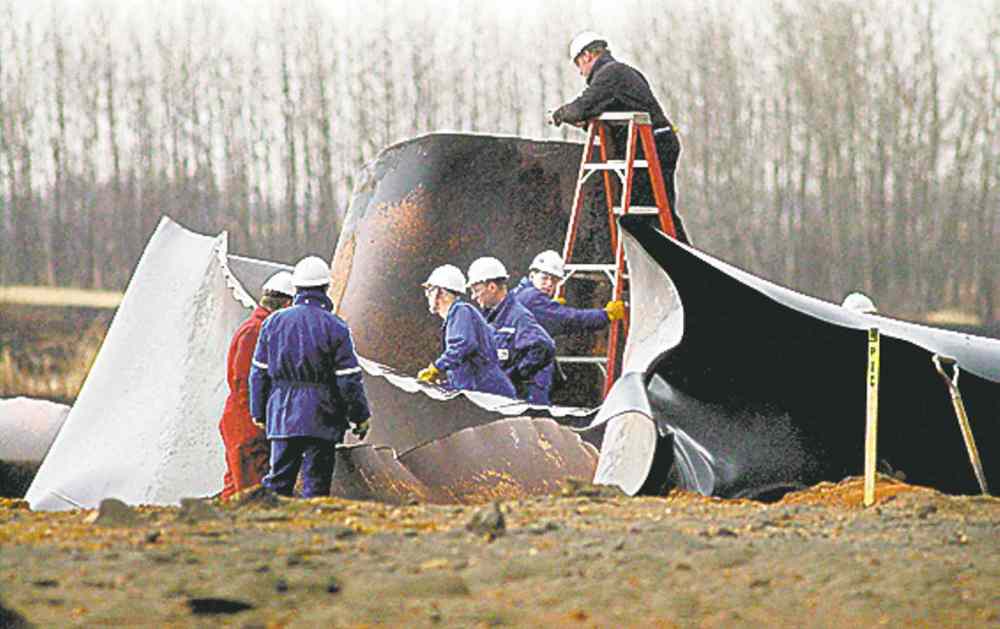
Here’s what happened in the other three incidents — and what wound up being the cause, according to TSB investigations:
1. Rapid City
July 29, 1995
At 5:42 a.m., a TransCanada Pipelines gas line ruptured and caught fire near Rapid City, north of Brandon. The heat led a second, adjacent gas pipe to rupture and catch fire and also damaged a third line.
The incident left behind a crater that was 51 metres wide and five metres deep. One TransCanada employee suffered minor cuts and bruises.
An investigation into the explosion revealed the first rupture was caused by stress corrosion cracking, which involves the slow growth of small cracks in an environment capable of corroding a pipe. The second rupture was partly the result of a delay in shutting down the flow of gas to the first pipe.
In the wake of the accident, TransCanada accelerated its pipeline inspections and testing in Western Canada, while the National Energy Board launched an investigation into stress corrosion cracking.
The Transportation Safety Board also warned standards governing how close two pipelines may be placed might not be good enough.
2. St. Norbert
April 15, 1996
At 6:15 p.m., a geyser of water and mud rocketed up from the La Salle River near Winnipeg’s southernmost neighbourhood, at a spot where a TransCanada gas pipeline crosses the river. Fourteen minutes later, the escaping natural gas caught fire, creating a fireball that destroyed a home 178 metres away, as well as hydro lines and trees on both sides of the river. The explosion also left a 13.5-metre-wide crater on the bottom of the river.
Amazingly, nobody was injured.
The investigation into the accident found a shift in the river slope led the pipe to move and stress out a crack in the pipe that may have been present since the pipeline was laid in 1962. The action of the external force is known as “environmental assisted cracking.”
After the investigation, TransCanada examined all its pipelines for evidence of shifting on the slopes of riverbanks.
3. Brookdale
April 14, 2002
At 11 p.m., a TransCanada gas pipeline ruptured, exploded and caught fire two kilometres west of the village of Brookdale, northeast of Brandon. The explosion created two craters — one at each end of the ruptured section of pipe — and burned until 2:30 a.m. the following morning.
About 100 people were evacuated within a four-kilometre radius of the blast, but there were no injuries.
Just like in the case of the Rapid City blast, stress corrosion cracking was found to be the culprit for the explosion. But this was unusual because this particular pipe was coated with asphalt and was buried in non-corrosive soil.
The investigation found the combination of the pipe’s coating separating from the surface, a fluctuating water table, the presence of anaerobic bacteria and other factors all combined to create a corrosive environment.
After the incident, TransCanada retested pipelines, conducted excavation tests and took other measures aimed at searching for stress corrosion cracking.
bartley.kives@freepress.mb.ca
Related Articles
Natural gas flowing to some communities
Advertisement Advertise With Us
Advertisement Advertise With Us