
Spring’s a buzz kill for area beekeepers
Advertisement
Read this article for free:
or
Already have an account? Log in here »
We need your support!
Local journalism needs your support!
As we navigate through unprecedented times, our journalists are working harder than ever to bring you the latest local updates to keep you safe and informed.
Now, more than ever, we need your support.
Starting at $15.99 plus taxes every four weeks you can access your Brandon Sun online and full access to all content as it appears on our website.
Subscribe Nowor call circulation directly at (204) 727-0527.
Your pledge helps to ensure we provide the news that matters most to your community!
To continue reading, please subscribe:
Add Brandon Sun access to your Free Press subscription for only an additional
$1 for the first 4 weeks*
- Enjoy unlimited reading on brandonsun.com
- Read the Brandon Sun E-Edition, our digital replica newspaper
*Your next Free Press subscription payment will increase by $1.00 and you will be charged $20.95 plus GST for four weeks. After four weeks, your payment will increase to $24.95 plus GST every four weeks.
Read unlimited articles for free today:
or
Already have an account? Log in here »
Hey there, time traveller!
This article was published 15/05/2014 (4501 days ago), so information in it may no longer be current.
Brandon-area beekeepers say hives are about two to three weeks behind schedule due to the extended period of cool weather this spring.
However, while the below-average temperatures have likely shortened the season for honey producers, they have also kept grain and canola farmers off the fields for spring planting.
“Fortunately (for us) there’s no seeding happening,” Rivercrest Honey Farm owner Will Clark said yesterday. “That means canola will also be late, and our main honey flow is from canola. In the big picture, we’ll probably be OK.”
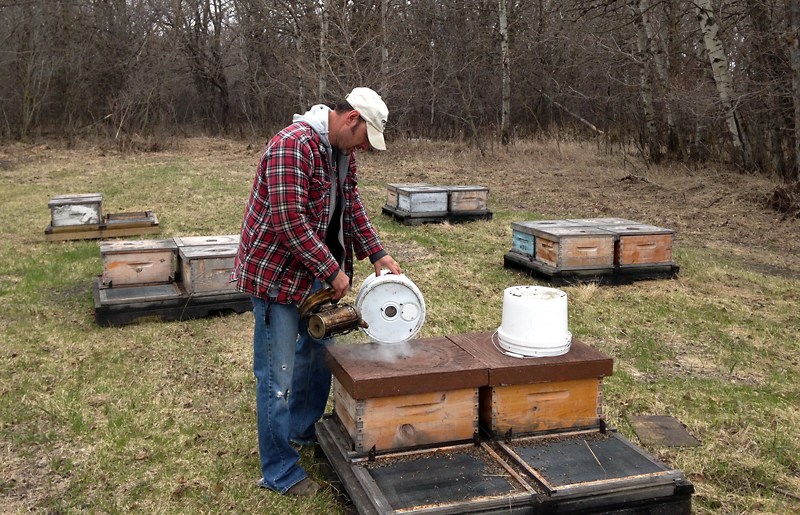
Environment Canada predicted last month that most of the Prairies, including southern Manitoba, would experience below normal temperatures well into May. The mercury hit 10.1 C on May 13, eight degrees below the average temperatures reported for that date.
“The bees need warm weather,” Clark said. “We don’t even have normal. Even 15 C would help, and we’re not close to that.”
Though the cool weather is hampering bee hive development, local beekeepers say this spring is not as bad as last spring, when many producers sustained major bee losses and had to rebuild their stock.
Clark says he has not heard of any major bee die-offs this year, but cool May weather forced him to provide extra feed for his bees, as the trees and flowers have yet to create nectar.
“It’s been really hard on them,” Clark said. “It takes extra feeding. All we can do right now is make sure they don’t starve.”
Bill Bygarski, who operates a honey farm southwest of Brandon, says his bee stock weathered the winter pretty well.
“Most have come through in fairly good condition this year,” he said.
Following the 2012-13 winter, Bygarski was hit with a 27 per cent loss, due to an early winter and a late spring season.
“The problem last year was that the bees didn’t come through winter as well,” Bygarski said.
And while his bee stock came through winter “fairly successfully,” the cool spring is certainly not welcome.
“A later crop tends to be a smaller crop. There’s always that concern. But I can’t control the weather.”
Bygarski, who also keeps hives near Riding Mountain National Park, west of Sandy Lake, says this kind of spring could spell bear trouble for his bees.
On a year like this, he says, bear forage is meagre, so they destroy the hive trying to get at the insects inside.
“They’ll knock hives over and tear frames apart. It’s a misconception that bears eat honey. They’re after the larva and the bees. They’ll completely wreck hives.”
» mgoerzen@brandonsun.com