
Global production
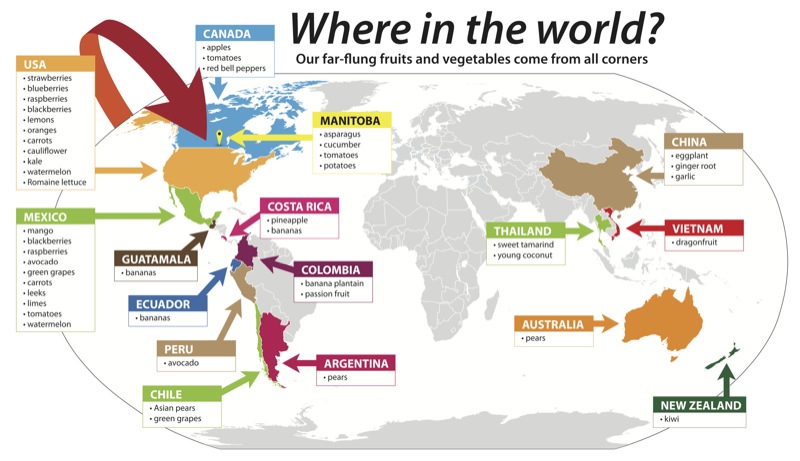
Our far flung fruits and vegetables come from all corners
Advertisement
Read this article for free:
or
Already have an account? Log in here »
We need your support!
Local journalism needs your support!
As we navigate through unprecedented times, our journalists are working harder than ever to bring you the latest local updates to keep you safe and informed.
Now, more than ever, we need your support.
Starting at $15.99 plus taxes every four weeks you can access your Brandon Sun online and full access to all content as it appears on our website.
Subscribe Nowor call circulation directly at (204) 727-0527.
Your pledge helps to ensure we provide the news that matters most to your community!
To continue reading, please subscribe:
Add Brandon Sun access to your Free Press subscription for only an additional
$1 for the first 4 weeks*
*Your next subscription payment will increase by $1.00 and you will be charged $20.00 plus GST for four weeks. After four weeks, your payment will increase to $24.00 plus GST every four weeks.
Read unlimited articles for free today:
or
Already have an account? Log in here »
Hey there, time traveller!
This article was published 14/06/2014 (4339 days ago), so information in it may no longer be current.
New Zealand kiwis, avocados from Peru, Chilean grapes and Vietnam dragonfruit.
Produce travels from around the globe before it lands on the supermarket display here in Brandon and ultimately, our plates.
Are these items still healthy after they’ve been shipped thousands of kilometres?
Rick Holley, professor of food microbiology and food safety at the University of Manitoba, said it’s all about how the food is transported and if it is temperature controlled.
“I don’t think travelling from continent to continent really matters all that much if transportation standards are established,” he said. “What does matter though, is time from harvest.”
The retention of some nutrients is affected as time goes on, particularly vitamin C.
“With kale or broccoli, you can certainly see significant changes in ascorbic acid content at room temperature after harvest,” Holley said.
If transportation takes place at 4 C, which is where refrigerators should run normally, then there is less of an effect.
“So you could get broccoli … from the Fraser Valley (in British Columbia) that had been stored improperly that had lower vitamin C content than broccoli that came from Chile, for example, that had been stored at four degrees,” he said.
Nutrient degradation can also happen with vitamins A and B if produce sits for too long at a higher temperature.
In addition to temperature controls, there are other techniques to keep some fruits looking fresh longer. Holley said one technique is modified atmosphere for long-term storage of apples — high concentrations of nitrogen and reduced concentrates of oxygen. Adding a wax to apples and using dyes in oranges are also common, he said.
Here in Brandon’s grocery stores, Mexico is a common origin for many fruits, including grapes, limes, blackberries, raspberries and watermelon. California is common for oranges, lemons, various berries, kale, lettuce and carrots.
Some of the more exotic countries of origin for produce sold in Brandon include Colombia (passionfruit), Thailand (coconut), Ecuador (bananas) and Costa Rica (pineapple, bananas).
Canadian produce is becoming more common (bell peppers, tomatoes, kale) as the summer season begins. Some Manitoba-grown veggies are already on the shelves, including asparagus, potatoes, tomatoes and cucumber.
Many fruits, like tomatoes, bananas and pineapples are shipped in an immature state so they ripen when they get to their destination.
“These will have to be transported while they’re still green,” said Michael Eskin, professor in the department of human nutritional sciences at the University of Manitoba. “They can be ripened as required once they reach the shore.”
Eskin said the concern he has about produce shipped from around the globe is the agronomic conditions under which the crops are grown.
“Are they using pesticides no longer permissible in Canada?” he asked. “To what extent is the capacity of the Canadian Food Inspection Agency, to their availability to check everything that comes from abroad?”
Eskin said the consumer assumes everything sold in the supermarket has been duly inspected, but “that is definitely not the case.”
When it comes to pesticides, Holley says the levels of detectible residues on grocery store produce are generally very low.
“Those levels of detectable residues are anywhere from a thousand to ten thousand-fold less than those levels which could possibly have a long-term health effect in humans,” he said.
In recent years, there has been more of a push to “eat local,” one of the goals of Food Matters Manitoba, a registered charity with a mission to engage Manitobans toward healthy, fair, sustainable food.
Executive director Kreesta Doucette said there is a variety of reasons to eat food grown close to home.
“Eating locally is one way for people to be more conscious of the foods that are going in their bodies,” she said. “Another reason is economics … We know that when you spend money supporting our local families, that keeps money in our communities.”
If you shop at local farmers markets, Doucette said you know produce is as fresh as you can get.
“When it’s in season, that’s a great option. It doesn’t make sense to be buying lettuce from California in the summer when you can buy Manitoba lettuce here,” she said. “I think that really, for not just the health reasons, but for the economic reasons, buying local in season is a really great first step for people.”
Eskin agrees eating local is good from two perspectives — the local economy and the fact it is not being transported through long distances.
“There’s nothing better than fresh,” he said. “There’s a real advantage in terms of taste and probably in nutrients because you’re not transporting, you’re not using … undesirable pesticides or other related products.”
Eskin said consumers need to be better informed of what they are eating.
“You spend hours researching when you want to buy a computer or iPad … going through different models, prices,” he said. “When you buy a can of food, that you take inside your body, do you ever bother to read the label?”
» jaustin@brandonsun.com
» Twitter: @jillianaustin