
Railway says it’s full steam ahead
CN hopes to avoid grain shipping crisis
Advertisement
Read this article for free:
or
Already have an account? Log in here »
We need your support!
Local journalism needs your support!
As we navigate through unprecedented times, our journalists are working harder than ever to bring you the latest local updates to keep you safe and informed.
Now, more than ever, we need your support.
Starting at $15.99 plus taxes every four weeks you can access your Brandon Sun online and full access to all content as it appears on our website.
Subscribe Nowor call circulation directly at (204) 727-0527.
Your pledge helps to ensure we provide the news that matters most to your community!
To continue reading, please subscribe:
Add Brandon Sun access to your Free Press subscription for only an additional
$1 for the first 4 weeks*
- Enjoy unlimited reading on brandonsun.com
- Read the Brandon Sun E-Edition, our digital replica newspaper
*Your next Free Press subscription payment will increase by $1.00 and you will be charged $20.95 plus GST for four weeks. After four weeks, your payment will increase to $24.95 plus GST every four weeks.
Read unlimited articles for free today:
or
Already have an account? Log in here »
Hey there, time traveller!
This article was published 04/12/2014 (4291 days ago), so information in it may no longer be current.
CANADA’S largest railway — CN Rail — has added locomotives, hopper cars and workers in the wake of last winter’s grain transportation crisis, a senior company official said Wednesday.
Jean-Jacques Ruest, CN’s executive vice-president of sales and marketing, told delegates attending the 19th annual Fields on Wheels conference in Winnipeg the railway purchased 60 new locomotives this year and plans to buy another 60 in 2015. That’s on top of the 44 new ones and 37 second-hand ones it purchased in 2013.
It also hired about 3,900 new employees this year, Ruest said, and has added another 1,000 grain cars to its fleet since last fall.
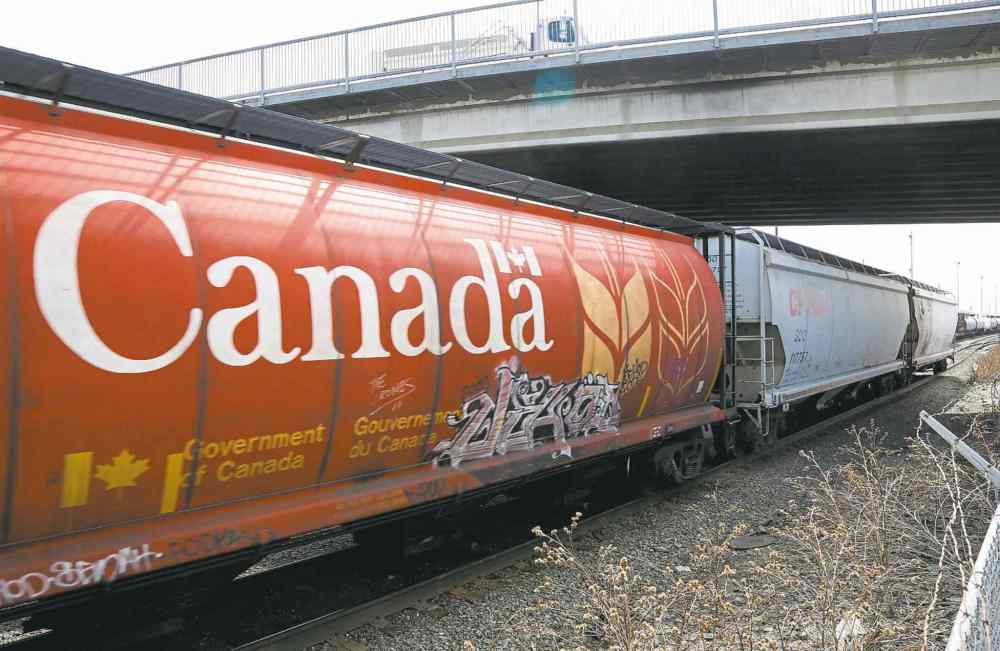
But whether that will be enough to avoid a repeat of last year’s transportation crisis is unknown, Ruest added. That will be mainly determined by whether Western Canada experiences another brutally cold winter.
“Hopefully, this winter won’t be as bad as last winter,” he added.
Unseasonably cold weather and a record harvest in 2013 overwhelmed grain transportation last winter. Not only did the cold, snowy conditions slow down train movements, the railways also had to resort to running shorter trains.
And even though Ruest said CN still moved a record amount of grain in the 2013-14 crop year, there were still huge delays in getting grain to port because of the sheer volume that had to be moved.
One thing working in the railway’s favour this time around is that it was a smaller crop this year, which means less grain to move. But there’s also leftover grain from last year that still has to be moved, Ruest said, which means the railways will be operating at full capacity this year.
Ruest said CN estimates it has enough capacity to handle its share of this year’s crop, plus more of the leftover grain from last year. So if the weather co-operates, things should be back to normal by next spring, he said, with capacity once again exceeding the amount of grain that needs to be shipped.
Ruest also outlined several other measures CN has taken to help speed up grain movements.
One is to offer additional incentives to grain companies to lease more hopper cars on their own and use them to move grain over CN’s network.
Ruest said about 35 per cent of the grain CN expects to move this year will be through this kind of arrangement, which it refers to as its commercial-fleet-integration program.
And the railway would like to see that number increase to 50 to 60 per cent by late next year, he added.
Another is to load more specialty crops into shipping containers at its intermodal terminal in Saskatoon and ship the containers on flatbed cars to Vancouver, rather than shipping the crops by hopper car and transferring them to shipping containers after they arrive at the port. That will speed up loading at the port and free up more hopper cars to use for shipping grain.
Keystone Agricultural Producers president Doug Chorney told Ruest he was encouraged by some of the steps CN has taken.
“While we still have lots of challenges ahead, you’re moving in the right direction.”
Chorney said in a later interview that although most of Manitoba’s crop from last year has been moved to market, there’s lots of grain from this year that still needs to be shipped.
He also said the long-range weather forecast for this winter doesn’t sound promising.
“We’re off to a cold start and there are a lot of experts predicting we’re going to have another severe winter. If that happens again, it will have (negative) impacts, no doubt about it,” Chorney said.
murray.mcneill@freepress.mb.ca