
Breakthrough eye surgery ‘an amazing change’
Advertisement
Read this article for free:
or
Already have an account? Log in here »
We need your support!
Local journalism needs your support!
As we navigate through unprecedented times, our journalists are working harder than ever to bring you the latest local updates to keep you safe and informed.
Now, more than ever, we need your support.
Starting at $15.99 plus taxes every four weeks you can access your Brandon Sun online and full access to all content as it appears on our website.
Subscribe Nowor call circulation directly at (204) 727-0527.
Your pledge helps to ensure we provide the news that matters most to your community!
To continue reading, please subscribe:
Add Brandon Sun access to your Free Press subscription for only an additional
$1 for the first 4 weeks*
- Enjoy unlimited reading on brandonsun.com
- Read the Brandon Sun E-Edition, our digital replica newspaper
*Your next Free Press subscription payment will increase by $1.00 and you will be charged $20.95 plus GST for four weeks. After four weeks, your payment will increase to $24.95 plus GST every four weeks.
Read unlimited articles for free today:
or
Already have an account? Log in here »
Hey there, time traveller!
This article was published 03/01/2015 (4144 days ago), so information in it may no longer be current.
Just days after eye surgery, Marie Janz is already experiencing significant vision improvement — from a clear computer screen to sharp street signs across the road.
“It’s an amazing change. I’m sitting here in front of the computer without glasses on and seeing the screen very clearly,” Janz said.
Janz suffered from cataracts, as well as other vision problems later in life. This caused frustration in her day-to-day work, which includes a lot of driving and paperwork.
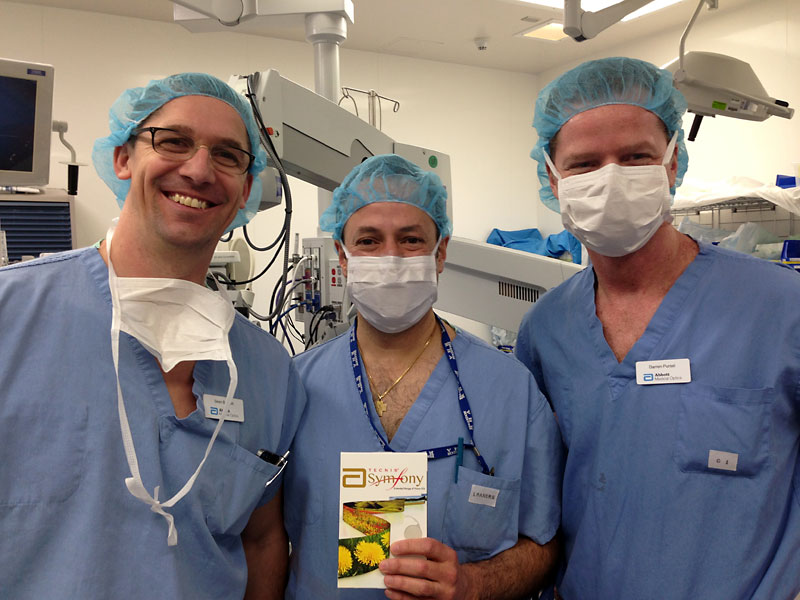
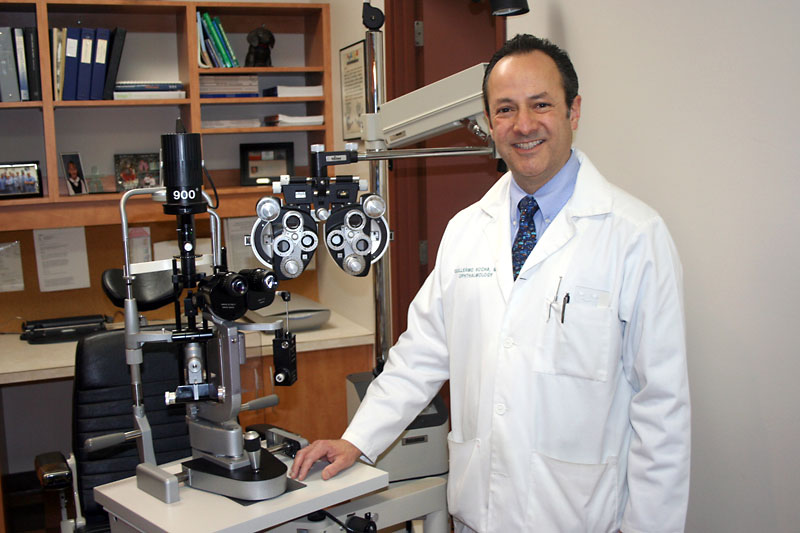
Janz is the first person in Canada to receive a new artificial lens implant, called the Symfony extended range of vision lens — and it was done right here in Brandon by ophthalmic surgeon Dr. Guillermo Rocha.
“Vision-wise I’m far-sighted and near-sighted, so I was becoming frustrated with the glasses,” Janz said. “I had to use reading glasses because what I had wasn’t doing the job, and they couldn’t improve it anymore because of me needing the bifocals.”
Janz said things are looking “clearer and clearer” and she is thrilled with her new and improved vision, and thankful she doesn’t have to adjust glasses between paper and computer screen.
“These lenses are computer-friendly, so that is marvellous,” she said.
Janz was a perfect candidate for the revolutionary new artificial lens, which improves vision for people struggling with cataracts, astigmatism and other vision issues. The only problem is it’s not yet approved by Health Canada.
Throughout his career, Rocha has been involved with organizations on a national and international scale, such as the Canadian Ophthalmological Society. He is president of the Canadian Cornea Society. Through his work, he learned about the Symfony lens, which has been available in Europe and Asia. Rocha said the lens had very good results overseas, and wanted to add it to his practice in Manitoba.
“There are some very reputable people in Europe who have produced studies that sort of stimulated me to proceed with this lens here in Canada,” he said.
Rocha went through the proper channels with Health Canada and was granted a limited release of the product through the special access program.
Abbott Medical Optics then ordered two sets of the lenses for Rocha — one for Janz and one for another patient.
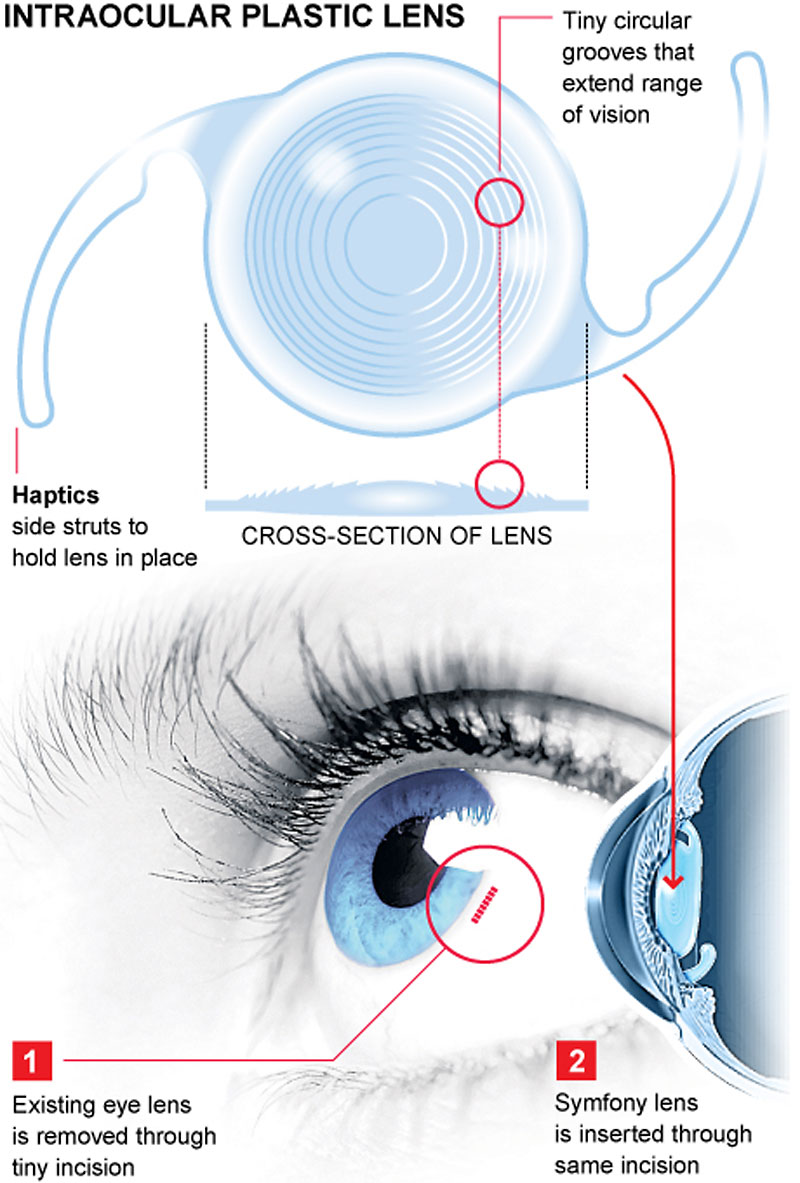
The surgery itself takes just 10 minutes, and is the same procedure as a cataract surgery — the difference is the type of lens being inserted.
“We go through a very small opening on the side of the eye, then we peel open the membrane that covers the cataract itself on the surface, and then aspirators suck out the cataract from within,” Rocha said, explaining a cataract operation.
Existing multi-focal lenses typically provide great distance vision and great near vision but poor intermediate vision. The unique aspect of the new lens, according to Rocha, is the fact that it provides the patient with the full range.
“The design is different, therefore you have distance, intermediate, and near in what’s called extended range of vision,” Rocha said. “So there’s no peak for distance and peak for near, but rather a complete nice flow of all levels of vision. Second, because of its design, it doesn’t reduce light as much as the others.”
Previous multi-focal lenses have produced halo bursts and glare and would not have the smooth focus of a natural eye.
“I think over the next month to two months we will know more and more about this lens and that will hopefully help the decision as to whether or not it’s fully approved in Canada,” Rocha said. “If it is so, the nice thing is we will have had a few months of experience with it, and we can then sort of give our impressions and our opinions to other people who are just starting with it.”
Following the quick procedure, patients are back to doing their regular activities within just three to four days. Janz had each eye done in separate operations, on different days. The lenses are intended to last for life.
Darren Pursel, strategic accounts manager with Abbott Medical Optics, was in Brandon for the first-of-its-kind surgery in Canada.
“For people that want vision at all distances without any of the tradeoffs traditionally associated with multifocal implants or other technologies available today, this is the next step,” Pursel said.
The hope is that the lens will be approved by Health Canada within the next year.
“With Health Canada there’s no way of knowing when they’re going to give us approval,” Pursel said. “We’re hoping this lens will be approved sometime in 2015 and that way other surgeons will have access to the technology.”
Pursel said the cost will depend on the surgeon, but estimates patients would pay approximately $1,000 per eye.
» jaustin@brandonsun.com
» Twitter: @jillianaustin