
Ghosts of the gallows
Advertisement
Read this article for free:
or
Already have an account? Log in here »
We need your support!
Local journalism needs your support!
As we navigate through unprecedented times, our journalists are working harder than ever to bring you the latest local updates to keep you safe and informed.
Now, more than ever, we need your support.
Starting at $15.99 plus taxes every four weeks you can access your Brandon Sun online and full access to all content as it appears on our website.
Subscribe Nowor call circulation directly at (204) 727-0527.
Your pledge helps to ensure we provide the news that matters most to your community!
To continue reading, please subscribe:
Add Brandon Sun access to your Free Press subscription for only an additional
$1 for the first 4 weeks*
- Enjoy unlimited reading on brandonsun.com
- Read the Brandon Sun E-Edition, our digital replica newspaper
*Your next Free Press subscription payment will increase by $1.00 and you will be charged $20.95 plus GST for four weeks. After four weeks, your payment will increase to $24.95 plus GST every four weeks.
Read unlimited articles for free today:
or
Already have an account? Log in here »
Hey there, time traveller!
This article was published 17/01/2015 (4131 days ago), so information in it may no longer be current.
“Deliver us all from evil,” said Rev. Flewellyn in a calm, steady voice, standing on the scaffold platform before the lever was pulled, opening the gaping trap door underneath William Webb.
The rope tightened and Webb’s body slightly trembled and twitched after a thud.
With his head covered by a black veil, the rope still taut on his neck, a doctor confirmed Webb’s death about 18 minutes after he climbed onto the creaking structure, which was tested with a 175-pound bag of sand in the days prior to the Dec. 28, 1888 hanging.
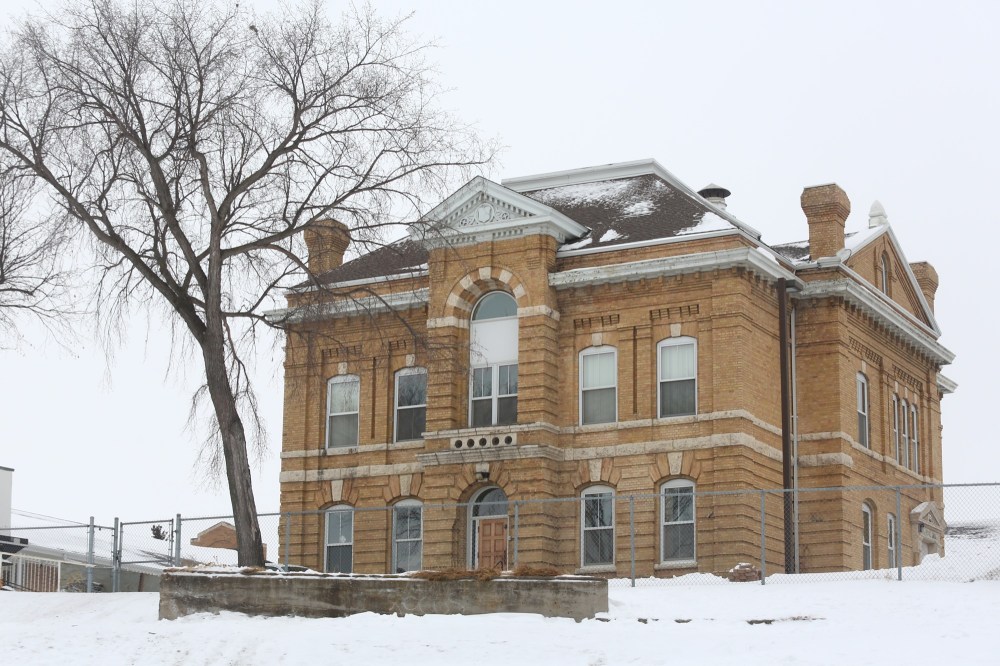
His neck had broken, the doctor reported, but Webb’s final moment was believed to be quick as some 40 people looked on, including hometown Brandon reporters and Winnipeg press.
Webb, an abusive husband who shot his wife in the head with a 12-gauge shotgun in front of their four children in September 1888, was the first of four hangings the Wheat City had experienced.
He lies on the site of the Rideau Park Personal Care Home — the former Brandon Gaol — under a patio alongside the infamous Hilda Blake, the orphan immigrant who murdered her employer, Mary Lane, in July 1889.
Historians say the gravesite of the two infamous murderers should be acknowledged by the government.
“It’s odd, that you have these bodies, in an unmarked grave under a senior citizens’ home … and everybody knows that they’re there, but no one is prepared to acknowledge that,” said historian Tom Mitchell, who co-penned “Walk Towards the Gallows,” a biography of Blake that deals with the story as a part of labour history and focuses on her place in society.
“The city and the province seem to regard the site of the old Brandon Gaol as something to be, I don’t know, completely ignored or suppressed,” Mitchell said.
Blake’s story is fraught with lore of sex, crime and violence; a tale of a rogue, carefree woman trapped by social circumstances — or one of a moral lunatic — depending on who you speak to.
It has been written that Blake was in a sexual relationship with Robert Lane and shot his wife out of jealousy.
The polarizing story has been told and retold through several published stories and even a locally produced stage opera.
“People like to recall certain parts of history in a public way, but the Hilda Blake story is not one of them,” Mitchell said.
Provincial law states that human bodies buried outside cemetery grounds that have heritage significance should be identified in the area, if the heritage minister deems them significant.
A provincial spokesperson said if human remains are buried at an historic site, they are under no obligation to do anything with them other than to ensure the burials are not disturbed. Further, no records were immediately available that confirm Webb and Blake do in fact lie underneath the care home.
But newspaper accounts from the day state the bodies were to be buried at the old Brandon Gaol, and cemetery records say nothing to the contrary.
Unless someone claimed the body, it would be buried in jail grounds, Mitchell said.
And when Manitoba Health took over the jail from the justice department in the mid-1980s, the government said the bodies of Blake and Webb would be exhumed if they were located where construction was slated to take place, but they never were.
At the time, the whereabouts of the two condemned was passed down from employee to employee at the jail, and information was sketchy.
Bill Ryan, a former jail guard, told the Brandon Sun in 1985 that he discovered the graves’ location 20 years earlier when he was assigned to fill in the ground that had settled into the coffins.
But it has also been suggested Blake’s body is elsewhere.
A sensationalized front-page article written about the Blake case in a 1930s issue of American magazine “Master Detective” matter-of-factly stated that in a small town about 140 kilometres outside Brandon stands a gravestone with the inscription:
“Hilda Blake Forgive Us Our Tresspasses As We Forgive”
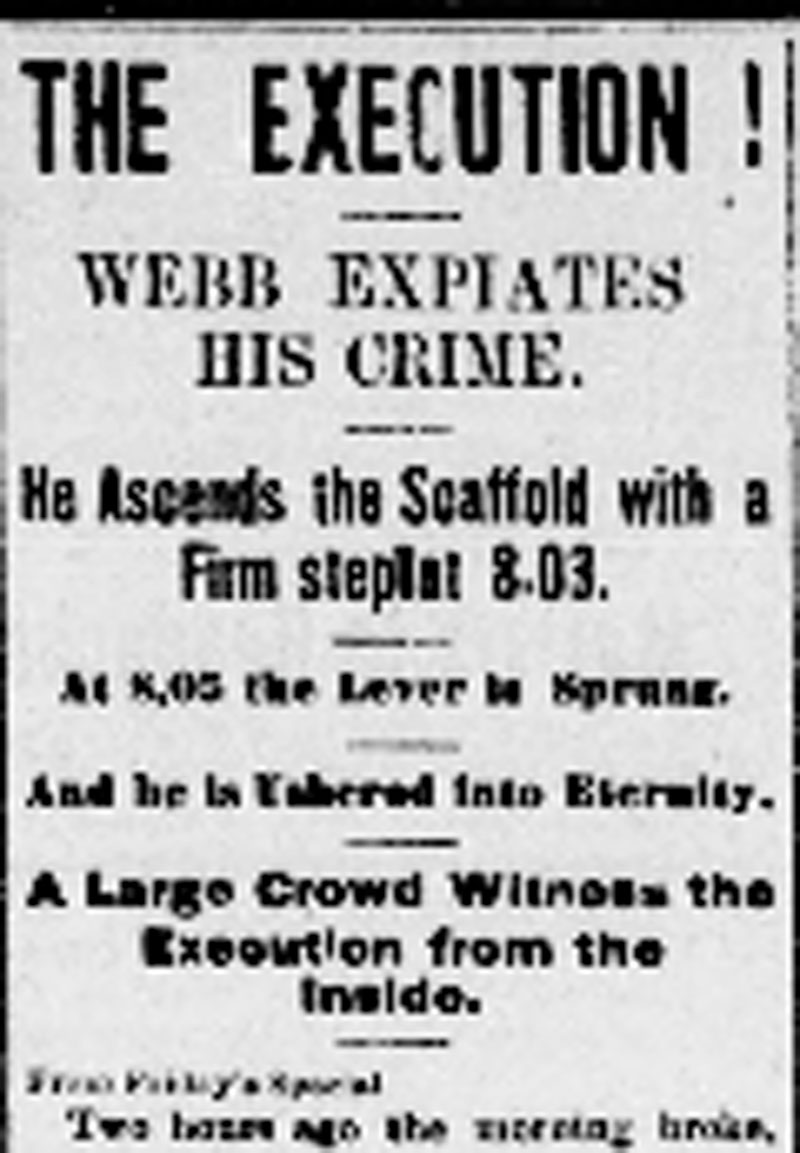
Perhaps the stone doesn’t stand over a body.
Mitchell said he and his co-author, Reinhold Kramer, couldn’t confirm the existence of such a gravestone during their research for the Blake biography.
Despite the liberties the magazine article may have taken, it’s commonly believed Blake was buried in the jail yard.
Mitchell said an attempt was made by the city’s heritage committee years ago for the hanging site to be marked by the province.
Kris Desjarlais, co-chair of the current heritage committee and newly minted city councillor, said he’d be open to pushing for something in Rideau Park.
“Having something with the story there would certainly pique my interest,” he said. “I’m open to having a discussion about it and seeing what other people think. I wouldn’t rule it out.”
Blake was the only woman to be executed in the province, on Dec. 27, 1899.
At the Headingley jail, 16 of the 18 bodies of men hanged between 1929 and 1952 have been exhumed, interned in a nearby field and marked with a plaque and large white cross, according to the Winnipeg Police Service.
Dale Brawn, co-author of “Every Stone a Story: Manitoba’s Buried History,” a book that details the lives of Brandon’s executed, said markers to acknowledge executions aren’t typical in Canada.
“It isn’t strange in the context of jails across the country,” Brawn said, a lawyer in Sudbury, Ont., who grew up in Brandon. “There was such a tendency to rush these things … and the record-keeping was sloppy.”
Headingley was forced to dig up the bodies in the 1970s after the nearby river threatened to wash them away, Brawn said.
It’s not unusual for tourists to come through places like Brandon, who may have read about Blake, Mitchell said, and Brawn thinks historical plaques would be a huge boon for Brandon to use for walking tours.
“I’ve long thought that kind of thing in western Manitoba could be a big tourist thing,” Brawn said.
Unlike Webb and Blake, the whereabouts of Harry Green — the final person to die at the hands of the state in Brandon — is well documented, though nothing on the surface marks his resting place at the municipal cemetery.
On Feb. 25, 1915, Green sat in a jail cell, eating eggs and toast and drinking coffee while the temporary gallows awaited him outside.
Wearing the same outfit he wore at his death sentencing three months earlier, he didn’t sleep the previous night, but rather sang hymns with his spiritual adviser, a reverend of the Salvation Army.
After his breakfast, Green walked out of the jail, silently looking straight forward past the some 40 spectators.
The hangman strapped the ankles of the still-silent Green. Death was instantaneous.
After two shotgun blasts echoed across the farm fields in the Hartney district on May 17, 1914, farm hands — suspicious of fellow worker Thomas Hill’s disappearance — ended up finding the man in his 50s shoved into an abandoned well, bubbles rising to the surface of the water 16 feet down, with what looked like the heel of a man’s shoe peeking up from the water.
During the trial, Green was described as callous and without remorse, even chewing gum during the proceedings as the circumstantial evidence mounted against him.
At the time of Green’s arrest after the body in the well was identified, he was wearing his victim’s vest and carrying his watch.
“I was possessed of a devil at the time” was the only explanation Green gave after he was sentenced to death for shooting his best friend in the head.
Only one of Brandon’s executed lies in a marked burial.
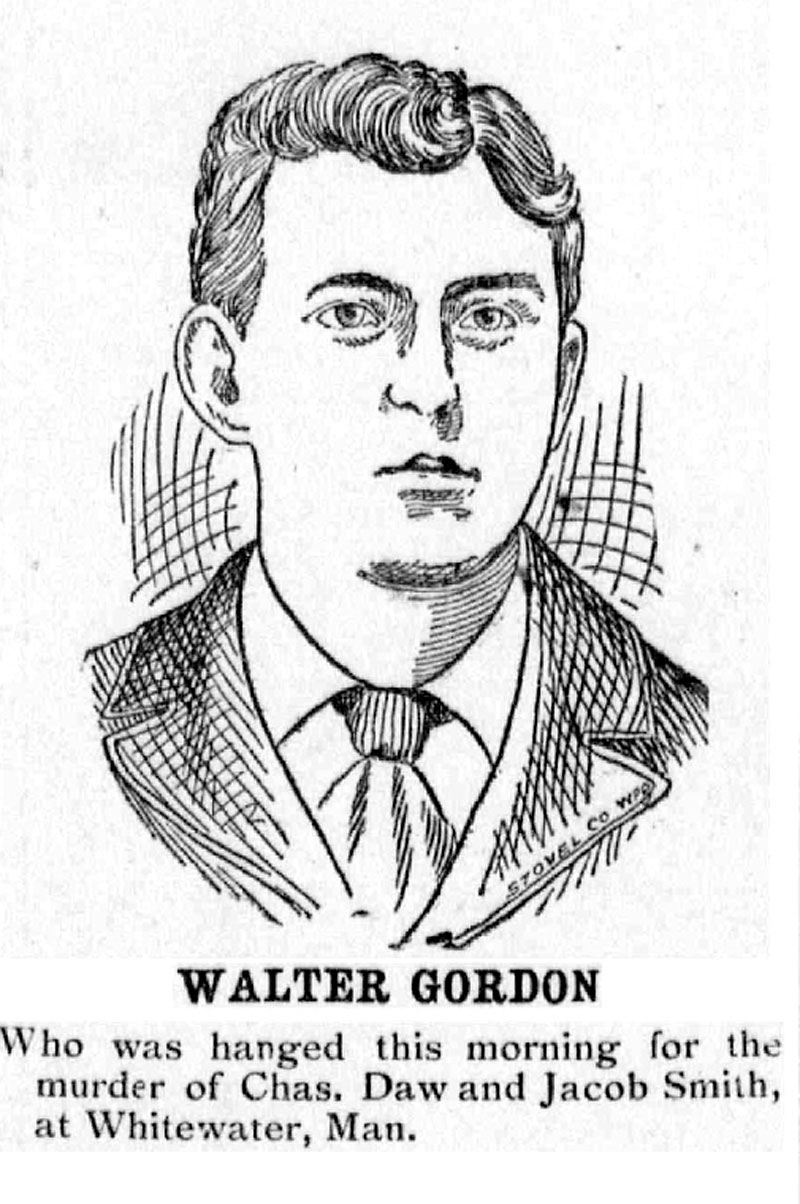
In the Brandon Municipal Cemetery lies a small, unassuming stone with the initials W.G. — a reminder of a national manhunt for one of the most heinous murderers in western Manitoba.
The parents of Walter Gordon quietly assumed his body after the gallows trap sprung on him on an unusually cool summer morning in 1902.
Gordon didn’t receive a headstone for two years following his death, which is common practice even today for convicted murderers, in an effort to discourage vandalism attempts.
Gordon, 24, was set to purchase a Boissevain farm from his employer, Charles Daw. When the deal went sour, Gordon shot Daw in July 1900.
Like his fellow Westman murderer Harry Green, Gordon opted to dispose of his victims in a rural well.
When a friend of Daw wasn’t convinced of Gordon’s explanation of Daw’s whereabouts, he too was shot and killed and joined Daw at the bottom of the well.
By the time authorities were tipped off about the Boissevain bodies, Gordon had already fled to South Dakota. But he wasn’t in the United States long before he was recognized as wanted posters were fanned out across Canada and parts of the U.S. To evade capture, Gordon returned to Canada with plans to board a South Africa-bound ship to fight in the Boer War.
But before he boarded, he was caught.
Public appetite to see Gordon’s hanging was large, with 150 people in the ticket-holding audience — including his mother, who witnessed the death.
The penalty, the Brandon Sun headline read, had been paid.
» gbruce@brandonsun.com
» Twitter: @grjbruce