
Planting the seed: Erickson-area farmer takes chance with quinoa crop
Advertisement
Read this article for free:
or
Already have an account? Log in here »
We need your support!
Local journalism needs your support!
As we navigate through unprecedented times, our journalists are working harder than ever to bring you the latest local updates to keep you safe and informed.
Now, more than ever, we need your support.
Starting at $15.99 plus taxes every four weeks you can access your Brandon Sun online and full access to all content as it appears on our website.
Subscribe Nowor call circulation directly at (204) 727-0527.
Your pledge helps to ensure we provide the news that matters most to your community!
To continue reading, please subscribe:
Add Brandon Sun access to your Free Press subscription for only an additional
$1 for the first 4 weeks*
- Enjoy unlimited reading on brandonsun.com
- Read the Brandon Sun E-Edition, our digital replica newspaper
*Your next Free Press subscription payment will increase by $1.00 and you will be charged $20.95 plus GST for four weeks. After four weeks, your payment will increase to $24.95 plus GST every four weeks.
Read unlimited articles for free today:
or
Already have an account? Log in here »
Hey there, time traveller!
This article was published 22/08/2015 (3926 days ago), so information in it may no longer be current.
NEAR ERICKSON — Standing beside a field of quinoa, Ryan Pengelly asks a neighbouring farmer if he thinks he’s crazy.
“You have to start somewhere,” the farmer jokes from the cab of his diesel pickup.
While not the first to grow quinoa in the province, Pengelly took a big risk seeding the South American crop that is grown for its edible seeds.
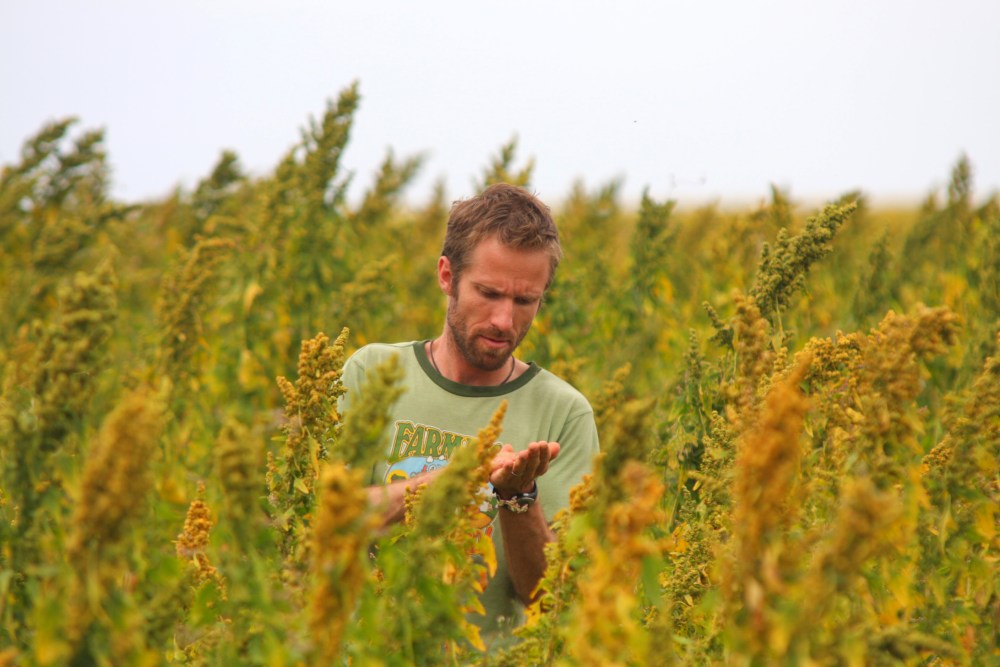
Last year, he planted an acre of quinoa and was able to sell approximately 400 pounds of what he called “dark tan” seeds at farmers markets throughout the province. The product retailed for $10 per pound.
“We didn’t make a lot of money, but we paid ourselves enough to keep experimenting,” he said.
Pengelly comes by his passion for quinoa honestly. His wife, Alexandra Lozada, is from Lima, Peru, where quinoa fields are as common as canola or wheat on the Prairies.
While living in the South American country, Pengelly saw similarities between the growing conditions in the high altitudes of the Peruvian mountains and the farm he grew up on near Erickson.
Cooler temperatures, a shorter growing season and marginal soil are aspects both areas share in common.
In 2014, Canada imported 3.75 million kilograms of quinoa from Peru, second only to Bolivia with slightly more than four million kilograms, according to Statistics Canada.
Pengelly hopes to fill some of the demand for the product domestically, and if export numbers are any indication, it’s a burgeoning market. Since 2012, imports of quinoa have almost doubled in just two years from 4.3 million kilograms imported from approximately 10 countries to more than 8.1 million kilograms in 2014.
Pengelly — who only recently moved back to farm with his wife and the couple’s two children,four-year-old Tiago and one-year-old Analucia — is part of a growing movement in the food industry that sees producers exclusively handle a commodity from seed to sale.
While the farm is a business first, it is guided by an ideology that at times is at odds with the modern commercial farm.
“It’s about being connected to my home,” said Pengelly, who also owns 300 free range and pastured chickens. “I know this land and I care about it. Can we make a living taking care of the land? I don’t have an answer for that yet, but we’re going to give it a try.”
The family also owns 10 hogs that roam paddocks set up in five acres of forest near Pengelly’s father’s homestead.
In many ways, Pengelly is building on the ingenuity of his father, Harvey, who has been farming niche crops in the area since buying the land in the 1970s.
The farm now consists of two sections of land. It may sound like a good-sized operation; however, the vast majority of it — scattered through the changing elevations near the southeastern border of Riding Mountain National Park — isn’t being farmed.
The elder Pengelly graduated with a science degree, majoring in fisheries and wildlife biology.
The principles he learned at university he applied to the land he bought in 1976. Keeping some of the land in its natural state, where it’s able to sustain diverse ecosystems and retain water, is important to him.
In the early years, Harvey worked with Ducks Unlimited on a few projects before transitioning the farm to the point where it mainly grew alfalfa, native grass and wild sunflower seed.
The sorting machinery used for those seeds has proved valuable for quinoa, allowing the family to sort the seed and deliver a high-quality product to the end consumer.
Standing in front of a steel shed, dressed in blue coveralls with a grease-stained Fraser Auction hat on and two homemade machined bushings in his hand, Harvey said there were a lot of challenges in those early years farming the land, with the family relying on his wife Carol’s off-farm income as a pharmacist.
There is a measure of concern in his voice when he speaks of the uncertain waters his son has waded into on the farm, including attempting to turn a portion of the farm into certified organic — a trial to see if organic is viable for land that is phosphorous and sulfur deficient.
Maybe some of that concern is because Harvey knows just how challenging trying to break into a niche market can be, particularly without some of the tools conventional farming provides that organic doesn’t.
And maybe some of it is that it’s easier to be the one taking the risk than seeing someone you care about enter those same unchartered waters.
“Anybody that has the passion for it will find a way to make a go of it,” he said. “It’s not easy, though, because we’re on marginal farmland. The elevation was a negative for me, but it may be a positive for quinoa.”
For the younger Pengelly, moving into the organic market isn’t as “rogue” as it used to be, with new technologies such as rock phosphate on the farming side of things and marketing through the Internet on the sales side. He is already exploring the use of rock phosphate and the family owns a website: TamarackFarms.ca.
Furthermore, a new wave of educated consumers is demanding to know where and how their food was produced — and in many cases, willing to pay a premium for the types of practices Pengelly is implementing.
“We don’t know exactly how we’re going to do it,” Ryan said about the transition to organic. “But it’s important to do it for us as a family and I think it’s more important to the consumer, too.”
» ctweed@brandonsun.com
» Twitter: @CharlesTweed