
Family, historian worry 19 victims on 1916 rail disaster forgotten
Advertisement
Read this article for free:
or
Already have an account? Log in here »
We need your support!
Local journalism needs your support!
As we navigate through unprecedented times, our journalists are working harder than ever to bring you the latest local updates to keep you safe and informed.
Now, more than ever, we need your support.
Starting at $15.99 plus taxes every four weeks you can access your Brandon Sun online and full access to all content as it appears on our website.
Subscribe Nowor call circulation directly at (204) 727-0527.
Your pledge helps to ensure we provide the news that matters most to your community!
To continue reading, please subscribe:
Add Brandon Sun access to your Free Press subscription for only an additional
$1 for the first 4 weeks*
- Enjoy unlimited reading on brandonsun.com
- Read the Brandon Sun E-Edition, our digital replica newspaper
*Your next Free Press subscription payment will increase by $1.00 and you will be charged $20.95 plus GST for four weeks. After four weeks, your payment will increase to $24.95 plus GST every four weeks.
Read unlimited articles for free today:
or
Already have an account? Log in here »
Hey there, time traveller!
This article was published 11/01/2016 (3937 days ago), so information in it may no longer be current.
On a frigid, snowy morning in the heart of Brandon 100 years ago tomorrow, 19 people died in what remains the second-worst train disaster in Manitoba.
A century later, some who’ve researched the tragedy are concerned it’s faded too far from the Wheat City’s memory.
Environment Canada shows the low on Wednesday, Jan. 12, 1916 sitting at -46 C, snow had been falling since Sunday.
The bitter weather would wreak havoc on the entire day.
The wreck
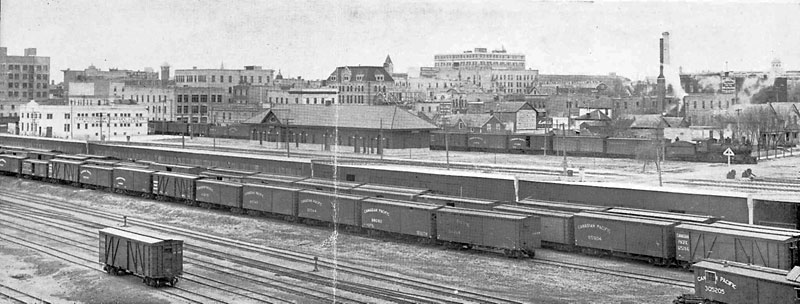
That morning, a group of temporary workers were tasked with clearing the snow off the tracks in the Canadian Pacific Railway yard and onto a snow train: a locomotive, a caboose and several flatbed cars, onto which workers shovelled snow by hand.
Visibility was terrible: reports say smoke from the nearby plant combined with ice fog had socked in the yard.
Just after 10 a.m., the snow train slowly rolled onto a main line. In the train’s caboose were some of the workers, huddling around a stove to get warm. At its helm was Ernest Westbury, a 20-something Brandonite at the front-end of long career on the railway. Reports suggest it was going no faster than four miles per hour.
At the same time, a freight train headed for Winnipeg was rolling towards the same main line. Despite warnings to look out for the snow train, the freight train struck the rear of the snow train at 10:05 a.m., just as it reached the mainline.
The freighter was estimated to be doing no more than eight miles per hour, but the slow speed did little to spare carnage.
The big, steel engine of the freight train tore through back of the snow train, lifting two flatbed cars over the wooden caboose —crushing many in and injuring many walking near the caboose.
Sixteen men were killed on site, three more in the days following. The disaster could have been far worse, “There were only thirty men near the caboose, the rest of the seventy-five in the gang having gone to work at another spot,” notes a Sun article the day after the disaster.
Many of the first responders to the carnage suffered frost bite as they fought to save lives.
In their coverage, the Winnipeg Tribune ran an archived photo of the train yard with an ‘X’ drawn where
the collision happened —photographers couldn’t get their cameras to work in the cold.
The news made the front page of the Calgary Herald and got ink in the next day’s New York Times. At the time, it was the most lethal train disaster in Manitoba.
George McGhie, a Scottish-born supervisor, died in the caboose. The 38-year-old left behind a wife and two sons.
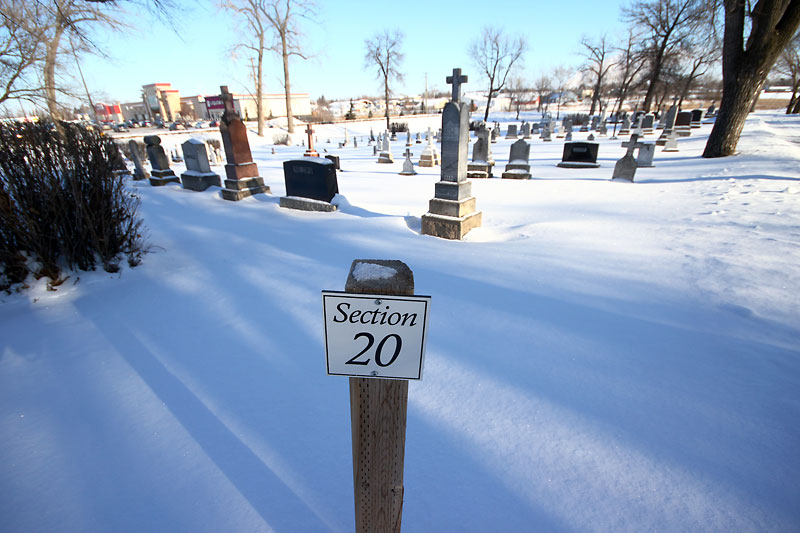
The other 18 victims were poor day-labourers, listed by newspapers at the time as Austrians.
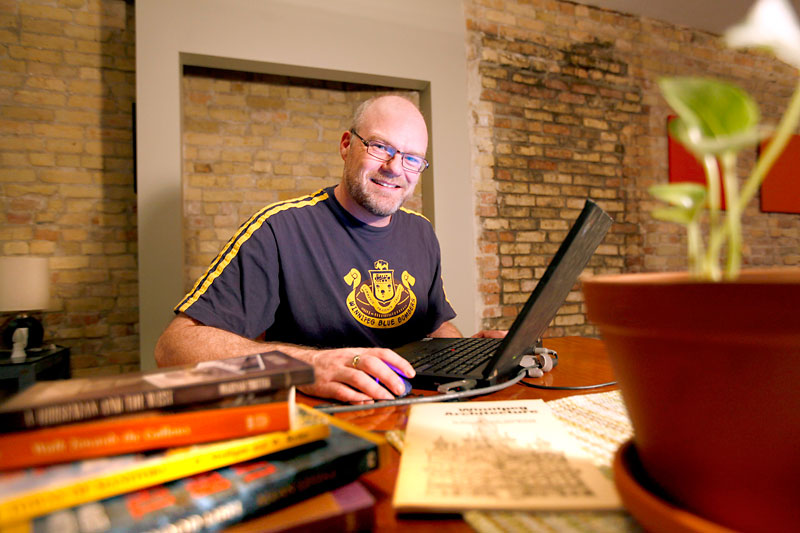
Manitoba historian Christian Cassidy, author of the blog West End Dumplings, said they’d likely have come from modern-day Ukraine, he’s worked hard to combine the often conflicting names and details given about the men.
‘Driven to the work by necessity’
Those hired were “a hardy type and driven to undertaking the work by necessity to get food for themselves and their families” said a Brandon Daily Sun article from the day of the crash.
Their families received few benefits, because they were employees of CPR. The city employed four fellow Ukrainians to prepare burial sites in the frozen ground at Brandon Municipal Cemetery.
Both train operators were exonerated in the ensuing inquest at city hall, which started the day after and resumed two weeks later when some of the injured could testify.
Westbury, it was discovered, hadn’t been told to look for other trains while his train worked in the yard.
“I expect every man to look after his own train. I could not look after all the trains,” retorted the yard foreman from the stand.
Westbury, physically unscathed, went right back to work said his grandson, Allan Wood.
“He was uninjured so back in those days you get back to work,” Wood said.
Wood said his family never spoke about story, and Westbury’s involvement.
“I (found out) well after I was married … I started doing a little digging,” said Wood.
He figures his grandfather would’ve been in his mid-20s at the time, he had all five of his children after the crash.
Despite a long career on the tracks, Ernest Westbury’s life was never the same.
“I can’t recall a diagnosis except that he was insecure, or unstable mentally,” said Wood.
“I think it affected him mentally. He ended up passing away in the Brandon Mental Hospital. Near the end he lost it, he was back driving his train again — sitting up in bed, going “Whoo-woo.”
That, says Wood, was enough for his family to sweep memories of the day under the rug — something that seems to have happened on a larger scale across Brandon.
No memorial
“For the families of the deceased, there should be a real nice epitaph or something,” said Wood.
“If you go to Dugald (the site of the worst train disaster in Manitoba), and granted I think 30 people were killed in Dugald, there is a memorial and a remembrance of what happened there. That’s what I was trying to do with the blog post and the Free Press story, was to say, ‘Hey, this is completely forgotten,’” said Cassidy.
The City of Brandon doesn’t have plans to recognize the disaster’s centenary.
“It’s a lovely cemetery … and they are all in a row except for the supervisor (McGhie). It would be nice to have a plaque or a bench at the end of that row — right at a little driveway section, just to say here they are,” Cassidy said.
» tbateman@brandonsun.com, with files from Christian Cassidy, Winnipeg Free Press
» Twitter: @tombatemann