
Why Makda is one of my heros
Advertisement
Read this article for free:
or
Already have an account? Log in here »
We need your support!
Local journalism needs your support!
As we navigate through unprecedented times, our journalists are working harder than ever to bring you the latest local updates to keep you safe and informed.
Now, more than ever, we need your support.
Starting at $15.99 plus taxes every four weeks you can access your Brandon Sun online and full access to all content as it appears on our website.
Subscribe Nowor call circulation directly at (204) 727-0527.
Your pledge helps to ensure we provide the news that matters most to your community!
To continue reading, please subscribe:
Add Brandon Sun access to your Free Press subscription for only an additional
$1 for the first 4 weeks*
- Enjoy unlimited reading on brandonsun.com
- Read the Brandon Sun E-Edition, our digital replica newspaper
*Your next Free Press subscription payment will increase by $1.00 and you will be charged $20.95 plus GST for four weeks. After four weeks, your payment will increase to $24.95 plus GST every four weeks.
Read unlimited articles for free today:
or
Already have an account? Log in here »
Hey there, time traveller!
This article was published 28/05/2016 (3804 days ago), so information in it may no longer be current.
By James C. McCrae
The shortest years of my working life were the three that ended April 28 when my appointment as a Canadian citizenship judge expired. I move on now with gratitude for the appointment and the experience, carrying with me unforgettable recollections of happy new Canadians, among the finest citizens I have ever been privileged to meet.
During my three years, there were 400 to 450 citizenship ceremonies, at least 40,000 handshakes, hugs, smiles and photos, thousands of beautiful children, dedicated citizenship department staff and immigration volunteers, and many special ceremony guests.
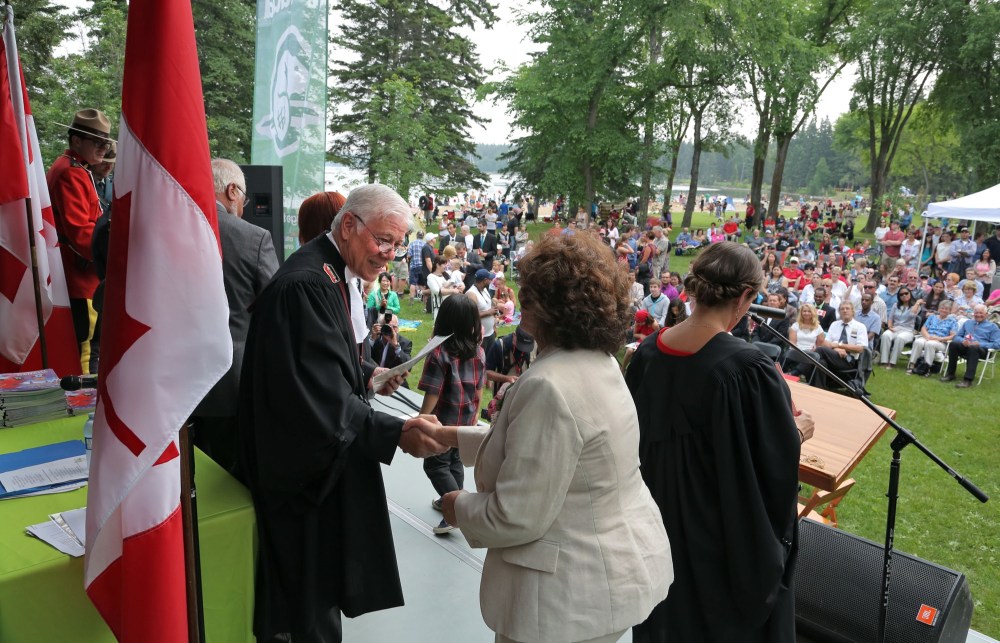
It was my honour to greet new Canadians in Calgary, Edmonton, Fort McMurray, Iqaluit, Brandon, Shilo, Clear Lake, Thompson, Winnipeg and Ottawa.
I was impressed with the unwavering dedication of members of the Royal Canadian Mounted Police and the Canadian Forces who attended and stood guard at citizenship ceremonies, adding symbolic colour and bringing with them messages of patriotism and service.
It was my duty to remind new Canadians of the wonderful rights we enjoy as Canadians, but also to impress upon them the importance of remembering the awful price paid to preserve those rights, and fulfilling our duties to Canada and our fellow Canadians.
Little did I realize it at the beginning, but I learned
more from new Canadians
about hope, determination, responsibility and strength of character than I had known in all the years of my life before my appointment.
The story of Makda Kavaruganda (not her real name) illustrates this point.
For the first year of my term, one of my duties was to administer the knowledge of Canada test to citizenship applicants.
When she arrived for her citizenship test, Makda apologized for what she called her poor English. After a brief conversation with her, I was satisfied her English language skill was sufficient, at least at a basic level, to qualify her to proceed with her citizenship application and to undergo the required knowledge of Canada test. I remember being impressed with what appeared to me to be her determination to acquire Canadian citizenship.
Before I began asking her the required test questions, I told her it was interesting to me that she was a refugee from an African country, and I wondered how life in Canada was treating her. She told me Canada was a very good place for her and her children.
I knew she had five children, having briefly scanned the information in her citizenship application. She told me her children were in good health and achieving a good education in Canada, and that was so much better than her experience had been. She told me she had never been to school, could not read or write in her own language and that, of course, she could not read or write in English or French either.
But she wanted me to know she works hard in Canada at two jobs, cleaning office buildings.
I noted in her citizenship file that she had not previously failed the written knowledge of Canada test. Why, then, was she already before me, the judge? As the system required at the time, most applicants came to the judge only after they had failed the written test twice.
In Makda’s case, she requested an oral test with a judge because she could not read the book the government provided to assist her in learning about Canada, and a written test was out of the question.
Having heard all this, my expectation, sadly, was that this woman would not do at all well on her citizenship test. In my work, I had encountered some applicants for citizenship who had not prepared adequately for their tests. I had heard the excuses: I work two jobs; I don’t have time to study; too many bills to pay; my house is full of kids, there’s too much noise for me to study, and I’m so tired at night; my English is not so good yet — to name a few.
After the Canadian citizenship test questions were asked by me and answered by Makda, we began a conversation. Makda had passed the test. In her broken English, she answered correctly 18 of the 20 questions. Fifteen correct answers are required in order to pass the test. I announced to her that she answered 18 questions correctly and had passed the test.
Makda knew enough about Canada’s Indigenous peoples, European settlement, political history, military history, hockey, geography, Canada’s system of government and the symbols of Canada. She knew enough about the rights and responsibilities of Canadians and about Canadian law. She knew enough about Canada to pass the citizenship test.
When the test was finished, I could not help but feel astonished that someone like Makda could know so much more about Canada than perhaps millions of Canadians who were born in Canada.
When our post-test conversation began, Makda began to sob uncontrollably. I offered her a tissue. She took it from me, and thanked me. I asked her what was wrong. Shouldn’t she be happy now? Shouldn’t she be relieved the test was finished and that she had succeeded in passing it? She told me she was indeed happy and relieved; her tears were tears of joy.
It was then she told me her story, leaving nothing out.
Makda told me how she and her three small children watched, helplessly and in utter panic and horror, as her husband, the father of the children, was hacked to death by three adolescents wielding machetes. Why? Because her husband was not of his attackers’ ethnic group. Makda’s brother, who lived with her family at the time, was also forced to watch.
After the three young men finished the bloody execution of her husband, leaving him a mass of blood, bone and tissue, they turned to her brother. He too was hacked to death, his body unrecognizable when the attackers stopped hacking.
Then it was Makda’s turn. The young men attacked Makda, too, with their machetes. But they stopped short of killing her. Lying on the roadway and writhing in pain and fear, Makda waited for death, but it did not come. Then, expecting the same treatment for her children, Makda was surprised when she and her children were loaded onto the rear of the pickup truck in which the attackers had arrived at the location of the executions and torture.
Makda and her children were taken away, she to a prison and the children to the home of one of the executioners. At the prison, Makda was gang-raped on many occasions by her jailers and male fellow prisoners. She told me the rapes led to the births of two more children, each of them taken away immediately after she delivered them. There was no doctor, no hospital. An older woman, also a prisoner, helped Makda through her labours and deliveries.
Makda told me there was an airplane crash, and that the president of her country was killed. People of her ethnic group were blamed for the crash, she said, and many thousands were brutally killed as retribution, including her husband and brother. She said some people, not of her group, were also victims of the violence. “Those were good people. Good people were killed. Bad people did the killing.”
People from both groups were being killed, women raped, children raped, beaten, hacked — murdered. Makda told me she could not understand why she and her children were not executed along with their father and uncle.
But she thanked God for all her blessings, a comment that haunts me to this day.
When Makda was released from prison, she searched for her children, and found them.
Canada accepted her, and her children, as refugees. After all she had endured, Makda was able to seek, and find, work in the country that adopted her. Her children attended school in Calgary. In due course, Makda applied to become a Canadian citizen, including her younger children in her application. By then, her older children were required to apply on their own, which they did.
The Government of Canada sent the family members copies of a book, “Discover Canada,” to study in preparation for their citizenship tests. As Makda was unable to read, her older children worked with her and coached her for many days, weeks and months, until she was ready to come to me for her test, and to pass it.
Makda is one of my heroes, and so are her children. They love their mother, obviously, but they also loved the prospect of all the members of the family becoming Canadian citizens together. A minor refugee child is granted citizenship when it is earned by the child’s parent.
Only a totally insensitive person could fail to be touched and inspired by Makda’s story. For me, the lessons are manifold. Those of us who were born in Canada should pause more often to appreciate our Canadian heritage, our freedom and our democracy, and the price paid for these gifts.
And perhaps we should look to our newest Canadians as examples of the quality of citizenship to which we all might wish to aspire.
» Supplied
* * * * *
McCrae ‘challenged,’ ‘fulfilled’ by time as citizenship judge
Jim McCrae has worn many hats throughout his career, but he says his most recent position was the most rewarding.
Last month, the former politician and real estate agent ended his three-year term as a Canadian citizenship judge.
“I was so challenged and fulfilled by what I was doing,” McCrae said. “The ceremonies, those are the happiest events that you can imagine — it’s like going to a wedding and I got to do it several times a week sometimes.”
Over the past three years, McCrae split his time in Winnipeg and Brandon overseeing citizenship tests, conducting hearings and travelling around the country officiating ceremonies.
McCrae met Makda — the subject of his article for The Brandon Sun — within the first few months of his term, and he has told her story at many events. He does, however, leave out many of the graphic details for the sake of children in attendance.
“That story has always stood out for me because … Makda showed me some of her scars — and at that moment I thought, ‘What an experience this person has had,’” McCrae said, adding that many of the new Canadians he has met can relate to her experiences. “Many of them have wet eyes when you tell that story. They’ve been through a lot themselves.”
When asked what his plans are for the future, McCrae said they will likely include some combination of writing, travelling, studying and riding his motorcycle.
“The ‘R’ word does not enter my vocabulary,” he said. “Some people look forward to retirement, but I’ve just had so many wonderful things to do in my life and maybe there’s something else wonderful waiting around the corner.”
» Eva Wasney