
Officials hail community mobilization’s first year as a success
Advertisement
Read this article for free:
or
Already have an account? Log in here »
We need your support!
Local journalism needs your support!
As we navigate through unprecedented times, our journalists are working harder than ever to bring you the latest local updates to keep you safe and informed.
Now, more than ever, we need your support.
Starting at $15.99 plus taxes every four weeks you can access your Brandon Sun online and full access to all content as it appears on our website.
Subscribe Nowor call circulation directly at (204) 727-0527.
Your pledge helps to ensure we provide the news that matters most to your community!
To continue reading, please subscribe:
Add Brandon Sun access to your Free Press subscription for only an additional
$1 for the first 4 weeks*
- Enjoy unlimited reading on brandonsun.com
- Read the Brandon Sun E-Edition, our digital replica newspaper
*Your next Free Press subscription payment will increase by $1.00 and you will be charged $20.95 plus GST for four weeks. After four weeks, your payment will increase to $24.95 plus GST every four weeks.
Read unlimited articles for free today:
or
Already have an account? Log in here »
Hey there, time traveller!
This article was published 13/06/2016 (3635 days ago), so information in it may no longer be current.
The numbers are in from the first year of a project that aims to identify Brandonites in dire straits and “swarm” them with help before crisis strikes.
And while those at the helm of Community Mobilization Westman say it’s too early to take many lessons from the first 12 months, they are touting their first year-end report as proof of the model’s value to the Wheat City and surrounding area.
The project was brought to Westman by Brandon Police Service Chief Ian Grant, and based a concept by ex-police officer Brent Kalinowski in Prince Albert, Sask.
It sees officials from about a dozen human service agencies from Westman meet at a “Hub Table” twice weekly to consider how they may collaborate to address specific families or individuals whose circumstance may put them in harm’s way in the near term.
“There may not be criminality, but people are definitely at high risk — high risk to offend, be offended against or that they’re at such a place in their life that they don’t know where to turn and you know that disaster is going to strike this family if people don’t step in and do something to help them,” Grant said.
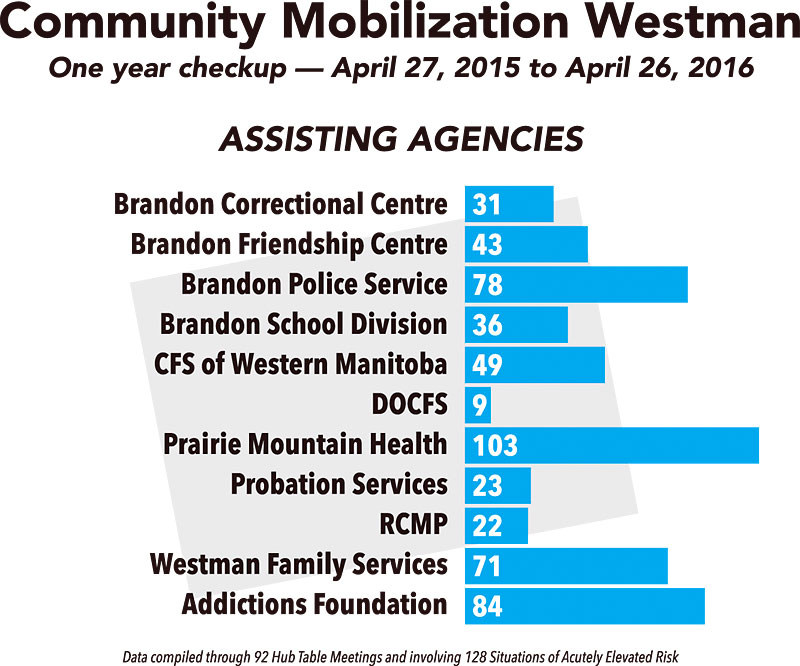
Currently, officials from the Brandon Police Service, Brandon School Division, Brandon Correctional Centre, Brandon Friendship Centre, CFS of Western Manitoba, Prairie Mountain Health, Probation Services, RCMP, Westman Family Services and Addictions Foundation of Manitoba are around the table. Additional agencies like Samaritan House, the John Howard Society and the Women’s Resource Centre are involved in a secondary capacity.
These meetings happen twice a week, and within 48 hours of a case coming to the table, representatives from all of the relevant agencies will knock on the front door of the person they believe they can help, to offer their services directly.
The quick-strike, swarm approach has proven successful, its leaders say.
“People around the table said ‘I never would have believed that (the) swarm would have worked. But once we’ve seen it happen, we’ve never been thrown out of a house,” said Mark Sefton, a former principal and current BSD board chair, and chair of CMW.
Of the 135 specific situations considered in the first year, 128 met the threshold for further action.
Of that, only three times was a offer of support denied at the front door of a home. In total, 225 individuals were connected with or informed of services.
“We’re talking about something with immediacy involved. If a situation came to the table on a Friday, then they would probably be arranging the door knock for the Friday if not probably a Monday,” Grant said.
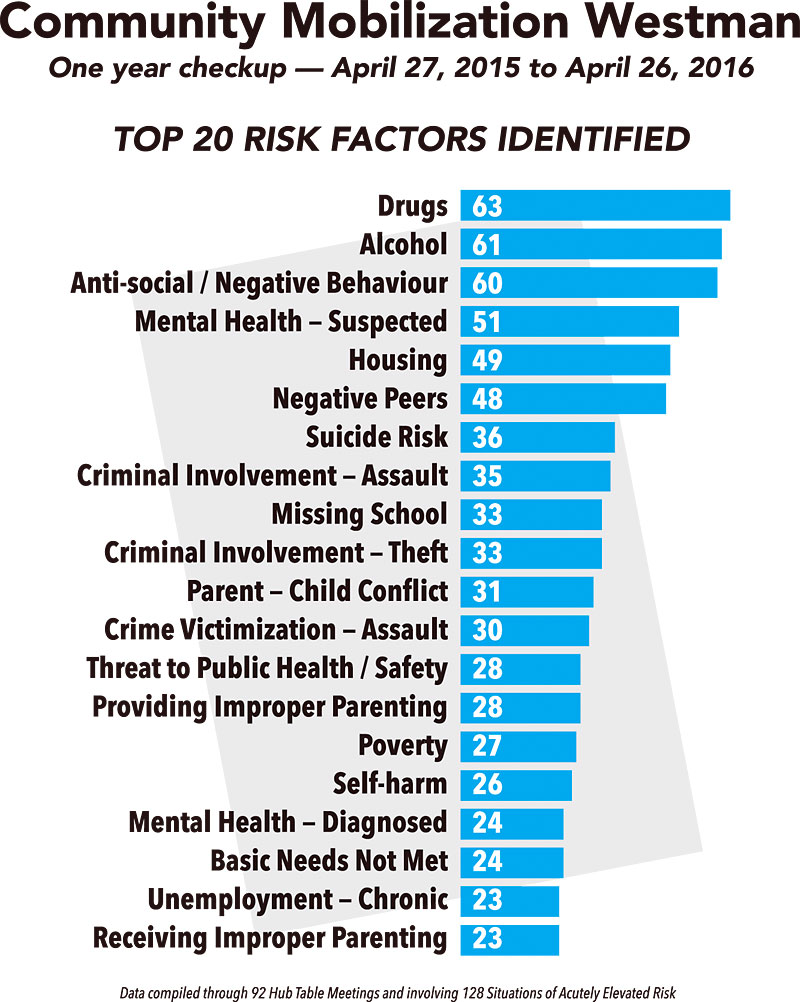
In each case taken on, “risk factors” were identified and catalogued. In 63 of the cases accepted, “drugs” were highlighted as a factor contributing to a situation identified as Acutely Elevated Risk.
After that, “Alcohol,” “Antisocial and or Negative Behaviour,” “Suspected Mental Health,” “Housing” and “Negative Peers” were all noted on specific files more than 50 times in the first year.
None of those are a surprise, Sefton said.
“But what this does is it gives us the hard data to show that,” he added.
The data collected annually will become far more useful in responding to emergent trends within the community.
Prince Albert’s community mobilization group, now five years old, is working to develop an “alcohol strategy” after data gathered over several years suggested abuse had hit a “crisis” level.
Currently, the Brandon initiative isn’t externally funded — which may be a road block to smaller local agencies being able to provide a staffer for the Hub Table meetings.
“All of these agencies (involved), primary members, are bigger organizations and even they are struggling to have people there all the time. They are managing this off the corner of their desk,” Sefton said.
Additional funding is “something we want to talk about with a wide variety of people,” Grant added.
Currently, the only funding received is for a vehicle, used for the door-knocks, which is supplied by the province.
Grant said that money for a full-time co-ordinator for the program may be a request on the horizon, to better organize meetings, analyze trends and liaise with the agencies involved.
Neither Sefton or Grant have specific targets or goals for the program in coming years.
“We’re never going to arrest our way out of social problems,” Grant said, reciting a phrase he used during the launch of the program.
But based on other Prairie cities’ use of the model, Grant said Brandon may see less calls to police, less emergency room visits and less people jailed overnight.
“If you do nothing at all, you don’t do this, I think you’d see the calls for service grow and grow and grow — which ours have been. I guarantee there’s going to be calls to replace those calls, but at least the people that you’ve dealt with know where to go and get help and they’re not adding to the increasing volume of calls we’re getting,” he said.
“The need never disappears, but with time you hope that the acuity of the need diminishes and the number of risk factors will diminish,” Sefton added.
» tbateman@brandonsun.com
History
Updated on Tuesday, June 14, 2016 1:57 PM CDT: A previous version of this article noted that 17 times was an offer of support denied at the front door of a home. In fact, only three times was did a subject refuse the services offered via Community Mobilization Westman in it's first year.