
Brandon police Taser use drops
Advertisement
Read this article for free:
or
Already have an account? Log in here »
We need your support!
Local journalism needs your support!
As we navigate through unprecedented times, our journalists are working harder than ever to bring you the latest local updates to keep you safe and informed.
Now, more than ever, we need your support.
Starting at $15.99 plus taxes every four weeks you can access your Brandon Sun online and full access to all content as it appears on our website.
Subscribe Nowor call circulation directly at (204) 727-0527.
Your pledge helps to ensure we provide the news that matters most to your community!
To continue reading, please subscribe:
Add Brandon Sun access to your Free Press subscription for only an additional
$1 for the first 4 weeks*
- Enjoy unlimited reading on brandonsun.com
- Read the Brandon Sun E-Edition, our digital replica newspaper
*Your next Free Press subscription payment will increase by $1.00 and you will be charged $20.95 plus GST for four weeks. After four weeks, your payment will increase to $24.95 plus GST every four weeks.
Read unlimited articles for free today:
or
Already have an account? Log in here »
Hey there, time traveller!
This article was published 18/06/2016 (3612 days ago), so information in it may no longer be current.
Brandon Police Service officers have been judicious when it comes to using Tasers on troublemakers in the city in recent years, according to data obtained through a freedom of information request.
June marked the 10-year anniversary of city police adding the powerful, albeit controversial, weapon to its arsenal.
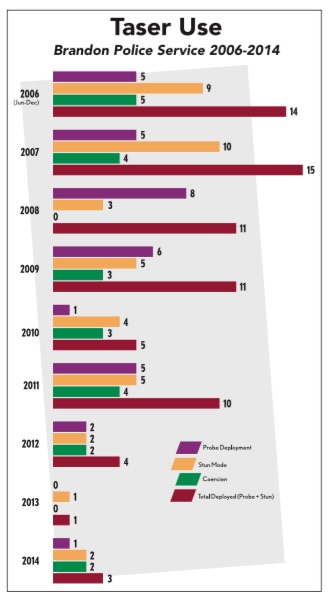
Since its debut in 2006, officers have zapped 74 people through 2014. The 2015 police report wasn’t readily available.
In its first six months on the tool belt, officers used the stun gun on 14 people. The following year, another 15 people were hit with an electric pulse that courses through the body, leaving the subject incapacitated.
In the three years ending in 2014, officers used their Taser only eight times in total.
“I think the numbers show we are very responsible with our use of force within the service,” BPS Sgt. Dallas Lockhart said. “When you consider the number of contacts we have in a year, our use-of-force incidents are very low.”
Officers were dispatched to 33,600 calls in 2014, according to the police service’s annual report. Three people were zapped that same year — one was stunned via probe deployment, two were push stunned and another two people were involved in incidents that BPS deems as “coercion.”
Probe deployment is when the gun is fired, according to Lockhart. In those cases, the gun is pointed at the subject and a cartridge is deployed with darts on it that embed in people’s skin and send the voltage vis wires connected to the gun.
Push- or drive-stun mode is when the officers are close enough to press the gun up against the subject and deliver the electricity.
Coercion is the act of using the gun’s laser to neutralize a threat without ever actually firing the stun gun.
Lockhart said he has used a stun gun in the field once over the past decade.
“I used it in the drive-stun mode to take a man to the ground and then used it as a coercion tool to keep his two buddies back until I had him in handcuffs,” Lockhart said.
While it’s difficult to give rigid criteria regarding what situation warrants the weapon’s use, Lockhart said BPS developed a policy based on provincial and national statutes.
Officers are trained to use the weapon annually, while additional training instruction is provided when new information becomes available.
The education is designed to combat “Taser dependency.”
“It’s hard to paint a picture with absolute borders on it because there are so many variables in any given one incident,” Lockhart responded to a question about when it is acceptable to use a Taser.
“It can be everything from the size of the officer versus the size of the subject to the number of people involved. From the location where the incident is happening to the emotional or psychological state of the subject or levels of intoxication. All of those things must be instantly evaluated by the officer or officers responding in order to choose the right platform.”
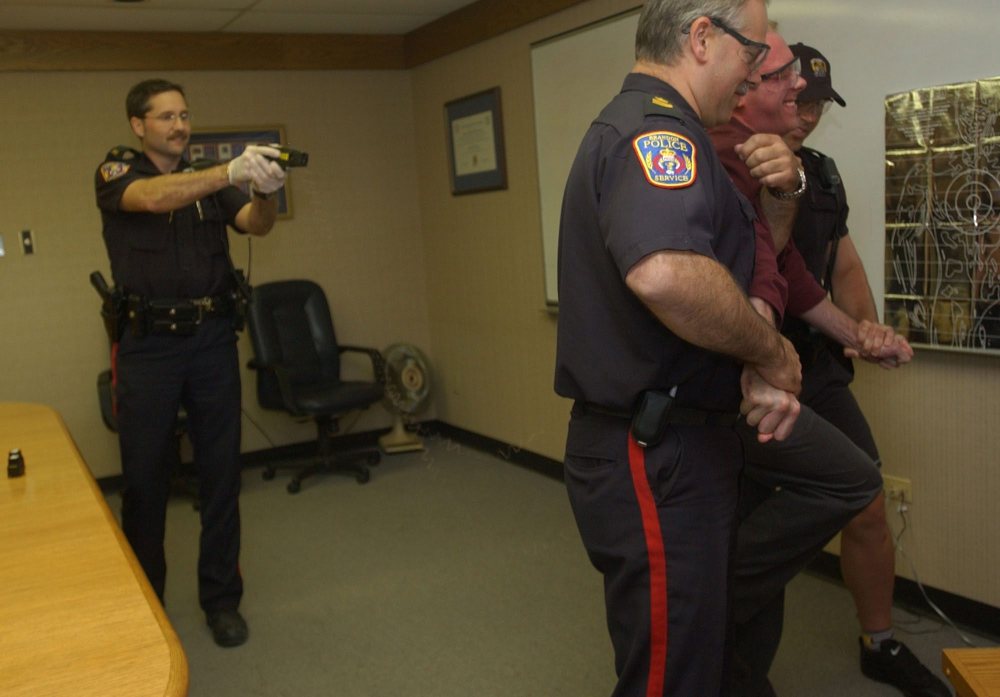
Tasers are considered one of three “intermediate” weapons on a BPS officer’s belt — with the other two being batons and pepper spray cannisters.
“It’s another tool that we have on our belt that is appropriate in some circumstances and not appropriate in other circumstances,” Lockhart said.
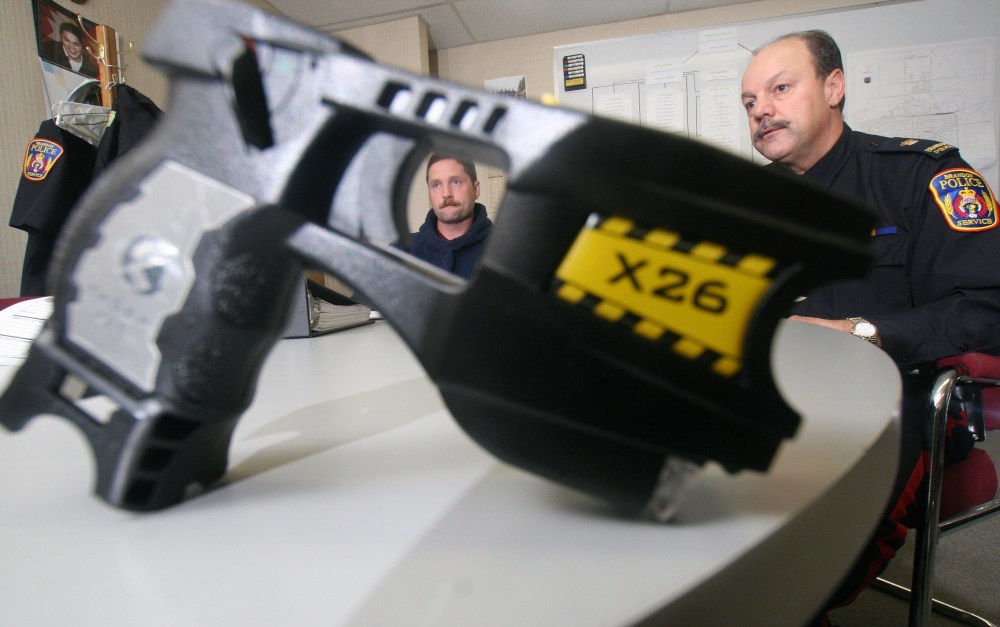
BPS still uses a model of the X26 Taser. The same style of Taser that was used 10 years ago on Brandon Sun crime reporter Ian Hitchen.
Hitchen recounted the painful experience of being shot by Lockhart in the June 15 edition of the newspaper.
“It was five seconds of intense panic I won’t forget,” he wrote. “Hours after I got zapped, I was still trying to figure out what exactly hit me.”
Hitchen wrote that he had a hint of what was coming when a pair of officers took him by the arms to make sure he didn’t collapse to the floor and injure himself.
A moment later he heard the gun crack and a tug on his shirt.
“Before I had time to wonder if the darts embedded in my back hurt or not, the first electric pulse roared through the Taser’s wires and darts and into me,” he wrote. “Then came wave after numbing wave of electricity that seemed to travel up and down my body.”
While the Taser has become commonplace in law enforcement, there was opposition to its introduction in Brandon in 2006.
In 2007, Robert Dziekanski was killed while RCMP officers arrested him in Vancouver International Airport. He was shocked five times and the incident was caught on video.
An inquiry concluded the RCMP were not justified in using a Taser against the Polish immigrant.
The RCMP issued an apology and paid the man’s family a financial settlement after a lawsuit was filed in 2009.
Lockhart said BPS monitored the incident closely.
“Our training and policy was very cognizant of those types of situations,” he said.
Lockhart expects the Police Services Act, which is currently being rewritten in Ontario, will feature new regulations surrounding Tasers that will be adopted by police forces across the country.
The force is also expected to upgrade to the Taser X2 in the next couple of years.
The new stun gun is digital and features more tactical advantages, including a backup shot, dual lasers and a warning arc to ensure accuracy.
“It’s a much more controlled energy delivery system,” Lockhart said. “There is a lot more diagnostic and use information that can be retrieved from the firing records.”
The most recent use of a Taser was Thursday night when officers attempted to arrest a man, who resisted and in the process pushed one of the officers into a hot water tank.
After a struggle, an officer used a Taser to “gain control of the man.”
“It is a very good tool,” Lockhart said. “And like any tool system, it has its time and place. It’s not the answer to every situation by any stretch.”
» ctweed@brandonsun.com
» Twitter: @CharlesTweed