
16 PMH workers earn over $200,000
Advertisement
Read this article for free:
or
Already have an account? Log in here »
We need your support!
Local journalism needs your support!
As we navigate through unprecedented times, our journalists are working harder than ever to bring you the latest local updates to keep you safe and informed.
Now, more than ever, we need your support.
Starting at $15.99 plus taxes every four weeks you can access your Brandon Sun online and full access to all content as it appears on our website.
Subscribe Nowor call circulation directly at (204) 727-0527.
Your pledge helps to ensure we provide the news that matters most to your community!
To continue reading, please subscribe:
Add Brandon Sun access to your Free Press subscription for only an additional
$1 for the first 4 weeks*
*Your next subscription payment will increase by $1.00 and you will be charged $20.00 plus GST for four weeks. After four weeks, your payment will increase to $24.00 plus GST every four weeks.
Read unlimited articles for free today:
or
Already have an account? Log in here »
Hey there, time traveller!
This article was published 09/08/2016 (3524 days ago), so information in it may no longer be current.
While specialists again make up the top earners in Prairie Mountain Health’s Public Sector Compensation Disclosure Report, the document only lists a small number of the doctors practising in Westman.
The report lists every PMH employee making $50,000 or more annually and includes the salaries of physicians, nurses, pharmacists, paramedics, housekeepers and administrators, among others.
Between Jan. 1 and Dec. 31, 2015, the region spent approximately $338 million on employee salaries and 16 employees were paid more than $200,000.
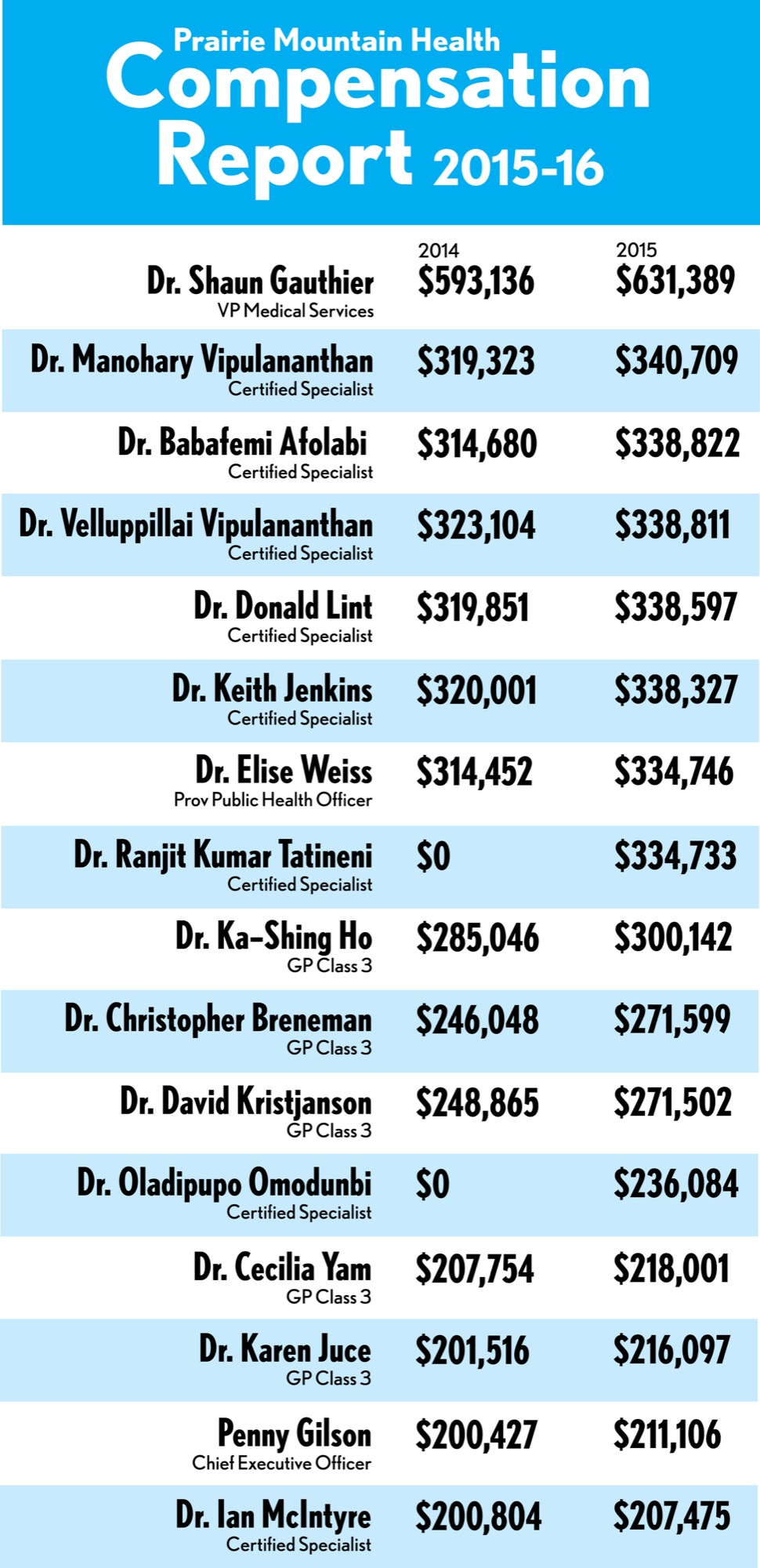
Dr. Shaun Gauthier, PMH’s chief medical officer and vice-president of medical and diagnostic services, held the top spot, earning $631,389 last year. Psychiatrist Dr. Manohary Vipulananthan was the highest paid specialist, taking home $340,708.
However, only salaried doctors are included in the disclosure report — leaving out fee-for-service physicians who make up the majority in the region.
“We have very few of our docs actually in our report,” said PMH CEO Penny Gilson, who made $211,106 last year.
Fee-for-service doctors bill directly to Manitoba Health, Healthy Living and Seniors and the province is responsible for reporting their gross annual earnings — which, in some cases, includes the cost of operating a practice or lab and is therefore different from their net income.
For example, Brandon pediatrician Dr. Emmet Elves and cosmetic dermatologist Dr. Jason Sneath billed the province $856,634 and $1,168,473 respectively in the fiscal year ending March 31, 2015.
“As total revenues and costs of practice vary significantly between specialty groups and between individual practitioners, net income can also vary significantly,” a provincial spokeswoman said via email, adding that Manitoba Health does not pay for doctors providing services to insured patients outside Manitoba.
Gilson says doctors choose different payment options for a variety of reasons.
“Some physicians know that they can actually make more money if they go fee-for-service and are prepared to work hard,” she said. “Some people choose salary because they like that particular type of way of operating the business in the sense that we (PMH) then tend to manage their clinic staff … so they don’t have to run that part of the business.”
Prairie Mountain currently has a physician vacancy rate of nine per cent — most of which is in rural general practices — and Gilson says the highest turnover is usually among salaried doctors.
“We’ve had less turnover in our fee-for-service physicians because they have well-established practices,” she said.
PMH’s salary contracts are negotiated on an ongoing basis and have provisions laid out for termination and are subject to any negotiated settlements with Doctors Manitoba.
Last year, Doctors Manitoba and the province signed a new collective agreement that grants government employed doctors a 1.8 per cent base salary increase beginning in April 2015 and a two per cent annual increase until March 31, 2019. Doctors Manitoba also negotiates the tariffs in the Physician’s Manual that make up fee-for-service billings.
According to the collective agreement, doctors working in Brandon and rural Manitoba make five per cent more than doctors in Winnipeg due to location premiums, while doctors in northern Manitoba earn an additional 25 per cent.
An entry-level doctor working in Brandon currently earns $190,322, but is eligible for annual wage increases based on their classification and level of training. Top-tier doctors can make more than $40,000 on top of their annual salary if they are recognized by the Royal College of Physicians and Surgeons of Canada or the College of Physicians of Manitoba.
As per the Regional Health Authorities Act, health regions are also required to report the annual expenses of their chief executive officers and designated senior officers.
Gilson claimed $22,295 in expenses between April 1, 2015, and March 31, 2016 — the highest of senior staff in the region by more than $14,000.
“The other people (listed) are responsible for one site,” Gilson said, adding that she is required to travel throughout the 67,000-square-kilometre health region. “The jobs are extremely different.”
All of her expenses were claimed in-province and the majority ($17,278) is made up of vehicle mileage. She also spent $3,742 on accommodations, $768 on cellphone and personal communication devices and $505 on food and beverages.
Comparatively, the Southern Health-Santé Sud region CEO claimed $3,355 in expenses; the Winnipeg Regional Health Authority CEOs, three people held the position during the fiscal year, claimed a combined total of $15,445; and the Northern Health Region CEO claimed $27,609, most of which was related to air travel and accommodations.
Size-wise, the most comparable expenses came from the Interlake-Eastern Regional Health Authority’s CEO who claimed $15,331 in a region that spans 61,000 sq.-kms.
» ewasney@brandonsun.com
» Twitter: @evawasney