
Sun Interview Shines On … Dr. Jay Winburn
Advertisement
Read this article for free:
or
Already have an account? Log in here »
We need your support!
Local journalism needs your support!
As we navigate through unprecedented times, our journalists are working harder than ever to bring you the latest local updates to keep you safe and informed.
Now, more than ever, we need your support.
Starting at $15.99 plus taxes every four weeks you can access your Brandon Sun online and full access to all content as it appears on our website.
Subscribe Nowor call circulation directly at (204) 727-0527.
Your pledge helps to ensure we provide the news that matters most to your community!
To continue reading, please subscribe:
Add Brandon Sun access to your Free Press subscription for only an additional
$1 for the first 4 weeks*
*Your next subscription payment will increase by $1.00 and you will be charged $20.00 plus GST for four weeks. After four weeks, your payment will increase to $24.00 plus GST every four weeks.
Read unlimited articles for free today:
or
Already have an account? Log in here »
Hey there, time traveller!
This article was published 19/08/2016 (3516 days ago), so information in it may no longer be current.
I’ve often wondered what motivates people who choose what I would consider perhaps not pleasant careers — dentistry, urology, that sort of thing. What led you to orthodontics?
When I was considering careers, my two other choices were either to be an architect or a journalist. And I thought that both of those would be kind of exciting and fun in creative fields. So I’m glad I chose what I chose, but I’m sure I would have been happy if either of the other ones had worked.
Well, I can tell you that as far as I’m concerned, journalism is wonderful! But the options on your list are pretty disparate choices.
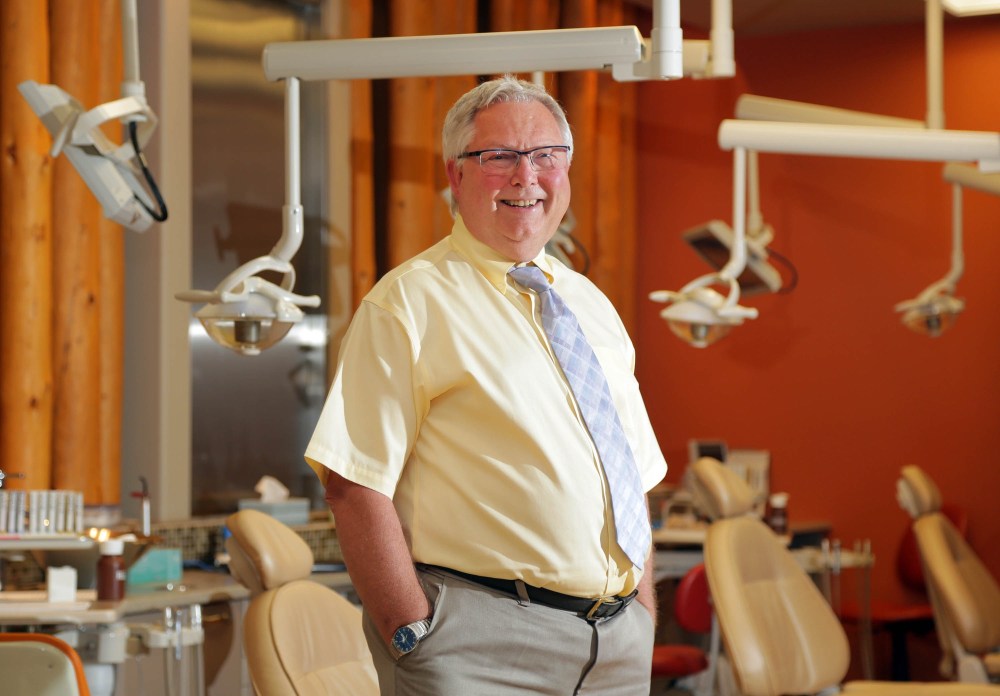
They are. And I don’t know why. Maybe when you’re young, you don’t think too rationally — you just know what you’re interested in. But the journalism — I like writing so I thought that would be fun, and maybe involve some travel and stuff like that in the process.
But here you are! So why was orthodontics your choice out of the three?
I think there are a few reasons for that. I originally started off in business school. I was born in Florida and raised in New York City and I went to The Wharton School of the University of Pennsylvania. And I really enjoyed it, but having been raised in New York City, which isn’t exactly a kid-friendly place, I knew I didn’t want to live in the big city. And it became clear that to have a really good career in business, you’d have to, more or less, live in a big city. I mean, you’d have to live in towns that had corporate headquarters and that type of thing. So I started looking around at different career alternatives, and I briefly looked at law. But I thought that would be too bookish, maybe — looking up precedents all day — I thought it might get boring. I looked into medicine and decided not to go there — my dad literally worked seven days a week, 16 hours a day, and I realized if I went into medicine, I’d have to be on call and I thought that it wouldn’t leave a lot left over for a real life. And a friend of mine — a roommate at the time — his dad was a dentist and suggested I consider dentistry. So he arranged for me to visit a couple of different offices.
It’s funny. I never wanted to do dentistry, but I knew from the beginning I’d like orthodontics. So I went to dental school, not with the idea of becoming a general practitioner, but knowing that I wanted to get into orthodontics.
But you had to do the dentistry first?
Yes.
So you have expertise in that area, then, too. But what was the draw to orthodontics?
Well, you have to understand I’m biased and prejudiced (laughs)! I think that, honestly, orthodontics is the most creative and intellectually challenging of the fields, because basically you’re figuring out a two-year treatment plan and there are lots of elements that go into that. And then also the fact that I’d be working with younger individuals was attractive as well. So it just really worked out. I love it.
And what do you love about it? Helping people?
Well, I definitely like that, but I don’t want to sound too cliché, if you know what I mean. I think what I like most about it is the visual result. My ex-wife was primarily an administrator and she worked very hard and was very good at her job. But I could never have a job where it was never really completed — it was always a work in progress — and where there was also never a visual outcome. For some reason or other, I like the visual outcome. And when I see a patient’s teeth at the end — see how nice they look and compare that to where I started, it gives me a sense of accomplishment. And I get that daily.
Another thing that’s nice about my profession is people are here because they want to be here. I’m not solving a disease problem or something else where they’re there because they have to be there. Basically people see an orthodontist because they want to have nicer teeth.
It’s not always cosmetic, though, right? I mean, people have other reasons why they need their teeth attended to.
Definitely the reason people seek treatment it’s because they want their teeth to look better. But the fact of the matter is is that anything that works right, looks right. And people think that I’m concerned about the way the teeth look from the beginning of treatment, but all I’m worried about initially is getting them to work right. And it’s only in the very end phases, which I sort of call finishing, that I’m just polishing off little aesthetic things. So when parents ask, ‘Why is this really necessary?,’ I’ll show them the child’s mouth and I’ll say, ‘Well, if your transmission went together like that and the mechanic said you didn’t need to get it fixed, would you leave the car there?’ And they wouldn’t. So yes those things that work right, look right, and that’s a nice aspect of it.
Are the majority of your clients youngsters?
For the first 20 years of practice or so, I would say 99 per cent of them were youngsters. And probably in the last 15 years or so, there’s being a marked increase in the number of adults seeking treatment, both men and women. I remember when I first started in Brandon, a lot of parents would ask me, ‘What’s the point of doing this stuff? They’re going to lose their teeth anyway.’ And I tried to explain that, no, that didn’t necessarily happen. But that was probably their family experience.
And you don’t mean baby teeth?
No, I mean permanent teeth. That was before kids commonly wore mouth guards. Half my hockey patients would have a missing tooth or two. I mean, half is an exaggeration, but a number of them would. It was actually the Children’s Dental Program that was started in southwestern Manitoba that was sponsored by the NDP government way back when. But they started setting up clinics in schools and taking care of kids’ teeth. And I think that had a profound change on people’s attitudes toward dentistry. They saw if their kids took care of their teeth, they could keep them. So the parents started paying more attention and putting more value on it. I never get asked anymore what’s the point. So I think things have changed a lot. It’s only since about 1950 that the idea that good dental health pays off has sort of been proven.
I would imagine in some cases there would be financial reasons why people wouldn’t do it. But doesn’t it make more sense to attend to the teeth earlier so that they grow properly throughout the course of a lifetime?
You have to understand that, coming from the States where I was raised and did my schooling, we didn’t have socialized medicine down there, so people were used to paying for their medical care. And I remember a lot of parents would ask me when we were discussing treatment, ‘Who’s going to pay for it?’ And they didn’t like the answer — YOU! But that’s changed a lot and I think people now — I mean, it is expensive, and I’ll never deny that. But I am just amazed by what parents will do for their kids. And there’ve been a couple of recessions since I’ve been in practice and I remember when the first one started, I thought, well, that’s the end of me for a few years. But parents make all sorts of sacrifices to make sure their kids get what they need.
And people in western Manitoba are quite practical, which is an attribute I like about them. So I think they ask a fair number of objective questions. And it’s not just that I think — I know — that the people who get the best dentistry end up spending the least on dentistry. If you take really good care of your teeth from the beginning, you’re going to have fewer maintenance problems and spend less in the long run, even though at the time it might seem to be very expensive.
You mentioned that more adults are coming for orthodontic treatment now.
I would say it’s about a 70-30 split — 70 per cent youngsters and 30 per cent adults. When I first came here, I tried for years and years to get my first Hutterite patient. And originally, they didn’t see any value in it and I always said, ‘Please bring the boss in — I’d like to explain to him the benefits of what we do.’ And I was in practice for 10 years before I had my first Hutterite patient. And now I have lots of Hutterite patients. So I think it’s not just orthodontics — it’s attitudes about dental health that have changed.
How did orthodontics lead you to Brandon?
When I first got out of orthodontic school, I had done a fair amount of research, mostly in biochemistry and molecular biology, and I was quite sure I wanted a career in academics. At that time, the University of Manitoba had one of the strongest research programs in North America in orthodontics, and it was primarily due to the founding head of the department, a fellow named John Cleall. He’d started the program and had encouraged research — all the orthodontic residents had to do a significant research project. So that was one of the things that attracted me here.
And another was that when I was going through my ortho residency, a resident in the Pediatric Dentistry program was from Manitoba. And so when Cleall announced that he was moving on to the University of Illinois, he suggested that they try to recruit me to come up here. So they did a very good job of that. I had a wonderful time at my interview and thought that the University of Manitoba was one of the friendliest places I’d ever been associated with. And I want to be clear: It is no accomplishment to get an academic job in orthodontics. I mean, they go begging because there’s such a big difference in income between academics and private practice. So I don’t want to hold out that it was an accomplishment for me to get the job, because it wasn’t.
So anyway, I was teaching full-time and the dean was very good to me because he knew I was into some research and he gave me a really light committee load which allowed me a fair amount of time for research. But I was young, I was fresh out of school, I didn’t have any clinical experience, and yet I was teaching a clinical science.
This is a true story: One of the committees I had to sit on was the maintenance committee, and that was a committee that did almost nothing. But I remember this committee meeting — we were sitting around and discussing the broken urinal on the second floor and I thought, ‘What the hell am I doing?’ So between that and not really feeling competent to teach a clinical science at that stage, I decided I’d go into practice and Brandon seemed to be a really good opportunity. There was one fellow from Winnipeg who was travelling out here occasionally, but nobody was here full time. And I’ve never regretted it. When I visit friends back in the States, they say, ‘Why did you settle for Brandon?’ And I say, ‘Well, you just don’t know Brandon! It’s a great place to live, the people are friendly here, yes, we have a winter, but it’s a true winter, so if you get into winter activities, you can enjoy it. And the summers are marvellous.’ I’ve always appreciated the length of the day here — you get out of work and you still have a full day left to enjoy. The only thing I don’t like about Brandon are the mosquitoes.
So this is your 40th year in orthodontics. I would think that’s a long time in any field.
It IS a long time in any career. But I can tell you I’m happier than I’ve ever been in my life. I work three days a week, so I’m sort of part time, but I still very much enjoy what I do. And I get plenty of free time, and though a lot of people my age are retiring, I’m not going to fix what isn’t broken.
My job isn’t drudgery at all, and I very much enjoy the social interaction — I enjoy the kids, I really enjoy talking with their parents, and because I see them for a couple of years, I sort of know what they’re involved in and it gets to be friendly and not just all professional. So that’s extra nice.
Can we safely say with 40 years in orthodontics, you’re going for the golden anniversary in the profession?
Well, I have no plans to retire!