
Celebrating 40 years of bluebird protection
Advertisement
Read this article for free:
or
Already have an account? Log in here »
We need your support!
Local journalism needs your support!
As we navigate through unprecedented times, our journalists are working harder than ever to bring you the latest local updates to keep you safe and informed.
Now, more than ever, we need your support.
Starting at $15.99 plus taxes every four weeks you can access your Brandon Sun online and full access to all content as it appears on our website.
Subscribe Nowor call circulation directly at (204) 727-0527.
Your pledge helps to ensure we provide the news that matters most to your community!
To continue reading, please subscribe:
Add Brandon Sun access to your Free Press subscription for only an additional
$1 for the first 4 weeks*
*Your next subscription payment will increase by $1.00 and you will be charged $20.00 plus GST for four weeks. After four weeks, your payment will increase to $24.00 plus GST every four weeks.
Read unlimited articles for free today:
or
Already have an account? Log in here »
Hey there, time traveller!
This article was published 21/10/2016 (3370 days ago), so information in it may no longer be current.
When Ken Barclay hears a bluebird sing, his head turns.
“When you get to know the voice, it’s great, but mainly it’d be the colour,” explained Barclay of what he notices when hearing the elusive avian’s call.
“It’s a special bird, it’s not like any other kind of blue.”
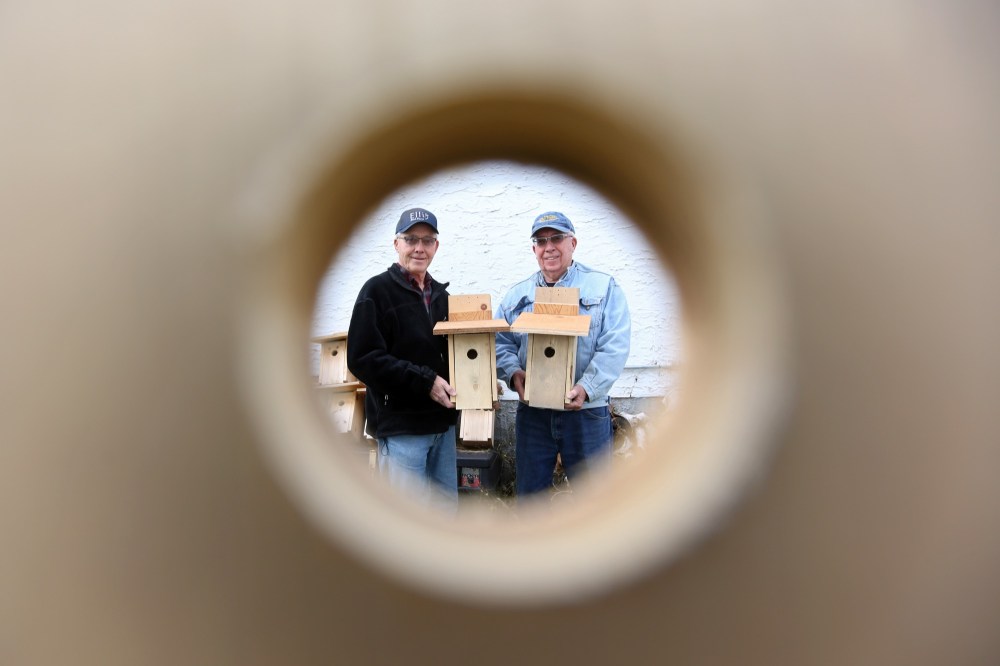
The bluebird all but disappeared decades ago on the prairies of western Manitoba, where it is supposed to flourish, until one man from Brandon, Jack Lane, changed that.
Now, 40 years following Lane’s passing, the group borne out of his life’s work has the same mission — to protect the bluebird.
Friends of the Blue Birds will celebrate 40 years at its next meeting Sunday afternoon at the Riverbank Discovery Centre in Brandon.
The informal organization only meets twice a year, but boasts approximately 90 members, 50 of whom actively monitor the few thousand bluebird-nesting boxes atop fence posts in Westman. They jot down specifics like the number of eggs, number of young birds taking their first flaps and if a second nesting occurred. They record all their statistics for posterity.
As marvellous as a bluebird is, there are other reasons compelling Barclay to take four hours out of his day, every few weeks, to check on his 150 birdhouses, some northwest of Souris and the rest south of Shilo.
“It’s the conservation, the outdoors,” Barclay said. “You’re going to see bluebirds. You’re going to see wildlife. You’re going to see wild flowers.”
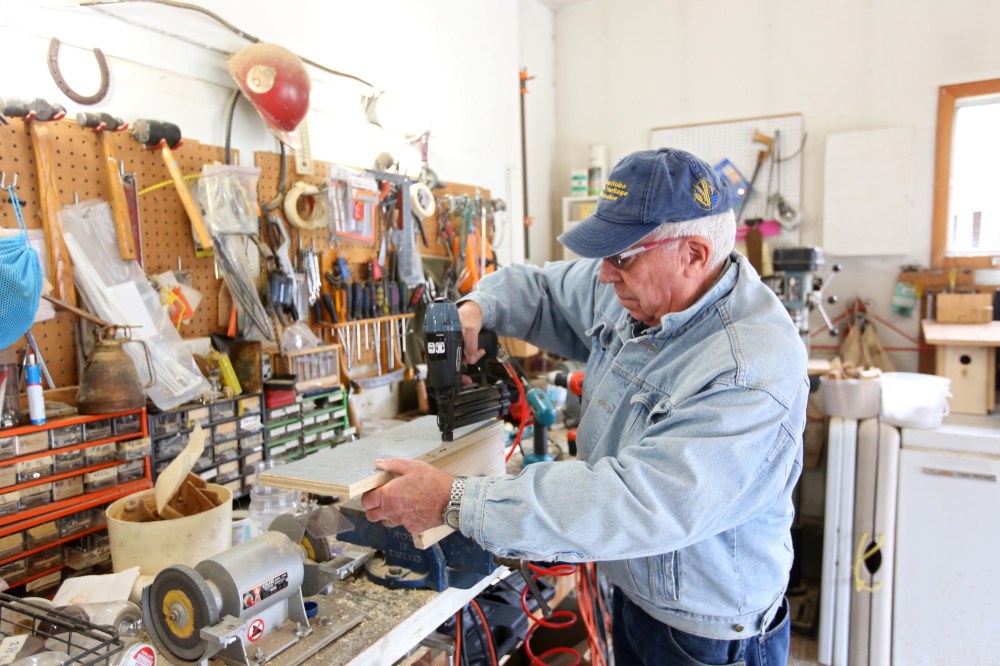
Herb Goulden, a retired wildlife biologist, has long been fascinated with the outdoors, as his career attests. He now builds birdhouses out of his garage, and is one of the volunteers who documents the local bird population.
He said tree swallows occupy the birdhouses, too, which doesn’t bother the Friends of the Blue Birds, since both species are at risk.
“These are cavity nesters, nestled in hollow trees, normally made by woodpeckers,” Goulden said of both animals. “Most of those kinds of trees have been knocked down or done away with it, so these boxes work well.”
Lane started building nesting boxes, after the avid birdwatcher noticed, in 1959, he hadn’t heard a bluebird sing in 30 years. He and his wife Nora formed the Brandon Junior Birders club, which, in collaboration with local children, built birdhouses to replicate the trees where the birds nested.
By 1962, the group spotted their first bluebird.
In the early 1970s, they wrapped a band around every bluebird they found. They counted more than 10,000 mountain bluebirds and nearly 2,000 eastern bluebirds within four years.
At its height, there were 4,500 nesting boxes along a 2,414-kilometre stretch, a year before Lane’s passing in 1975.
These days, Goulden estimates there are between 2,000 to 3,000 birdhouses throughout the region — many of which are tended to by their members.
Like anywhere in North America, bird populations are vulnerable as urbanization, agriculture growth and even climate change threaten their natural habitats.
Goulden said it sometimes feels like a losing battle.
“I think, overall, we’re not quite holding our own,” he said.
Bluebirds thrive in native prairie grasses, and man-made developments wipe out those pastures.
“They’re kind of like the canary in the coalmine, the last remnants of prairie, that’s where you’ll find the bluebirds,” he said. “They need grasslands and they need the insects.”
Lane’s commitment is apparent in volunteers like Goulden and Barclay, who, along with dozens more, want the bluebird to be a sight for birdwatchers to witness decades from now.
They need younger volunteers to get involved, however, and they encourage anyone interested to attend this weekend’s meeting.
“For me, this is an excellent example of how much people care about wildlife — in this particular case, bluebirds and tree swallows,” Goulden said. “It’s people giving to conservation right out of their own pocket.”
Friends of the Bluebirds holds its next meeting Sunday at the Riverbank Discovery Centre at 2 p.m.
» ifroese@brandonsun.com
» Twitter: @ianfroese