
Sun interview shines on Kevin McPhail
Advertisement
Read this article for free:
or
Already have an account? Log in here »
We need your support!
Local journalism needs your support!
As we navigate through unprecedented times, our journalists are working harder than ever to bring you the latest local updates to keep you safe and informed.
Now, more than ever, we need your support.
Starting at $15.99 plus taxes every four weeks you can access your Brandon Sun online and full access to all content as it appears on our website.
Subscribe Nowor call circulation directly at (204) 727-0527.
Your pledge helps to ensure we provide the news that matters most to your community!
To continue reading, please subscribe:
Add Brandon Sun access to your Free Press subscription for only an additional
$1 for the first 4 weeks*
- Enjoy unlimited reading on brandonsun.com
- Read the Brandon Sun E-Edition, our digital replica newspaper
*Your next Free Press subscription payment will increase by $1.00 and you will be charged $20.95 plus GST for four weeks. After four weeks, your payment will increase to $24.95 plus GST every four weeks.
Read unlimited articles for free today:
or
Already have an account? Log in here »
Hey there, time traveller!
This article was published 23/12/2016 (3462 days ago), so information in it may no longer be current.
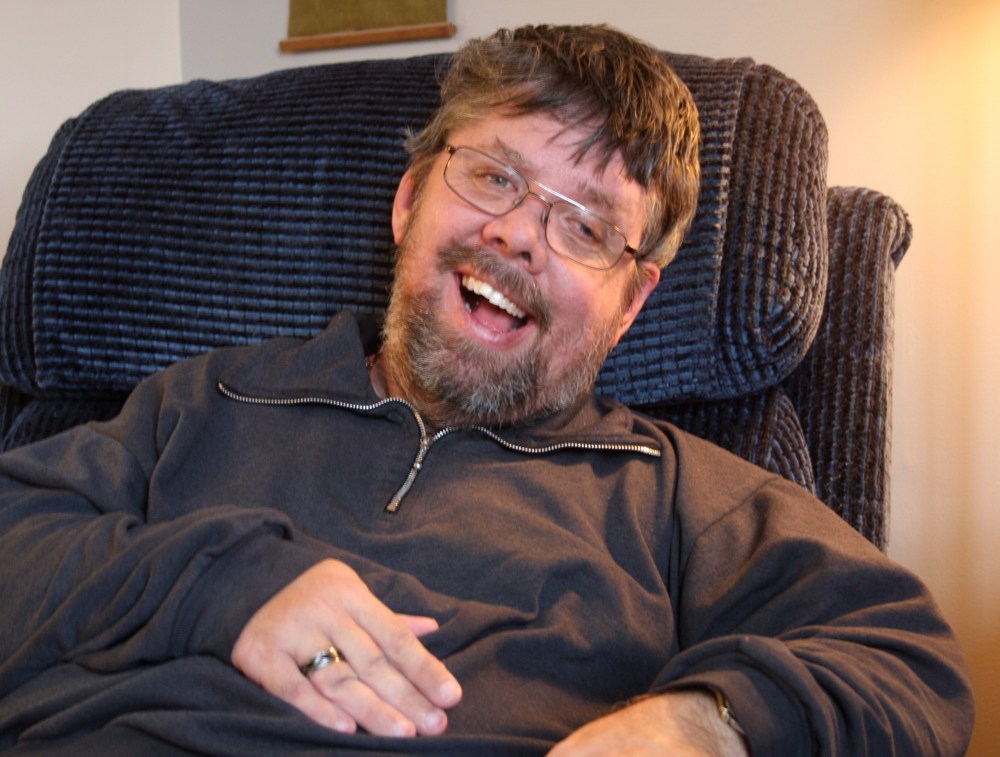
This is a story I’ve wanted to tell for decades. But the rules of journalism are clear — you never interview family members. However, since this is the final instalment of Sun Interview Shines On, I’m making a very rare exception.
Kevin McPhail is my stepson. When he was 13 years old, he suffered a traumatic brain injury after being flipped off an all-terrain vehicle he was driving. He sailed over the handlebars and landed on his head. He was not wearing a helmet. But the doctor who oversaw his care and studied the location of his injuries for several months told my husband, Kevin’s father, that in this unusual and exceptional instance, he felt if Kevin had been wearing a helmet, its weight and other factors actually might have broken his neck and killed him. But while we’ll never know, we all believe that everyone who operates these vehicles should wear a helmet.
Kevin spent six months in a coma and remained in care for 18 months after that. The speech centre in his brain was destroyed, and he had to learn to talk — and walk — all over again, which he did. But he still has trouble speaking. His right arm is only semi-functional. He’s blind in his left eye, he lost his sense of smell, he has braces on his feet and one leg, and uses a cane and a scooter to get around. His emotional reactions are unpredictable and sometimes uncontrollable, in that he often bursts into tears when he truly wishes to laugh. Many who suffer acquired brain injuries have no outward symptoms but suffer from personality disorders and often experience episodes of anger and violence. But that’s not the case for Kevin. Although his physical problems are readily evident, he’s always upbeat and full of fun. With his litany of jokes, his frequent laughter, and his zest for life, he’s become a familiar character around Brandon’s downtown and at Shoppers Mall, where many merchants spoil him endlessly.
So you have no memory of the accident?
None at all. Which I think is good. If I remembered, I’d probably have nightmares of the crash.
What was your first memory when you came out of the coma?
I wondered what the heck happened!
And what was your reaction when they told you what happened?
I don’t recall. I was just dismayed. I used to be able to do all those things — like speak and walk — it was just natural. And then all of a sudden, I couldn’t do anything anymore.
Do you remember the relearning process? Was it difficult?
It was very difficult. I learned to walk again and I couldn’t speak for years.
What happened when you finally had breakthroughs? Was it sort of exciting?
Yeah — I sang in church. Everybody was crying. It was fantastic!
The people of First Presbyterian Church have been really good to you, haven’t they?
Yes. They give me rides to places and when it’s snowing or raining, I call a cab and the church pays for it. They’re my extended family.
This is a difficult question, but with what happened to you, how do you maintain your faith in God? Because you are very faithful to your religion.
I didn’t die in the accident. I have some problems. But I can overcome them.
Do you overcome them with God’s help?
Who knows? But maybe God works through the people at the church who are so good to me. They treat me like a human being. And I have a job at the church, too. I go in and turn on the lights in the sanctuary for Sunday services. I put out the “No Parking” signs. And I lock the doors after church is over.
So the folks at First Pres make you feel important and valued, then.
Very much so.
Do other people make you not feel that way? Or are most people considerate?
Some people don’t make any allowances for your handicap. They ignore you. Some people treat me like I’m crazy. I think they’re crazy for thinking I’m crazy.
But most people treat me with dignity and respect.
Is that a change that you’ve noticed over the years? Because you’ve been living with this for almost 35 years now.
People used to distance themselves from me. They’d wave bye-bye and back away. Now they introduce themselves to me. For the most part, society has accepted me.
I’m encouraged to hear that. I’ve noticed, over the years, too, that people seem much more understanding. I guess as a society, we still have a ways to go, but at least we’re making progress.
I remember when I was in a wheelchair for a couple of months, it was very difficult to get around. But now, they’ve put ramps on most of the curbs to make it easier to be on the sidewalk. And they’ve made stores a lot more accessible.
I remember once, after I came out of the coma, I was in a wheelchair, and my family was taking me out to dinner at a restaurant in Calgary. And they had to wheel me in through the kitchen because there wasn’t a ramp or a flat surface!
And now accessibility is the law, too, which has certainly helped.
It has indeed.
Because there’s not a lot of stuff for you to do, you end up spending a lot of time downtown or at the mall, right? It’s sort of a daily social outing for you.
Right. I go every day except Sundays. I have fun bugging people. And they have fun bugging me.
What do they bug you about?
Anything and everything! (laughs)
Why do you suppose they’re so nice to you?
Because they’re good people. They’re accepting people. They don’t care if you’re handicapped or not.
Tell me a bit about ABI, or the Acquired Brain Injury support group in Brandon. It caters to all of Westman, I know. But you’ve been attending the meetings since its inception several years ago.
We meet at 7 p.m. on the third Monday of every month at the Public Health Office, A5 in The Town Centre. Our next meeting is January 16, 2017. People who have been brain-injured on the job, in car accidents, in sports, in any way or situation, are welcome to come. And their family members are encouraged to come, too.
We meet as a group to start with and then split off into survivors and caregivers so both groups can discuss issues that matter to them.
You were older and well established in dealing with your disabilities when this group started. Why do you keep going to the gatherings?
It’s a place I feel like I really belong. And maybe my story can help other people learn how to cope with what’s happened to them.
So life has dealt you a severe blow. But you’re so upbeat! I’ve always been so very proud of how you manage to charm the socks off people and how you make them laugh! You always seem to be in such good humour. Where does that come from?
My motto: “Don’t worry. Be happy.” I can’t change what happened. So I might as well make the best of it.
But you really seem to be into spreading joy! You leave people laughing in your wake.
My motivation is just to be happy. Don’t be sad. What’s the use? When I came out of the coma, I wanted to kill myself. So I went to a psychiatrist. And he said I was meant to be alive.
And you believed him?
Of course. I wouldn’t be here otherwise.
So then you decided your mission was make your life the best life you could? How do you do that?
I don’t know what I do, but I do it! I try to leave big footprints. Hopefully of understanding and acceptance. I don’t want anybody’s sympathy. I just want their respect. And I get that most of the time. It’s great!