
Shilo soldiers put bombing skills to test
Advertisement
Read this article for free:
or
Already have an account? Log in here »
We need your support!
Local journalism needs your support!
As we navigate through unprecedented times, our journalists are working harder than ever to bring you the latest local updates to keep you safe and informed.
Now, more than ever, we need your support.
Starting at $15.99 plus taxes every four weeks you can access your Brandon Sun online and full access to all content as it appears on our website.
Subscribe Nowor call circulation directly at (204) 727-0527.
Your pledge helps to ensure we provide the news that matters most to your community!
To continue reading, please subscribe:
Add Brandon Sun access to your Free Press subscription for only an additional
$1 for the first 4 weeks*
- Enjoy unlimited reading on brandonsun.com
- Read the Brandon Sun E-Edition, our digital replica newspaper
*Your next Free Press subscription payment will increase by $1.00 and you will be charged $20.95 plus GST for four weeks. After four weeks, your payment will increase to $24.95 plus GST every four weeks.
Read unlimited articles for free today:
or
Already have an account? Log in here »
Hey there, time traveller!
This article was published 25/01/2017 (3419 days ago), so information in it may no longer be current.
CFB SHILO — Military personnel essentially acting as air traffic controllers are treating communities like Sprucewoods as under siege by insurgents.
It’s part of a training exercise a trio of Joint Terminal Attack Controllers, or JTACs, have been involved in during a multi-week international effort described as Exercise Banshee Strike.
Sgt. Lane Starling, who also has experience calling in artillery attacks from the ground, is one of approximately 15 soldiers at CFB Shilo trained in co-ordinating airstrikes.
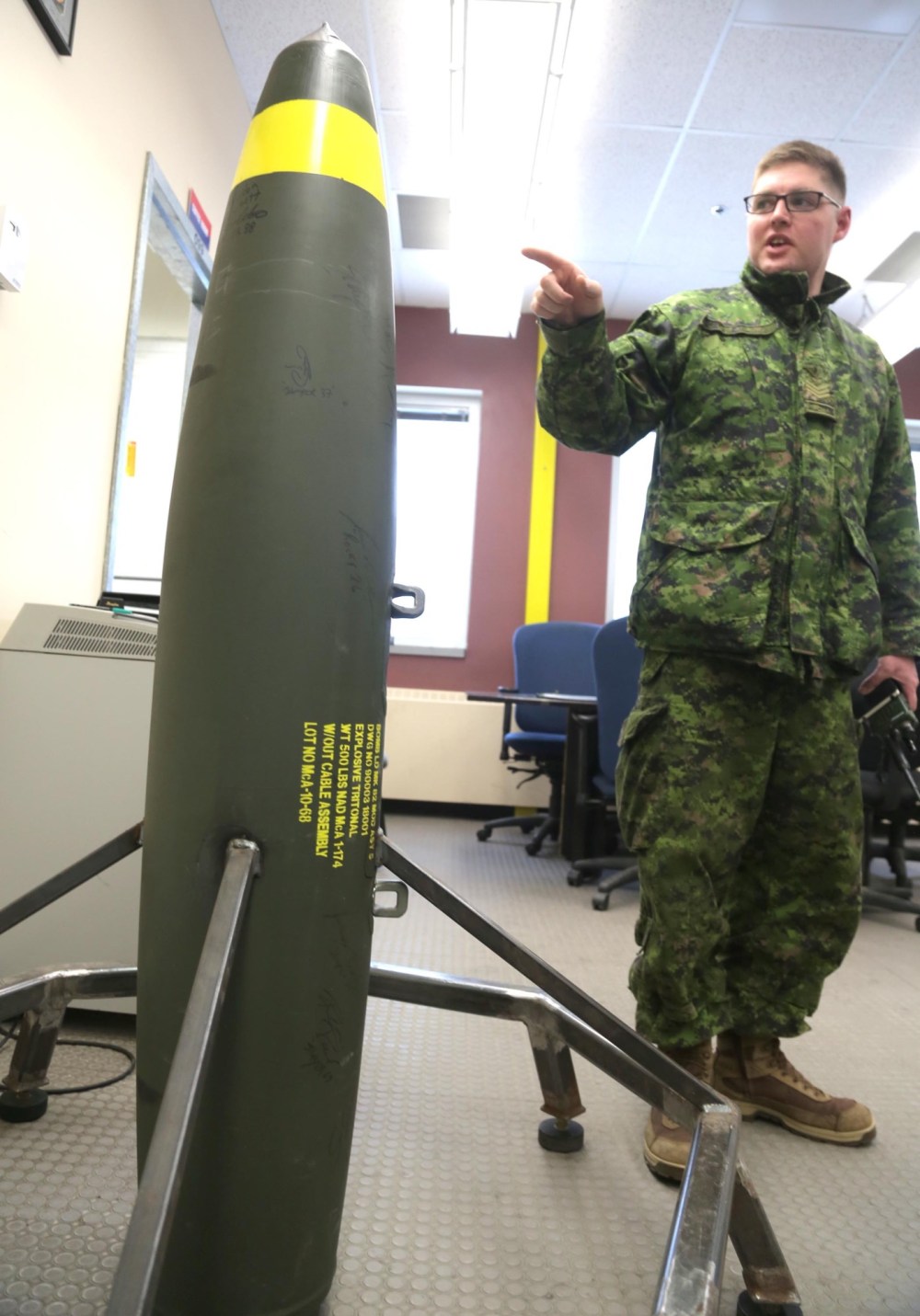
“I’ve done about 13 years in the military, and it is by far the coolest thing that I’ve done, talking to airplanes,” Starling relayed.
“The ability for me to do that and call in artillery fire — I’ve got more firepower at my fingertips than Jesus.”
He and two other JTACs are guiding aircraft simulations with the 69th Bomb Squadron, stationed at the United States Air Force base in Minot, ND.
On Tuesday afternoon, Starling, who has been stationed in Shilo for about six years, and Master Bombardier Joel Favron, in Shilo the last eight years, established the parking lot of the Waggle Springs Fish
and Game Association’s headquarters in Sprucewoods as their base for planning airstrikes.
The two JTACs were part of a scenario where rebel forces stole armoured vehicles and infiltrated a community. It’s a scenario comparable to ISIS-organized schemes taking place in areas of the Middle East.
One of the simulations Tuesday involved bombing three separate targets.
Starling said they use communities like Sprucewoods and CFB Shilo to replicate real-life scenarios.
“We use the local pattern of life to simulate what you would see actually overseas, in a regular town anywhere in the world,” he said. “There’s going to be people walking around, vehicles driving.”
Starling referenced an example of an insurgent leader entering a building.
“We like to make it difficult for each other, so we’ll put it next to a church or next to a school, so we have to force ourselves to mitigate that (complication) in order to go through all the appropriate procedures to strike the right target,” he said.
It can take anywhere from three to 10 minutes for a massive B-52 bomber, flying more than 20,000 feet overhead, to strike an actual target. In yesterday’s simulation, it took around 20 minutes as the crew aboard the American aircraft were learning.
An alpha jet, which flies significantly lower during training exercises, could not participate in Tuesday’s exercise because of cloud cover. The privately contracted fighter jet does not have the resources an operational military aircraft does to handle poor visibility.
Americans aboard the B-52 bomber — one of three of these aircrafts in the sky yesterday, too high above to be seen — could not utilize their cameras and thus relied on the Canadians to be their eyes on the ground.
In a real scenario, ground forces would always be involved in finding a target and ensuring an attempted bombing is safe.
“It comes to JTACs to brief them on what’s going on,” Starling said.
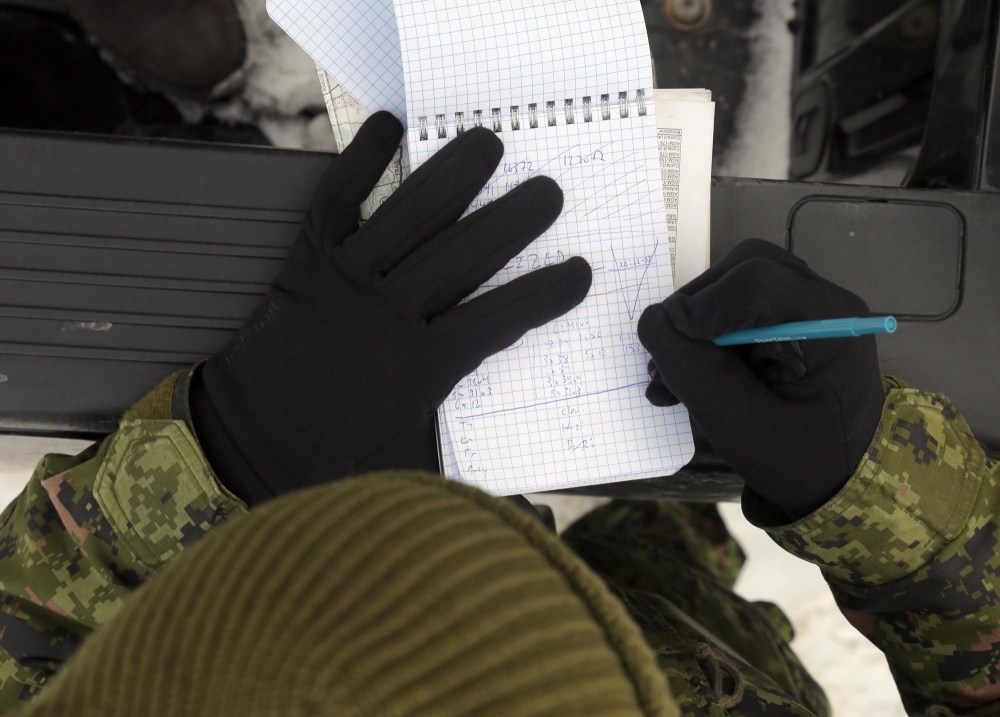
On instances where a camera can be employed, JTACs use what Starling described as a “Game Boy” to see footage from the camera and direct the jet’s personnel to the right target. A radio ensures constant communication between the parties.
After three weeks of simulation exercises, next week will involve releasing actual bombs. The projectiles, dropped in open terrain, will range in weight from 500 to 2,000 lbs.
“When we drop here, Wawanesa will let you know,” Starling said of the noise. “We usually rattle their windows pretty good.”
These exercises are an invaluable collaboration between soldiers on both sides of the border, he explained.
It ensures Americans are well-trained and gives Canadian JTACs practice with the jets they would direct on a battlefield.
“We gain value operating with their aircraft types,” Starling said. “Usually, in the theatre, the Americans have the big toys we’d be operating with.”
Favron got involved in aircraft coordinating after chatting with other soldiers who had the experience.
He has been a JTAC for approximately three years.
Favron notes his friends back home can only do what he does in a video game.
“Some of them get a little jealous, that’s for sure.”
» ifroese@brandonsun.com
» Twitter: @ianfroese