
Where Are They Now: Hoad helped change Brandon’s fortunes
Advertisement
Read this article for free:
or
Already have an account? Log in here »
We need your support!
Local journalism needs your support!
As we navigate through unprecedented times, our journalists are working harder than ever to bring you the latest local updates to keep you safe and informed.
Now, more than ever, we need your support.
Starting at $15.99 plus taxes every four weeks you can access your Brandon Sun online and full access to all content as it appears on our website.
Subscribe Nowor call circulation directly at (204) 727-0527.
Your pledge helps to ensure we provide the news that matters most to your community!
To continue reading, please subscribe:
Add Brandon Sun access to your Free Press subscription for only an additional
$1 for the first 4 weeks*
- Enjoy unlimited reading on brandonsun.com
- Read the Brandon Sun E-Edition, our digital replica newspaper
*Your next Free Press subscription payment will increase by $1.00 and you will be charged $20.95 plus GST for four weeks. After four weeks, your payment will increase to $24.95 plus GST every four weeks.
Read unlimited articles for free today:
or
Already have an account? Log in here »
Hey there, time traveller!
This article was published 22/02/2017 (3398 days ago), so information in it may no longer be current.
Jeff Hoad was there when it all turned around for the Brandon Wheat Kings.
Now 44 and a member of the Brandon Police Service, he played 226 regular season and playoff games with Brandon before being dealt to the Tri-City Americans as an overager during a Western Hockey League career that stretched from 1989 to 1994.
He was a part of the Brandon team with the fewest wins in franchise history, but also with the one that showed the biggest year-over-year improvement in Canadian Hockey League history.
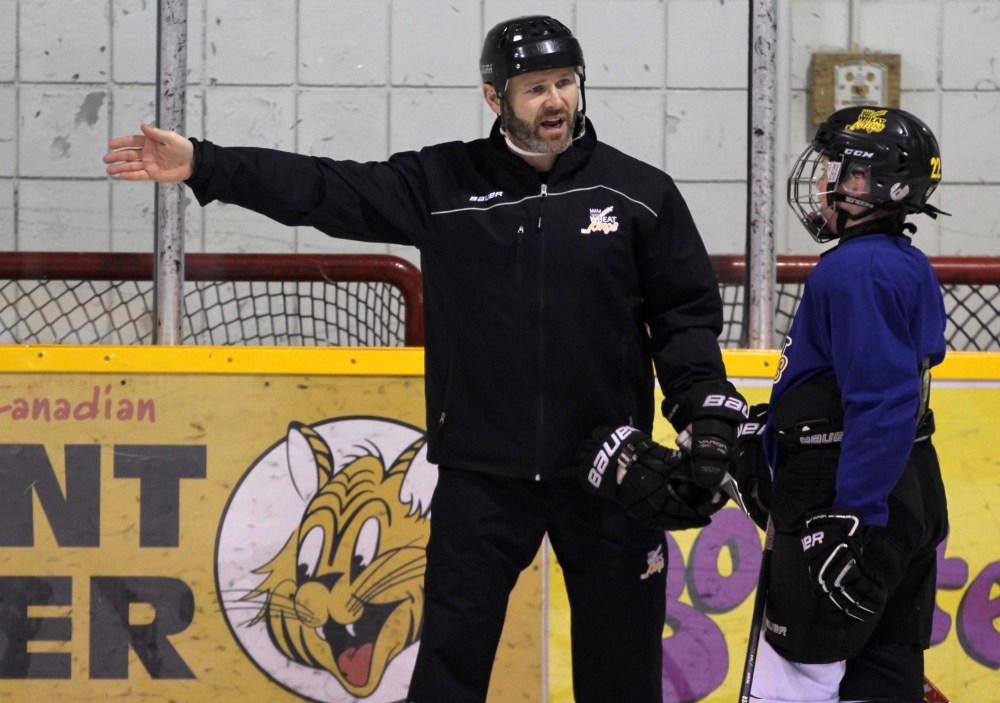
“I was here with some very good players on some not-so-good teams,” Hoad said. “Slowly that transition was taking place where they were bringing some players in. Marty Murray and Bobby House came from Spokane and they were big additions to our team. Marty Murray was 15 years old and everybody knew what type of player he was going to be. It was nice to be part of that transition from a team that struggled to turning that team around, not just for a season, but going forward since ’93-94 to what the team’s become.”
In the fall of 1989, Hoad was a born-and-raised, 16-year-old Brandonite looking to crack the roster on a team that had won just 25 games the year before and missed the playoffs.
The young forward earned a spot under head coach Doug Sauter, but would only stay for 11 games.
“I had a great experience but there was part of me that wasn’t 100 per cent sure that I was ready for that,” he said. “Part of me looks back now and wishes that I stayed that season. The reason I went down was a conversation I had with GM Kelly McCrimmon at the time whether I wanted to stay for the season or go back to AAA midget.”
Hoad ultimately elected to return to the Manitoba AAA Midget Hockey League, where he earned an all-star game spot in 1990 with future Wheat King teammates Craig Geekie, Mark Kolesar, Mike Maneluk and Todd Dutiaume.
Two of those players would prove to have a significant impact on his WHL career four years later.
In the fall of 1990 he stuck with the Wheat Kings. Hoad would go on to play 281 Western Hockey League games, scoring 96 goals, adding 116 assists and drawing 491 penalty minutes.
“I look back at my time with the Brandon Wheat Kings as probably my fondest time of my hockey playing career,” he said. “The biggest reason for that is once you turn pro, it becomes a business. You’re now looking after yourself financially, you’re married and have kids, you’re paying the bills. It’s a job. When you’re playing with the Brandon Wheat Kings or in the WHL wherever you’re playing, it’s a team. You’re playing for each other.”
His first two full-time seasons with the club — 1990-91 and 1991-92 — weren’t exactly high-water marks for the club. They missed the playoffs both seasons.
Hoad said current local players who are Wheat Kings — Tyler Coulter, Tanner Kaspick, James Shearer, Ty Lewis and Connor Gutenberg — have one big advantage that he didn’t
“They’re a little more fortunate with the teams that they’ve been on,” he chuckles. “They had a very good team, going to the Memorial Cup and their WHL championship. My first couple of seasons with the Brandon Wheat Kings we were not very good. We won 19 games one year, and in my 18-year-old season I remember fondly that we only won 11 … Everyone would go home but I lived here so through the summer and I was constantly getting questions about the team and why we weren’t very good. That made it more difficult but it didn’t take away from my experience. It only made it better.”
Hoad served as captain in his 19-year-old season, 1992-93, one of the most pivotal in Wheat King history.
After the 11-win campaign the year before, a team that included players such as Marty Murray, Bobby House and Darren Ritchie finally emerged, making the playoffs for the first time in five seasons and just the second time in nine years.
The Wheat Kings would miss the playoffs only twice in the next 23 seasons.
Hoad said one of the turning points came that summer when Brandon added his friend Trevor Robins from the Saskatoon Blades during the summer, giving the team a top overage netminder who would play in 59 games.
“You could see that things were falling into place,” Hoad said. “Going into training camp there was a different feeling in that dressing room. That was the first year that Bobby Lowes came in as head coach, and that was also the year I was named captain of the team, which was a huge honour. You could tell right from training camp that things were different.”
The Wheat Kings went on to win 43 games. They lost their first-round, best-of-five playoff series to a veteran Medicine Hat Tigers team 3-1, part of the process of learning to play in big games that would lead to a league title in 1995-96.
“I just remember that season being so much fun,” Hoad said. “After going through the previous years, which was so tough, to finally get to a point where we have a good team here and we’re winning, it was a good feeling.”
In his overage season, Brandon had five players competing for three spots. The others were forwards Pete Mehalic, Maneluk and Kolesar, and defenceman Dwayne Gylywoychuk.
Hoad picked a terrible time to get sick. An infection in his throat early in the season landed him in the hospital, where he lost 25 pounds. In the meantime, the Wheat Kings played five games and did well.
“Good for the team, maybe not so much good for me,” he chuckles.
McCrimmon decided on keeping Maneluk, Kolesar and Gylywoychuk, sending Hoad to the Tri-City Americans for 16-year-old Mark Dutiaume.
“It was beyond disappointing,” Hoad said. “It was gut-wrenching, heart-breaking to say the least.”
After spending a couple of games with the Americans — with the second one coming against the visiting Wheat Kings — Hoad asked to be sent closer to home. He landed with the Moose Jaw Warriors, where he put up 36 goals and 41 assists in just 55 games on a line with future National Hockey League star Ryan Smyth.
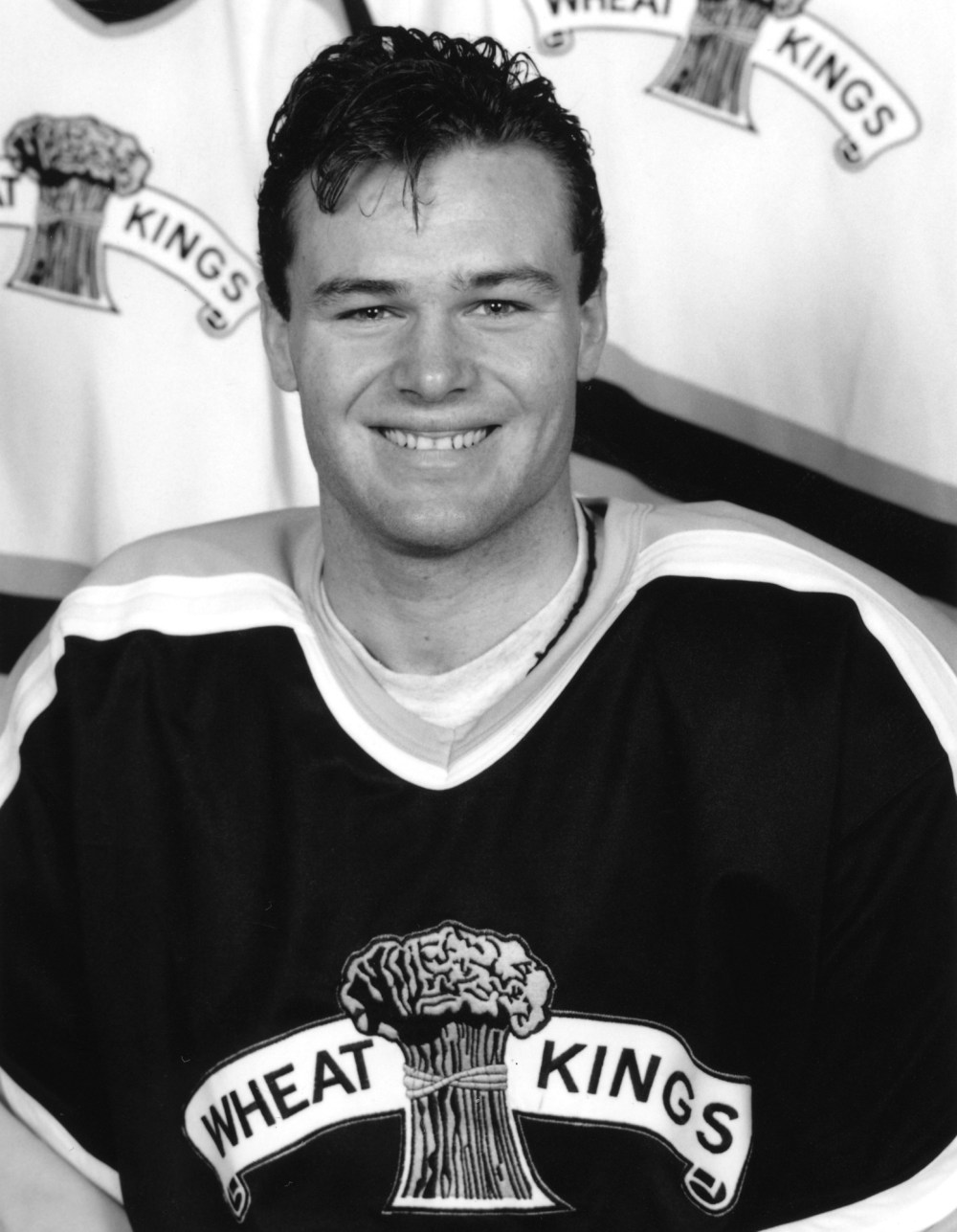
After the season ended, Hoad talked to a couple of NHL teams, eventually heading to camp with the Winnipeg Jets as a free agent. He earned a contract to play with the American Hockey League’s Springfield Falcons, but spent much of the season in the ECHL. After another season in the ECHL, he headed to Europe for the first of 10 seasons there.
Most of his career overseas was spent in the British Ice Hockey Superleague, which Hoad describes as better than the ECHL but not as good as the AHL. At the time, there were no caps on how many foreigners could play, so the team was largely former pro players from North America who came over.
He played in four cities — Nottingham, Ayr, London and Belfast — and enjoyed the chance to live in different places in a country where it was easy to communicate.
“It was an unbelievable experience,” he said.
His British-born grandfather allowed him to play there as a non-import, and gave him an additional perk. In 2002, Hoad received his British passport and played three seasons in a row at the world championships for the United Kingdom under the coach of his pro team.
He happily spent his final three pro seasons in Germany in the ski village of Tölzer, but during the 2005-06 season he knew the end was near.
“You know you can’t play forever, as much as you might like to,” he said. “You have to start looking to the future and what you’re going to do. I really had no idea.”
A friend let him know that the BPS was hiring so he decided to come home. Hoad says that like hockey, every day is different in policing, and it also offered him a chance to get into a career he could learn on the job.
He’s been there ever since.
Hoad is a married father of four, but due to his line of work, the details of his private life will remain private.
He does coach minor hockey, something that allows him to stay on the ice.
Life sometimes has a funny way of bringing people full circle, so Hoad’s new leadership role with the Wheat Kings makes perfect sense.
Hoad, who serves as the high school resource officer, jumped at the chance to come back as the team’s security liaison officer.
“I think I have credibility when I’m talking to them,” he said. “I can say that I know what you’re going through. Things may be different with social media, but the ins and outs of the game, the pressure, the stress, all the stuff that comes with it, if I’m looking at a player and say I know what you’re going through, they can believe me. I’m not just saying it.”
Hoad said that when he was in the league, the Kamloops Blazers were the epitome of what every team wanted to be: They were a proud, successful franchise that won every year.
He’s happy he was part of making the Wheat Kings something similar.
“In my time with the Brandon Wheat Kings, we started basically at the bottom,” he said. “For a number of years before Brandon had some OK teams but we never became a winning culture. All of a sudden in 1992-93, things changed and when you look back now from 1992-93 to sitting here in 2016-17, there are two seasons the Wheat Kings haven’t made the playoffs. You talk about a culture and a winning culture, people want to come to Brandon and play for the Brandon Wheat Kings …
“I look back at the group of players in the ’92-93 season; we started something that is still here today.”
» pbergson@brandonsun.com
» Twitter: @PerryBergson