
The War From Here: Piece of Vimy now stands in Manitoba
Advertisement
Read this article for free:
or
Already have an account? Log in here »
We need your support!
Local journalism needs your support!
As we navigate through unprecedented times, our journalists are working harder than ever to bring you the latest local updates to keep you safe and informed.
Now, more than ever, we need your support.
Starting at $15.99 plus taxes every four weeks you can access your Brandon Sun online and full access to all content as it appears on our website.
Subscribe Nowor call circulation directly at (204) 727-0527.
Your pledge helps to ensure we provide the news that matters most to your community!
To continue reading, please subscribe:
Add Brandon Sun access to your Free Press subscription for only an additional
$1 for the first 4 weeks*
*Your next subscription payment will increase by $1.00 and you will be charged $20.00 plus GST for four weeks. After four weeks, your payment will increase to $24.00 plus GST every four weeks.
Read unlimited articles for free today:
or
Already have an account? Log in here »
Hey there, time traveller!
This article was published 08/04/2017 (3284 days ago), so information in it may no longer be current.
Sunday marks the 100th anniversary of the Battle of Vimy Ridge, a four-day military offensive in the First World War that has been ennobled in the years since as a “coming of age” point in history for Canada.
While most Brandonites are familiar with the majestic monument of the Canadian National Vimy Memorial in France, they may not be as familiar with an original piece of “Vimy” closer to home.
Prior to the 1936 unveiling of the Vimy Memorial that is familiar today, several monuments lined the eight-kilometre escarpment near Vimy, France. While the Great War continued to rage, these monuments were erected by the Canadian Divisions that participated in the four day assault that began on April 9, 1917. One of these monuments would find its way to Winnipeg, where it remains to this day.
The Battle of Vimy Ridge was the first and only time in the First World War when all four divisions of the Canadian Corps fought together as a single unit. The battle was part of a larger British offensive known as the Second Battle of Arras that was fought from April 9 to May 16, 1917.
The Canadians spent months preparing for the assault at Vimy. Battle tactics were improved to maintain the momentum of battle, resulting in the “leapfrogging” of units which provided fresh troops accompanied by a creeping barrage of artillery support.
The Canadians’ objective was to take the ridge that had been in German control since 1914. The Canadian divisions consisted of three brigades, comprised of four battalions each. Lined along the western base of the escarpment in tunnels and trenches, the divisions were assigned specific objectives to reach on the east side of the ridge.
Commencing at the southern flank, the 1st Canadian Division, which contained the 8th Battalion (known as the Little Black Devils or Winnipeg Rifles), was to reach Farbus Wood.
The 2nd Canadian Division, containing the 27th “City of Winnipeg” Battalion, was to take Thelus Wood.
The 3rd Canadian Division, of which Brandon’s 1st Canadian Mounted Rifles (CMR) and Winnipeg’s 43rd “Cameron Highlanders of Canada” Battalion were a part, was to capture La Folie Farm.

And the 4th Canadian Division, assigned the largest attack frontage but shortest objective distance, was to take Hill 145 — the highest point of the ridge and future site of the Canadian National Vimy Memorial — as well as a German strongpoint known as the Pimple. Manitoba’s 44th Battalion and the Winnipeg Grenadiers’ 78th Battalion supported this division.
While the first three divisions achieved their initial objectives within hours, the 4th Canadian Division immediately encountered difficulties. It was soon discovered the artillery bombardments during the previous week, in which a million shells had been expended, had not broken through the enemy trenches at the north end of the escarpment. Enemy snipers and heavy machine-gun fire produced a staggering number of casualties. It would be during a “blinding” snowstorm on April 12, that the Pimple was captured by battalions of the 10th Brigade, including Manitoba’s Forty-Fourth.
According to Veterans Affairs Canada, there were 10,602 Canadian casualties at Vimy: 3,598 dead and 7,004 wounded. It comes as no surprise that the survivors erected monuments honouring their lost and fallen colleagues before war’s end.
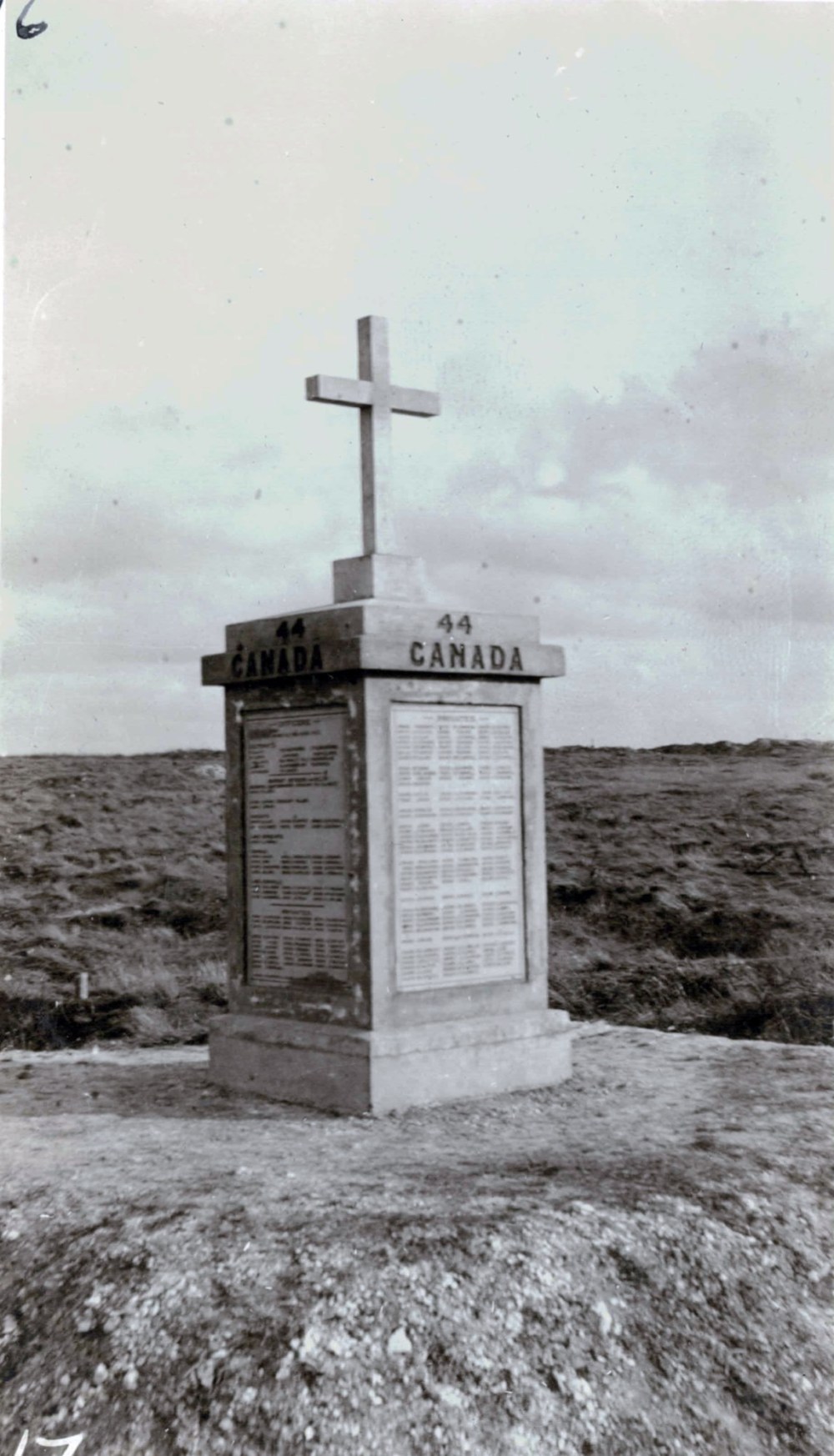
The 44th Battalion constructed a cross at the Pimple, recognizing its men who died at Vimy, La-Coulotte, and the Green Crassier. Capt. Herbert Bell Rugh, a prominent Winnipeg architect and one of the few surviving officers of the regiment, is credited with its design. Researchers from the Royal Winnipeg Rifles Regimental Museum believe the cenotaph was constructed in February 1918 when the battalion was last billeted in the area.
Following the war, the Canadian Battlefields Memorials Commission was established to oversee the creation of Canadian battlefield monuments in Belgium and France. A design competition was held and the French government granted the use of the proposed Vimy site to the people of Canada “freely and for all time.” With work set to begin in 1925, the previously existing monuments had to make way for the new Vimy Memorial.
Rather than have its beloved monument destroyed, the 44th Battalion Association raised $600 (approximately $10,500 today) in a nickel and dime campaign to dismantle the cross and its cement nominal roll and to relocate them in Winnipeg, the original home of the Forty-Fourth.
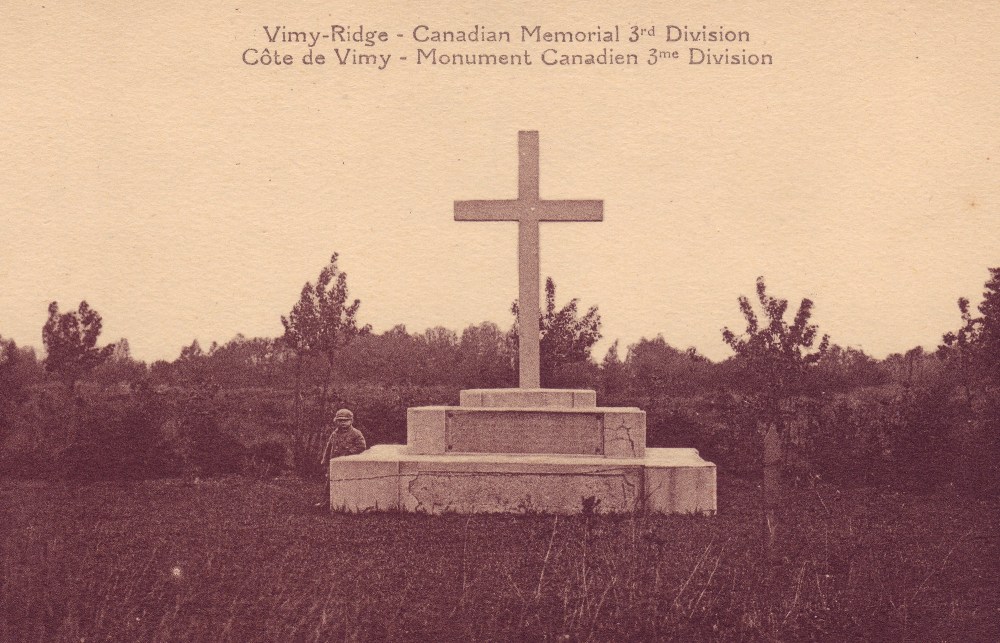
On a Sunday afternoon in June 1926, the relocated monument was officially unveiled in Wolseley’s St. James Park, later renamed Vimy Ridge Memorial Park. The monument continues to stand near the corner of Portage Avenue and Canora Street, serving as a tangible link not only to the members of the 44th Battalion but to the 11,285 Canadians who fought and died in France and have no known grave.
» Suyoko Tsukamoto is a Brandonite who has spent three seasons in the archeology field at the Camp Hughes National Historic Site.