
Indigenous population up, census shows
Advertisement
Read this article for free:
or
Already have an account? Log in here »
We need your support!
Local journalism needs your support!
As we navigate through unprecedented times, our journalists are working harder than ever to bring you the latest local updates to keep you safe and informed.
Now, more than ever, we need your support.
Starting at $15.99 plus taxes every four weeks you can access your Brandon Sun online and full access to all content as it appears on our website.
Subscribe Nowor call circulation directly at (204) 727-0527.
Your pledge helps to ensure we provide the news that matters most to your community!
To continue reading, please subscribe:
Add Brandon Sun access to your Free Press subscription for only an additional
$1 for the first 4 weeks*
*Your next subscription payment will increase by $1.00 and you will be charged $20.00 plus GST for four weeks. After four weeks, your payment will increase to $24.00 plus GST every four weeks.
Read unlimited articles for free today:
or
Already have an account? Log in here »
Hey there, time traveller!
This article was published 26/10/2017 (2993 days ago), so information in it may no longer be current.
Indigenous people make up 12.4 per cent of Brandon’s population — an increase of 2,660 since 2006.
According to the latest census data released Wednesday by Statistics Canada, 7,015 Indigenous people lived in the Wheat City and surrounding municipalities in 2016, compared to 4,355 in 2006. It also represents a 1,655 individual jump since 2011.
Leah LaPlante, chair of Brandon Urban Aboriginal Peoples’ Council and vice-president of Manitoba Métis Federation, Southwest Region, said she believes this increase is partly due to people becoming more comfortable with declaring who they are.
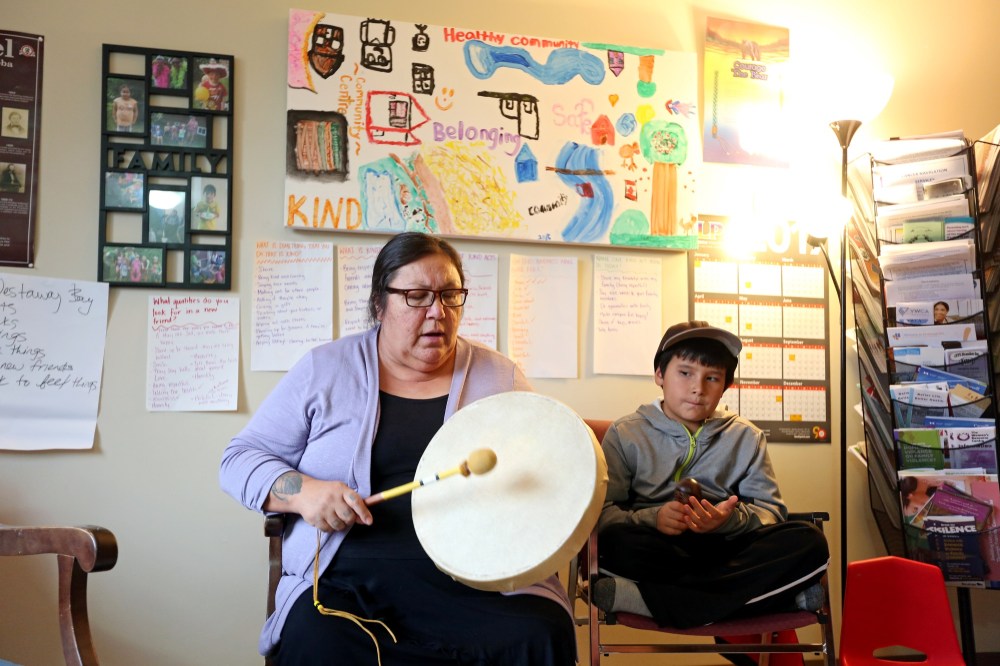
“I would really like to believe that the pride is coming back — they’re not afraid to stand up and say ‘I’m Aboriginal,’” she said.
Of the Aboriginal population in Brandon, 55 per cent (3,855) were First Nations people, 43.1 per cent (3,020) were Métis, and 0.4 per cent (30) were Inuit. The figures refer to Brandon’s census agglomeration, which includes the rural municipalities of Cornwallis, Whitehead and Elton.
LaPlante, who has been in Brandon for 20 years, says in the past there has been a definite “disconnect between the Indigenous people in the city and everybody else. We’re all very aware of that.”
But in recent years, great strides have been made — including the formation of BUAPC in 2012.
Through the group, different forums are organized, research is being done, and important conversations are happening around education, housing and social issues.
“Now we have people coming out to forums and vocalizing some of the issues that they have in their lives … and also putting forth ideas on how that could be better, and it’s really been working for us,” she said.
The support of Mayor Rick Chrest, Brandon City Council and other community leaders has gone a long way, LaPlante added. Her hope for the coming years is that even more Indigenous people join the conversation.
Susie McPherson Derendy, adult eduction instructor with the Brandon Friendship Centre, shared similar sentiments, in that major steps have been made in recent years.
“I’ve been here in Brandon for 31 years, and for the longest time it’s been the status quo,” she said.
She is pleased to see a growing number of Aboriginal cultural programs in the Brandon School Division, as well as in the wider community. A weekly powwow club brings people together, and an ongoing regalia group are just a few examples.
“Any time that Indigenous people are singing their songs, drumming their drums, dancing their dances, gathering and being together, I see that as cultural restoration, cultural revival, and I see that as healing,” she said.
While she’s thankful for the steps that have been taken, McPherson Derendy is hoping this is just the beginning.
“I think there’s an awakening that’s happening,” she said. One idea she would like to see come to fruition is an Aboriginal parent council.
“We as parents … are the ones that need to be part of the conversation. We don’t have to wait for organizations and governments … there are some things we can do without funding,” she said.
Mayor Rick Chrest said he is pleased with the progress that has been made, particularly with BUAPC, but also the many community resources available such as Manitoba Metis Federation and Brandon Friendship Centre.
“Each has strong organizations that advocate on behalf of their particular culture, so that’s also a strong feature here in Brandon,” he said.
Chrest said it means a lot to hear LaPlante say the community has made great strides when it comes to Indigenous issues.
“She’s a tremendous person, and a real straight shooter,” he said. “When I hear her say … we’ve finally turned the corner in a positive way towards Aboriginal relations in this community, I think that is very significant praise.”
Nationally, the Aboriginal population has jumped four times the non-Aboriginal growth rate from 2006 to 2016, now accounting for 4.9 per cent of the total population.
Winnipeg still holds the largest amount of Indigenous people among Canadian cities, with 92,810 people. That’s 12.2 per cent of the metro area’s population.
Aboriginal people represented 18 per cent of Manitoba’s population in 2016, but they made up for 29.6 per cent of children aged four or younger.
Meanwhile, the census revealed a boom in people identifying as Métis nationally, but the trend is half as common within Manitoba.
From 2006 to 2016, the Métis population rose 51.2 per cent, higher than First Nations or Inuit people.
Winnipeg held the largest population of Métis people in 2016, with the 52,130 reported representing a 28 per cent rise over the last decade. But Ontario, for the first time, has become the province with the largest chunk of Métis people, just over one-fifth, a number that rose 64.3 per cent in a decade.
» jaustin@brandonsun.com, with files from the Winnipeg Free Press
» Twitter: @jillianaustin