
Westman student earns top honours at national science fair for project on worm composting
Advertisement
Read this article for free:
or
Already have an account? Log in here »
We need your support!
Local journalism needs your support!
As we navigate through unprecedented times, our journalists are working harder than ever to bring you the latest local updates to keep you safe and informed.
Now, more than ever, we need your support.
Starting at $15.99 plus taxes every four weeks you can access your Brandon Sun online and full access to all content as it appears on our website.
Subscribe Nowor call circulation directly at (204) 727-0527.
Your pledge helps to ensure we provide the news that matters most to your community!
To continue reading, please subscribe:
Add Brandon Sun access to your Free Press subscription for only an additional
$1 for the first 4 weeks*
- Enjoy unlimited reading on brandonsun.com
- Read the Brandon Sun E-Edition, our digital replica newspaper
*Your next Free Press subscription payment will increase by $1.00 and you will be charged $20.95 plus GST for four weeks. After four weeks, your payment will increase to $24.95 plus GST every four weeks.
Read unlimited articles for free today:
or
Already have an account? Log in here »
Hey there, time traveller!
This article was published 19/05/2018 (2956 days ago), so information in it may no longer be current.
What began as an in-house project at her local school has earned a 14-year-old student from Westman a gold medal at a national science fair in Ottawa.
Amy Gudmundson received the top prize in the junior category at the Canada-Wide Science Fair this week for her project on worm composting, otherwise known as vermicomposting.
The Grade 8 student from École Jours de Plaine in Laurier, just north of McCreary, was a gold-medal winner and runner-up in the best of fair category at the Western Manitoba Regional Science Fair last month, earning her a spot at the national fair out east.
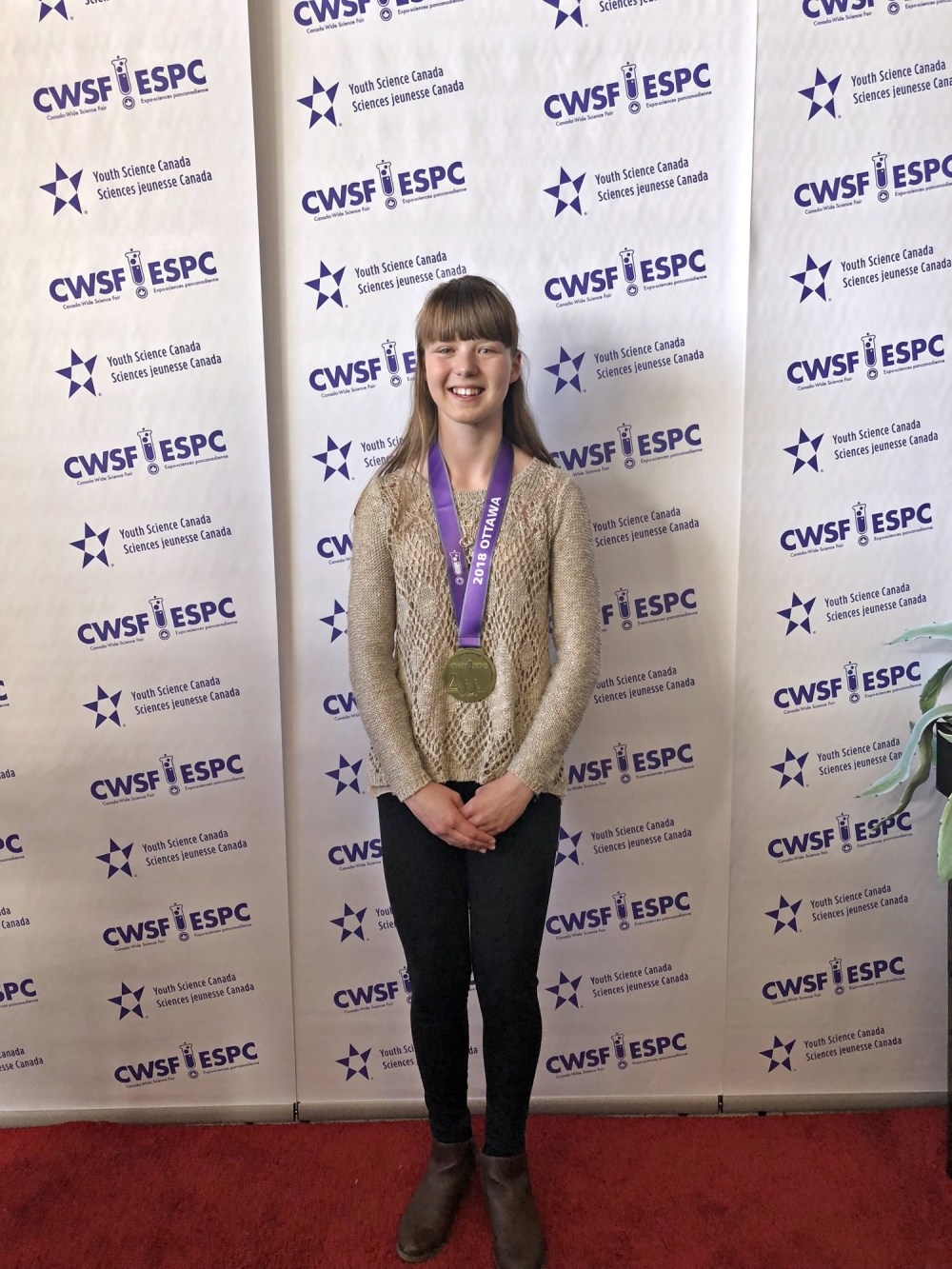
After a few days of public events and tours around Ottawa, Gudmundson received the news that she had won first place at the fair’s awards gala on Thursday night.
“I was very shocked,” she said. “It was something that I was not expecting and so it was wonderful when they called my name up.”
Her project, “Notre avenir avec le vermicompostage!” or “Our future with vermicompost!” was based on a pair of experiments she conducted using vermicompost, a method that uses worms to break down organic material.
Gudmundson started a vermicompost program at her school in April of last year, collecting food and vegetable waste in each classroom and composting them using the same process.
The aim was to introduce a project at school that was environmentally-friendly and could help reduce their carbon footprint by limiting the amount of organic waste that ends up in a landfill.
After receiving a lot of positive feedback her first couple of months, Gudmundson decided to continue her work the following school year.
With the Western Manitoba Regional Science Fair approaching and a recent outbreak of E. coli in romaine lettuce, Gudmundson decided to use the fair as an opportunity to answer some questions she had: How much compost would you need to successfully grow a plant and could you compost certain foods safely?
“Since vermicomposting isn’t something that is very well known, and I couldn’t find much scientific proof and research to back up some questions I was asking, I decided to lead my own experiments,” she said.
Her first experiment tested different proportions of vermicompost, while the second tested the soil for pathogenic bacteria, such as E. Coli or salmonella.
The results showed that soil made up of 70 per cent vermicompost — higher than her initial hypothesis of 50 per cent — was the best proportion to use for indoor plants.
Her second experiment, meanwhile, found that the soil contained no presence of pathogenic bacteria, as she had expected.

Her findings not only won her a pair of gold medals, but earned her a $4,000 entrance scholarship to Western University in London, Ont., and the chance to showcase her project at different schools in Ottawa.
“It’s really nice to be able to broadcast elsewhere and have people as interested in science as I am and … letting me explain my work that I’ve done,” she said.
Following her gold-medal finish, Gudmundson’s classmates sent her a video congratulating her on the win. She will be joining them this weekend in Quebec for a planned French trip with her school.
As for next year, Gudmundson hopes to keep her vermicompost project going as she moves on to Grade 9 at Jours de Plaine.
But coming off of a successful science fair, she said she was thankful for the support she has received from her school.
“It’s really nice to know that I’ve got everyone backing me up at home.”
» mlee@brandonsun.com
» Twitter: @mtaylorlee