
Buildings ravaged by downtown Brandon fire have long histories
Advertisement
Read this article for free:
or
Already have an account? Log in here »
We need your support!
Local journalism needs your support!
As we navigate through unprecedented times, our journalists are working harder than ever to bring you the latest local updates to keep you safe and informed.
Now, more than ever, we need your support.
Starting at $15.99 plus taxes every four weeks you can access your Brandon Sun online and full access to all content as it appears on our website.
Subscribe Nowor call circulation directly at (204) 727-0527.
Your pledge helps to ensure we provide the news that matters most to your community!
To continue reading, please subscribe:
Add Brandon Sun access to your Free Press subscription for only an additional
$1 for the first 4 weeks*
- Enjoy unlimited reading on brandonsun.com
- Read the Brandon Sun E-Edition, our digital replica newspaper
*Your next Free Press subscription payment will increase by $1.00 and you will be charged $20.95 plus GST for four weeks. After four weeks, your payment will increase to $24.95 plus GST every four weeks.
Read unlimited articles for free today:
or
Already have an account? Log in here »
Hey there, time traveller!
This article was published 26/05/2018 (2929 days ago), so information in it may no longer be current.
On May 19, 2018,fire tore through downtown Brandon, ultimately affecting three historic buildings in the process. Manitoba history buff and Winnipeg blogger Christian Cassidy took a look back at their histories this week, and has allowed The Brandon Sun to reprint in today’s paper edited versions of his blog posts from West End Dumplings.
The affected buildings include theHanbury Hardware Building(1907) at 705 Pacific Ave., which later became Christie’s Office Plus; theMassey Harris Building(1913) —now Massey Manor —at 638 Pacific; and theCockshutt Farm Supplies Building(1946) at 645 Pacific, which eventually became home to Collyer’s Sales & Service, the Brandon Boxing Club and Kazic Kontracting.
By Christian Cassidy
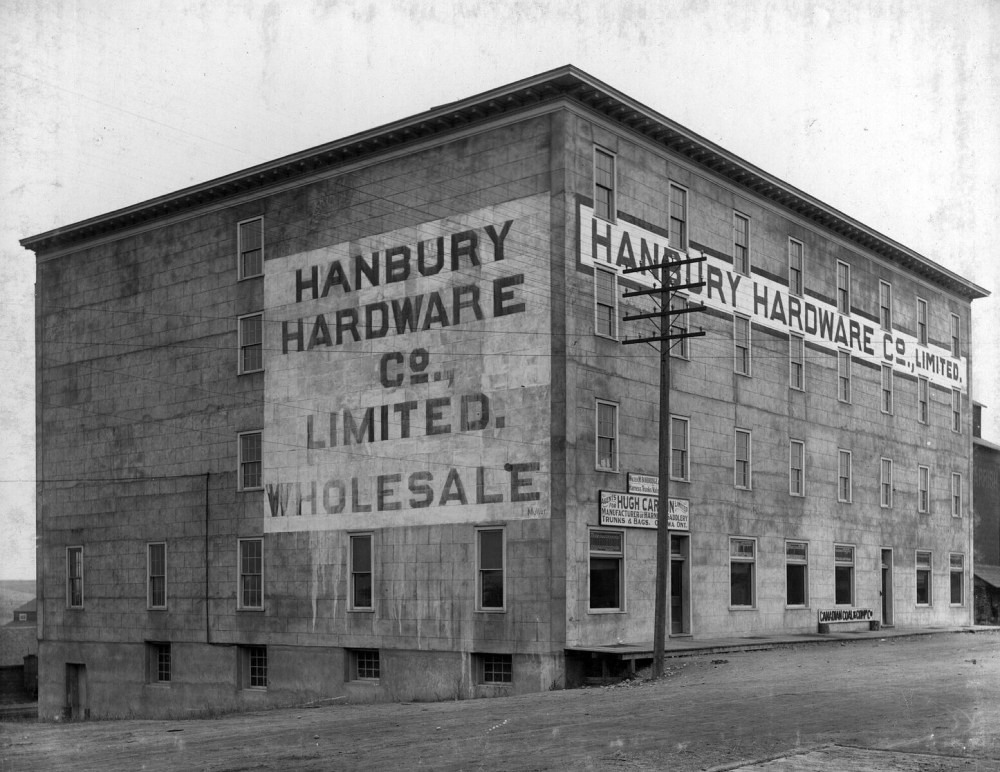
Hanbury Hardware
The oldest of the historic structures that burned last weekend is 705 Pacific Ave., built for the Hanbury Hardware Co. in 1907.
John Hanbury was born and raised in Ontario and worked in the building trades, eventually becoming a contractor. He came to Brandon in 1882 to set up business and oversaw the construction of dozens of buildings, from houses and small commercial buildings to significant landmarks such as the original Brandon Hospital and post office building.
In 1891, Hansbury expanded his business by opening a lumber yard and woodworking shop called Hanbury Manufacturing Co. on the 600 block of Assiniboine Avenue.The company made sashes and doors and their custom woodwork included office and hotel furniture and fixtures.
In 1907, Hanbury had this five-storey, 42,000 square-foot building constructed at 703- 705 Pacific Ave. for a new wholesale venture, Hanbury Hardware.
The main floor consisted of corporate offices for the four companies Hanbury was involved in: Hanbury Manufacturing Co., managed by A.C. Ayre; Hanbury Hardware Co., A.E. Carmichael, manager; Canadian Coal Co., A.B. Fleming, manager; and Manitoba Hardware and Lumber Co., W.M. Tyndall, secretary. The upper floors served as the warehouse for the hardware company.
By this time, Hanbury had long been the second-largest employer in Brandon after the Canadian Pacific Railway.
In 1920, Hanbury sold off his hardware division to Wood, Valance and Co. of Hamilton. The company distributed the contents of the warehouse to its branches in Winnipeg and Regina. Five years later, the remainder of his Manitoba assets were sold off and Hanbury died in B.C. in 1928.
In 1923, much of the former Manitoba Hardware Co. space was leased by the provincial government for the city’s first post-Prohibition, government-run liquor store. Its first manager was James Kirkcaldy, the city’s former police chief.
On Oct. 17, 1923, The Brandon Sun reported: “There was a lineup of cars waiting” when the store opened that morning. The store closed soon after Brandon got a new, self-serve liquor store at 10th Street and Victoria Avenue in 1970.
In 1922, the building became home to farm implement dealership Cameron and Rathwell. The company was formed earlier that year when W.A. Campbell and William F. Rathwell joined forces in business.
To diversify its business, the company purchased a car repair garage and used car lot in 1928 and moved the sales area to an adjacent property.
In 1941, Christie School Supply took over the building. The company was created in 1881 by E.L. Christie, first as a book store on Rosser Avenue. It then got into the business of distributing school supplies, including school furniture and textbooks.
By settling at the building in 1941, they were able to bring their offices and warehouse together under one roof.
Over the decades, the company moved into the office furnishings and supply business, changing its name toChristie’s Office Plusand continued to operate at this address until fire destroyed the building last weekend.
Massey Harris
While 705 Pacific Ave. was home to a series of distinctly local businesses, the origins of 638 Pacific were national.
Designed by Brandon architectThomas Sinclair, the three-storey, 70,000-square-foot building was constructed in 1913-14 for the Gordon McKay Co. of Toronto, the largest dry goods wholesaler in the country. This was to be its Western Canada headquarters.
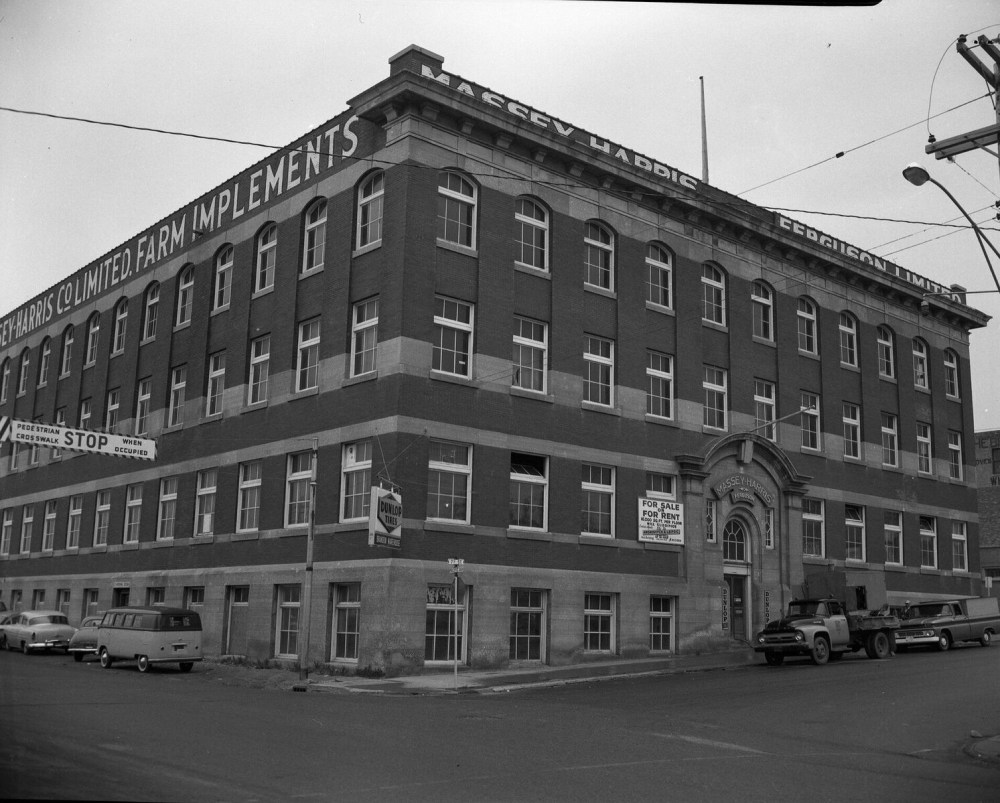
City officials were so taken with company president J.W. Woods and his estimate of $1 million in annual sales and good-paying jobs during a time of deep recession that they worked out a sweetheart deal with the company.
The city donated the land and borrowed $165,000 to construct the building. The company itself put in about $30,000 and would pay monthly “mortgage” payments to the city.
Gordon McKay took over the building in spring 1914 and began making payments but never moved in, citing the recession, then the war, as reasons for not setting up shop. In 1917, the building became property of the city.
During the war, the building was used to house troops and was later utilized for agricultural conferences.
In late 1920, thanks to the efforts of the Board of Trade and its president, P.A. Kennedy, a buyer was found. Toronto’s Massey Harris paid around $130,000 for its new Manitoba warehouse operation.
Massey Harris took over the property effective Jan. 1, 1921.
In 1964, the building became home to Voy’s furniture store, which was previously located on Ninth Avenue. The company had deep roots in the city, starting out as Brockie Furniture and Funeral Service. In 1925, Alfred Voy went to work for Brockie and eventually became a partner.
When, in 1947, the decision was made to split the company, Voy took over the furniture business.
In 1971, the building’s major tenant was the home furnishings department of Macleod’s department store. When it left in 1973, the building appears to have sat vacant for a long period of time.In 1985, some renovations were done and toy and game retailer Toyland moved in until around 1990.
In 1994, the building became home to a consortium of organizations that collected items for reuse and recycling under the banner Westman Recycling. It included a consignment store and what eventually became known as the Re-Store run by the Canadian Mental Health Association.
In 2007, the CMHA, Habitat for Humanity and Brandon Friendship Centreannounced a $6.7-million planto convert the building into affordable housing units to be known asMassey Manor. The CMHA owns the bottom two floors and the Brandon Friendship Centre the top.
Of the 58 suites, 14 are market-rate condominiums and four are emergency shelter beds. All were severely damaged or destroyed in the fire.
Cockshutt Farm Supplies
The Cockshutt Plow Co., later the Cockshutt Farm Equipment Co., was founded in Brantford, Ont., in 1882. It manufactured farm implements such as thrashers, spreaders and plows.
The company had a small sales office and parts depot in Brandon since at least 1905. Five years later, Cockshutt went on a major corporate expansion in the west. which meant a much larger facility for the city.
The Brandon Sun of Sept. 8, 1910 noted: “City engineer Speakman has granted a building permit to the Cockshutt Plow Co. for the erection of their new warehouse on Pacific Avenue and Sixth Street.”
The three-storey building cost about $20,000 to construct. It contained a showroom, repair department, sales offices and an extensive parts depot.
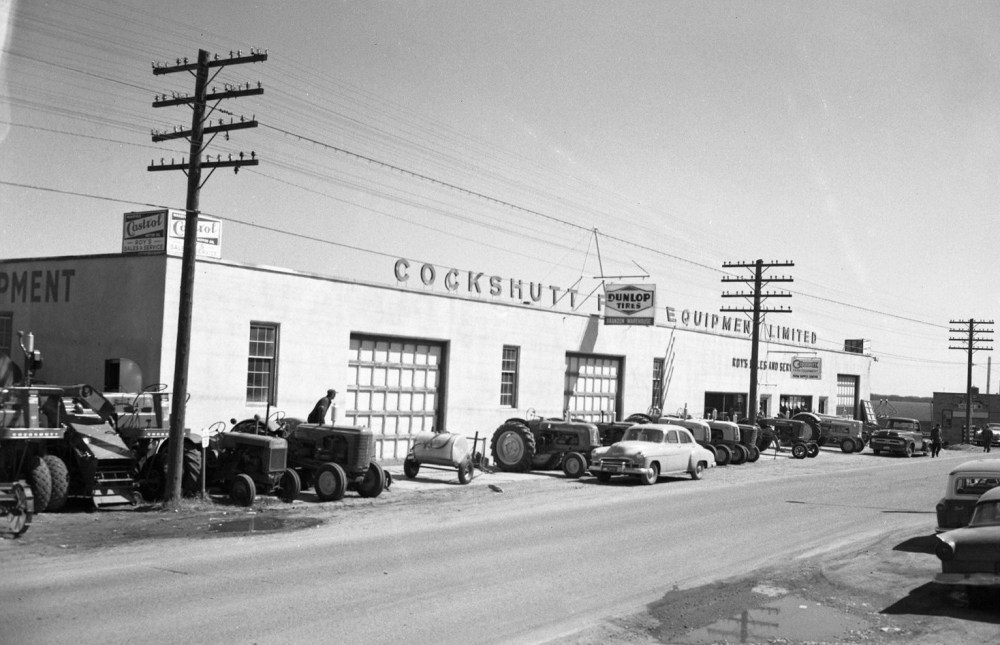
The Second World War had a major impact on Cockshutt’s business. Its factories in Ontario were retooled as aircraft and munitions factories which put a halt to new equipment and parts.
After 1944, they followed how car manufacturers sold and serviced their equipment by finding local dealerships to lease a franchise. In Brandon, that dealer was the Brandon Farm Equipment Co., which took over the building in 1945.
On May 25, 1946, there was a fire in a wooden warehouse situated behind the Massey-Harris Building across the street. Burning embers drifted across the street to the Cockshutt property. Both buildings burned to the ground.
Brandon Farm Equipment relocated temporarily to the Brown Block at Princess Avenue and 12th Street.
What made the fire particularly awkward was that five days later, company president George Cockshutt was arriving in town as part of a western tour to see the company’s facilities and to speak to the local Board of Trade.
Cockshutt Plow, which still owned the building, rebuilt in late 1946 and Brandon Farm Equipment returned to the site. The new building was just a single story but wider than the original structure.
In the early 1950s, a couple of dealerships came and went at this address and by 1955 it was simply known as Cockshutt Farm Equipment. In 1958, Adrian Roy’s Sales and Service was the new dealer.
In 1962, Cockshutt was acquired by the White Motor Company of Cleveland. There was already a dealer for White’s line of tractors in town, Lawson’s on Ninth Street. Within a year or two, the Roy’s/Cockshutt dealership disappeared in favour of Lawson’s.
The building appears to have sat empty for a number of years until it was divided into three addresses, 545, 601 and 603 Pacific Ave.
The eastern portion of the building, 545 and 601, became a Standard Auto Glass shop in 1973. Through the 1980s and early 1990s, it was a Westroc Battery centre. In the 1990s and early 2000s, it was home to moccasin maker Fleece Line, before they relocated to Winnipeg.
In 2001, Roddy Batson and Noel Harding opened the Brandon Boxing and Fitness Club on the second floor of the Massey-Harris Building across the street. In 2006, Massey Manor sent the club packing and they leased the former Fleece Line space. The club was destroyed in the fire.
The western portion of the building, 603, was Body Shop Supply Ltd. in the late 1970s, then Rob’s Auto Parts store from 1980 to 1986.
Collyer’s Sales and Service, the tenant at the time of the fire, traces its roots back to 1967 when Ward Collyer opened Collyer’s West End Service, an auto garage, on 26th Street at Victoria Avenue. In 1970, the business relocated to 702 Pacific Ave., across the street, and became Collyer’s City Centre Service.
In 1977, the company was rebranded Collyer’s Sales and Service and in 1986 relocated to 603 Pacific Ave.