
Province outlines plan for big carbon emitters
Advertisement
Read this article for free:
or
Already have an account? Log in here »
We need your support!
Local journalism needs your support!
As we navigate through unprecedented times, our journalists are working harder than ever to bring you the latest local updates to keep you safe and informed.
Now, more than ever, we need your support.
Starting at $15.99 plus taxes every four weeks you can access your Brandon Sun online and full access to all content as it appears on our website.
Subscribe Nowor call circulation directly at (204) 727-0527.
Your pledge helps to ensure we provide the news that matters most to your community!
To continue reading, please subscribe:
Add Brandon Sun access to your Free Press subscription for only an additional
$1 for the first 4 weeks*
- Enjoy unlimited reading on brandonsun.com
- Read the Brandon Sun E-Edition, our digital replica newspaper
*Your next Free Press subscription payment will increase by $1.00 and you will be charged $20.95 plus GST for four weeks. After four weeks, your payment will increase to $24.95 plus GST every four weeks.
Read unlimited articles for free today:
or
Already have an account? Log in here »
Hey there, time traveller!
This article was published 31/07/2018 (2851 days ago), so information in it may no longer be current.
The provincial government has released new details about how it intends to tax Manitoba’s highest carbon emitters.
Known as the output-based pricing system, or OBPS, facilities releasing more than 50,000 tonnes of carbon dioxide equivalent per year which will be required to register with Manitoba Sustainable Development, which will impose a limit on carbon emissions upon them.
A facility that goes beyond its carbon limit will be required to either pay a $25 tax on every extra tonne of CO2 equivalent, or offset their emissions by buying credits.
Facilities that release fewer emissions can bank or sell them, up to their limit, at the same cost of $25 per tonne.
In a news release, Sustainable Development Minister Rochelle Squires said the system will reduce emissions in carbon-intensive industries while saving jobs.
“The environment and economy go hand in hand,” she said. “Our Made-in-Manitoba Climate and Green Plan set us on the path to make Manitoba the cleanest, greenest, most climate-resilient province in Canada.”
A round of stakeholder consultations is expected to take place between September and December of this year.
Greenhouse gas emissions from the six largest emitters in Manitoba have remained relatively stable between 2006 and 2016.
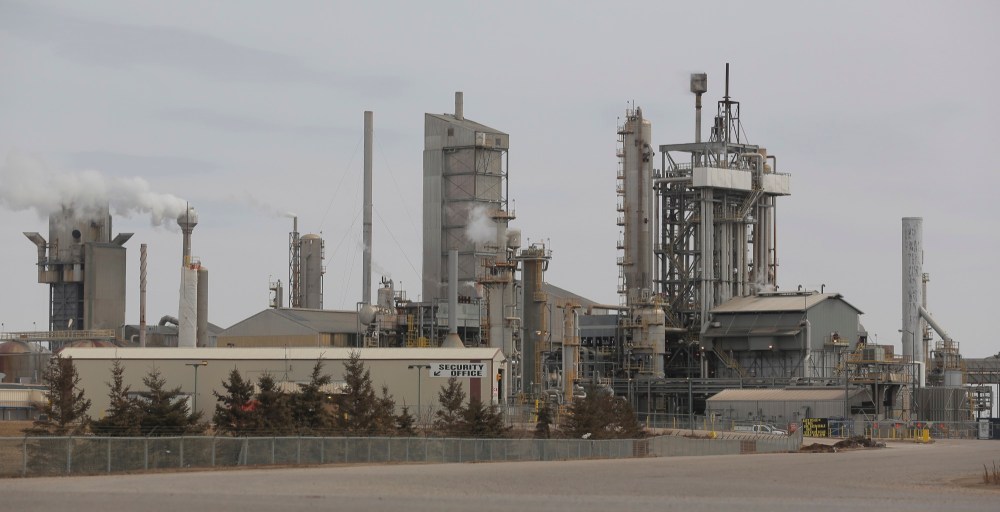
Koch Fertilizer Canada’s facility in the east end of Brandon tops the list as the largest single emitter in the province, releasing 688,159 tonnes of CO2 equivalent in 2016, which is more than the next five highest emitters — TransCanada Pipelines, Graymont, Canadian Kraft Papers, Husky Oil and Vale — combined.
Koch Fertilizer Canada representatives were not available for comment by press time on Monday.
The tax will not apply to municipalities, universities, schools, hospitals, landfills, wastewater treatment facilities or natural gas distribution networks.
The NDP, meanwhile, has criticized the government’s plan as weak, given that landfills and other operations will be exempt.
“They are letting the largest emitters off the hook completely, while offering no new programs to help all other Manitobans avoid the impacts of their upcoming carbon tax,” NDP sustainable development critic Rob Altemeyer said in a written statement.
The tax on industry will come into effect in January 2019, and performance standards will be set by June 2019.
Beginning January 2020, facilities with annual emissions of between 10,000 and 50,000 tonnes of CO2 equivalent can opt-in, something Keystone Agricultural Producers was pleased to see, a spokesperson for the group said.
The government has also announced it will apply a $25 per tonne consumer carbon tax on gasoline, diesel, propane and natural gas, which will be used to reduce personal taxes. Marked fuel for farming, forestry and mining will be exempt.
The NDP has argued that carbon tax revenue should be used to help consumers adopt energy-efficient technology.
The government’s announcement comes on the heels of an Angus Reid Institute survey, which found support for the federal carbon tax in Manitoba at 39 per cent as of this month.
The federal government has told provinces to put in place either a cap-and-trade system or have a $50 per tonne carbon tax by 2022.
Support for the carbon tax has fallen nationwide, the survey said, and both the Saskatchewan and Ontario governments intend on challenging its legality in court.
Brandon East Progressive Conservative MLA Len Isleifson said that whether the province puts in place its own plan or not, the tax is still coming.
“When you have no control over it as a provincial government, it’s concerning,” he said. “I’m there to represent the folks from Brandon East that elected me, and it’s a lot harder for me to answer to a federal carbon tax … than it is to speak to a provincial plan.”
Brandon-Souris Conservative MP Larry Maguire said it wasn’t surprising to him that support for the carbon tax has gone down.
He said there are many ways of addressing carbon emissions, such as dealing with the largest emitters, but said the federal government is desperate to find more income to deal with its huge deficits.
“Once people find out more about the fact that the tax is really a third level of tax … to go into general revenues, then they (will) see it for what it is.”
» mlee@brandonsun.com, with files from the Winnipeg Free Press and The Canadian Press
» Twitter: @mtaylorlee