
Sashmaker wanted her kids to be proud of Métis heritage
Advertisement
Read this article for free:
or
Already have an account? Log in here »
We need your support!
Local journalism needs your support!
As we navigate through unprecedented times, our journalists are working harder than ever to bring you the latest local updates to keep you safe and informed.
Now, more than ever, we need your support.
Starting at $15.99 plus taxes every four weeks you can access your Brandon Sun online and full access to all content as it appears on our website.
Subscribe Nowor call circulation directly at (204) 727-0527.
Your pledge helps to ensure we provide the news that matters most to your community!
To continue reading, please subscribe:
Add Brandon Sun access to your Free Press subscription for only an additional
$1 for the first 4 weeks*
- Enjoy unlimited reading on brandonsun.com
- Read the Brandon Sun E-Edition, our digital replica newspaper
*Your next Free Press subscription payment will increase by $1.00 and you will be charged $20.95 plus GST for four weeks. After four weeks, your payment will increase to $24.95 plus GST every four weeks.
Read unlimited articles for free today:
or
Already have an account? Log in here »
Hey there, time traveller!
This article was published 04/09/2018 (2812 days ago), so information in it may no longer be current.
SOURIS VALLEY — Mary Conway has attended every edition of Koushkoupayh Days since the Métis festival began in 2012.
She sat behind a little table on Saturday during the festival, and displayed sashes and necklaces that she made by hand that were for sale. The sashes were ruby red in colour with intricate designs, and the necklaces were created from wolf willow beads.
Conway said she started creating them because of her kids.
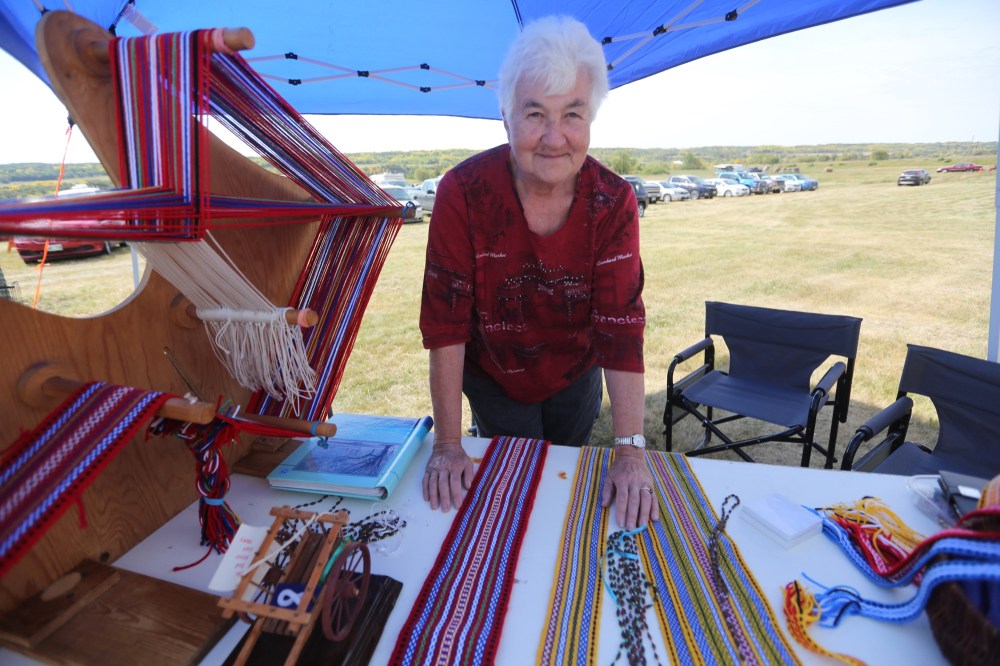
“I wanted my kids to be proud of being Métis,” she said. “Some people … I think it’s because they’re not proud of who they are. They don’t walk with their head up and step forward and get jobs and ask for jobs … do things.
“I wanted them to have more self-confidence and be proud of their heritage.”
The necklaces were started because of family, and it takes a family effort to come up with the finished product.
Conway’s son helped her pick the beads, and her husband took the skin off them so they could be used to create the necklaces that were for sale on the table in front of her on Saturday.
“He (my son) knows that I make these, and his job happened to be near a bush and he picked me a whole big bag full, so I have a whole bunch that I froze,” Conway said. “I get them out and I make some every winter.”
It’s a way Conway can stay busy while doing something that represents her heritage.
“You can watch TV, or you can read or you can just make sashes and necklaces, so I just use my spare time to do that,” she said.
The necklaces and sashes have both changed over time as it became easier to access different materials. In times past, Métis people used tiny beads in between the wolf willow beads that only used to come in red and white or blue and white colours, she said.
“Now we go to Walmart and just get any colour we like,” Conway said.
The polyester that the sashes are made from is also store bought.
The intricate designs that are woven into them all have meaning, Conway said.
The black design stands for the dark period, she said.
“When the settlers came, and when Louis Riel was hung and when the children went to the residential schools, those are all dark periods,” she said.
There’s also a blue and white design on the sash that stands for the water and the sky, and a green lifeline of the person who owns the sash.
In the middle of the scarf is a thicker pattern, which stands for the Turtle Mountains, where Conway lives.
“We think that’s the jewel of the Prairies, so we made it all colours, plus it shows all the flowers that grow in the Turtle Mountains that are all different kinds,” she said.
Each necklace takes about 30 minutes to create, and the sashes take a week. It’s $10 per necklace, and $100 for a sash.
The festival is a way for Conway to not just show off her creations, but to celebrate Métis culture.
“The people, I know most of them. I’ve been coming so long, so we can just have really a Métis reunion,” Conway said. “It’s good music, and it’s good friends and there’s good food and we just enjoy it so much.”
» mverge@brandonsun.com
» Twitter: @Melverge5