
Life opens up with heavy equipment operator certificate
Advertisement
Read this article for free:
or
Already have an account? Log in here »
We need your support!
Local journalism needs your support!
As we navigate through unprecedented times, our journalists are working harder than ever to bring you the latest local updates to keep you safe and informed.
Now, more than ever, we need your support.
Starting at $15.99 plus taxes every four weeks you can access your Brandon Sun online and full access to all content as it appears on our website.
Subscribe Nowor call circulation directly at (204) 727-0527.
Your pledge helps to ensure we provide the news that matters most to your community!
To continue reading, please subscribe:
Add Brandon Sun access to your Free Press subscription for only an additional
$1 for the first 4 weeks*
*Your next subscription payment will increase by $1.00 and you will be charged $20.00 plus GST for four weeks. After four weeks, your payment will increase to $24.00 plus GST every four weeks.
Read unlimited articles for free today:
or
Already have an account? Log in here »
Hey there, time traveller!
This article was published 10/11/2018 (2686 days ago), so information in it may no longer be current.
As a single mom, Kayla Bialkoski thought her options in life were limited.
That was before being accepted into a program at Assiniboine Community College to train Indigenous students for a career as a heavy equipment operator.
The Congress of Aboriginal Peoples covered the cost for qualified candidates who met their funding criteria. The heavy equipment was provided by Brandt Tractor Ltd.
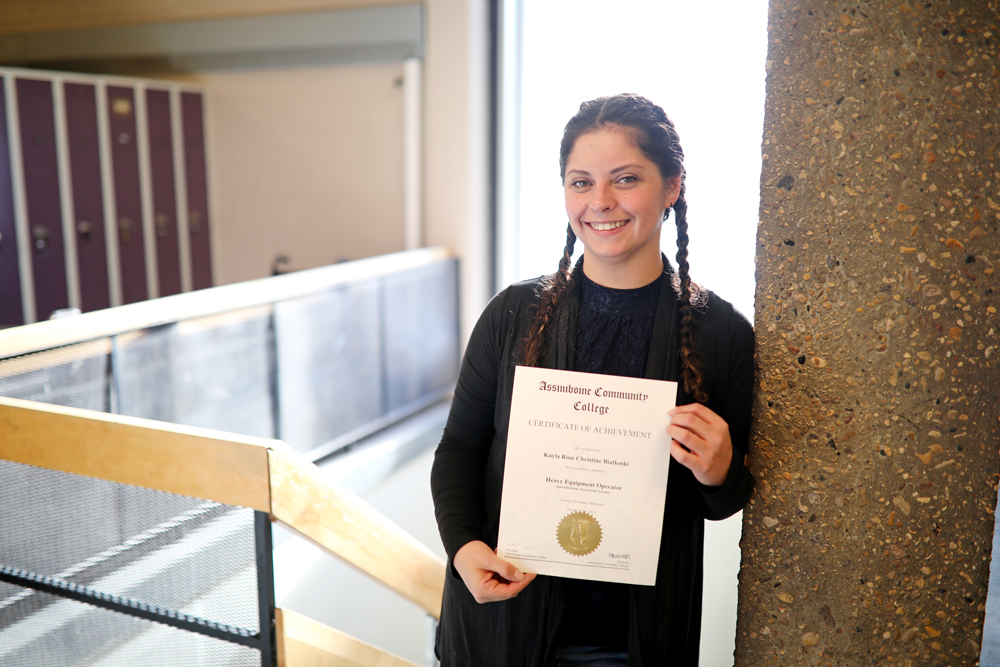
Nine students, including Bialkoski, graduated from the program taught at the college’s Victoria Avenue East campus from Aug. 7 through Oct. 12. The program combines training on high-end computer simulation equipment with practical hands-on experience in the seat of actual equipment.
If someone had not provided the funding for tuition and books for the course, “I’d probably still be sitting here (at home),” said Bialkoski, 29, whose family is from the Haida Nation in British Columbia. Armed with her certificate, Bialkoski is now on the hunt for a job in the heavy equipment industry.
The mother of four children, ranging in age from two to nine, said this is the first time she has had the opportunity to attend college.
“It’s empowering,” Bialkoski said Thursday, adding it enabled her to be a positive role model for her children and others. “It’s a great way to show your kids ‘You can do it, too.’”
The program trains graduates to properly maintain and service the machines and be employed as an operator in the heavy construction industry. Heavy equipment operators are well compensated and in demand in Manitoba and throughout Canada.
In keeping with the college’s Indigenization strategy, cultural content was infused into the curriculum. Elders and knowledge keepers visited the program regularly.
“We would like to acknowledge the effort the college has put into the program and are proud to partner with them to train students to be the best prepared that they can be for future employment within the heavy construction industry,” Brandt Tractor’s Winnipeg branch manager, Peter Paulic, said in a statement. “We believe in the program and the program’s ability to train for our future.”
The company donated five pieces of John Deere heavy equipment for ACC to use in training future operators to learn on.
“The Congress of Aboriginal Peoples is pleased to have had the opportunity to fund Assiniboine College’s Heavy Equipment Operator program this year, which followed last year’s Applied Electrical Installation Certificate program,” Sarah Mitchell, the congress’s national project co-ordinator, Aboriginal Skills and Employment Training Strategy, said in an email Friday.
“Providing skills training support to our constituents is important because it provides an opportunity for these individuals to engage in meaningful employment and it increases their overall quality of life — for themselves and their families. Investment in skills training programs is an investment in the future.”
CAP is one of five national aboriginal representative organizations recognized by the Government of Canada. Founded in 1971 as the Native Council of Canada (NCC), the organization was originally established to represent the interests of Métis and non-status Indians. Reorganized and renamed in 1993, CAP has extended its constituency to include all off-reserve status and non-status Indians, Métis and southern Inuit aboriginal peoples, and serves as the national voice for its provincial and territorial affiliate organizations.
CAP also holds consultative status with the United Nations Economic and Social Council (ECOSOC), which facilitates its participation on international issues of importance to Indigenous peoples.
“Assiniboine has been very pleased to partner with the Congress of Aboriginal Peoples to provide heavy equipment operator training in Brandon,” said Gerald Cathcart, ACC’s business development co-ordinator, community development.
“Our graduates remain in demand by local industry, demonstrating the value of programs in which students ‘learn by doing,’” Cathcart said in the statement.
» brobertson@brandonsun.com
» Twitter: @BudRobertson4