
RIDES — Oil that is, black gold, Texas tea
Advertisement
Read this article for free:
or
Already have an account? Log in here »
We need your support!
Local journalism needs your support!
As we navigate through unprecedented times, our journalists are working harder than ever to bring you the latest local updates to keep you safe and informed.
Now, more than ever, we need your support.
Starting at $15.99 plus taxes every four weeks you can access your Brandon Sun online and full access to all content as it appears on our website.
Subscribe Nowor call circulation directly at (204) 727-0527.
Your pledge helps to ensure we provide the news that matters most to your community!
To continue reading, please subscribe:
Add Brandon Sun access to your Free Press subscription for only an additional
$1 for the first 4 weeks*
- Enjoy unlimited reading on brandonsun.com
- Read the Brandon Sun E-Edition, our digital replica newspaper
*Your next Free Press subscription payment will increase by $1.00 and you will be charged $20.95 plus GST for four weeks. After four weeks, your payment will increase to $24.95 plus GST every four weeks.
Read unlimited articles for free today:
or
Already have an account? Log in here »
Hey there, time traveller!
This article was published 15/02/2019 (2640 days ago), so information in it may no longer be current.
All motor oils are not created equal.
You’ve got your synthetic, semi-synthetic and conventional motor oils. Not only that, but they also come in a variety of weights that work better in some environments than they do others.
Conventional oils are fine, “but it’s very limited when it comes to fuel efficiency and performance,” said Brian Evenson, manager of the Boss Lubricants branch just east of the Brandon Municipal Airport.
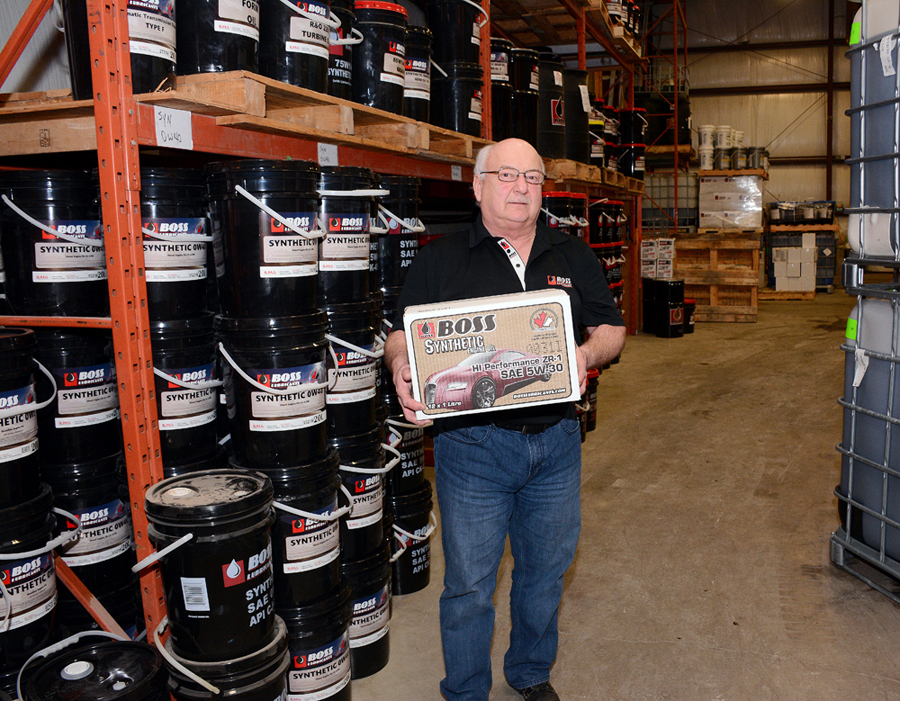
Alberta-based Boss Lubricants manufactures a variety of automotive engine oils, among other things, for both retail and commercial customers under its own brand.
“Conventional oils have a hard time with cold and heat,” Evenson said, “so you should probably use synthetics. It’s more money, but you’re going to get a better value, and it’s better for your engine. You have to weigh that, what you decide is best.”
He noted synthetic engine oils allow vehicle manufacturers to put their turbocharged engines into all sorts of vehicles, “because the synthetic oil can take that. The conventional can’t handle the heat, can’t handle the performance.”
Some manufacturers are now recommending owners use only synthetic or semi-synthetic oils (which are a blend of synthetic and conventional) in their vehicles.
“Part of that is performance and fuel efficiency,” said Evenson.
Synthetic oil is lighter than conventional oil and has smaller molecules that will perform better under heat or cold, he said, “where the conventional won’t. It’ll start to break down.”
Synthetic engine oils come in different grades, just the same as conventional oil.
“Lots of vehicles are taking zero-20s (weight),” Evenson said.
“It has nothing to do with winter,” he added. “That has to do with fuel economy. So it’s a very light oil, and it’ll work great in the cold.”
And being a multigrade oil, it works equally well in the summer heat, he said.
Evenson noted governments put in regulations requiring better fuel economy and fewer emissions in vehicles, “so you tighten tolerances and you put in lighter oil.”
When in doubt, consult your owner’s manual, Evenson said.
“Everybody has an owner’s manual in their car, and you should follow your owner’s manual,” he said. “It’ll tell you what you should use in your car, and as long as you’re using something that’s either what they recommend or equivalent then you’re safe. But you should always go with that.”
So, what do you do if you own a classic automobile that doesn’t come with an owner’s manual?
That’s a different ball game, Evenson said.
“You’ve got to be very careful with those, because you need a lot of zinc in the oil.”
The zinc is an additive to help prevent wear on the vehicle’s engine.
“If you put in a standard oil from 2019 here, you’re going to damage your engine,” he warned.
Evenson noted Boss manufactures a product specifically designed for classic vehicles called collector motor oil.
One more thing, said Evenson: make sure the oil you purchase is API (or American Petroleum Institute) approved.
“Make sure it’s approved and know where your oil’s coming from,” he said.
» brobertson@brandonsun.com
» Twitter: @BudRobertson4